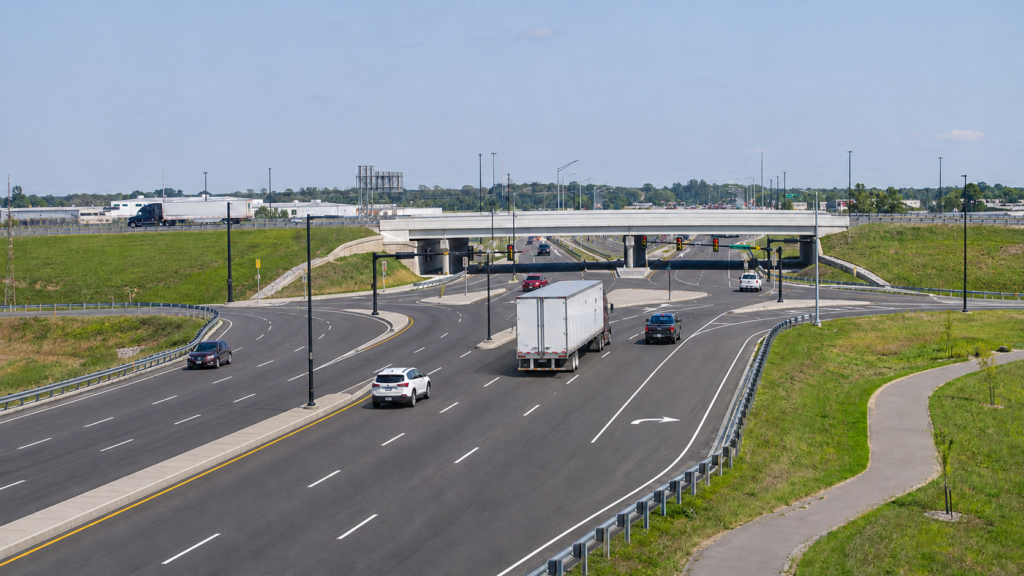
Drivers traveling through northern Findlay encounter a significantly different traffic pattern at Interstate 75 and County Road 99 than they did several years ago. The interchange has been redesigned as a diverging diamond interchange, an arrangement intended to improve traffic flow and reduce certain types of conflicts between vehicles.
Importantly, the interchange opened to traffic on November 17, 2025. Although additional work was expected in 2026, the interchange is already in service. Understanding the layout and monitoring restrictions can help motorists navigate safely.
Call (419) 873-5119 or request a free consultation today to speak with an experienced local Findlay auto accident attorney at Buckeye Law Group.
What Changed at the I-75 and County Road 99 Interchange?
The Ohio Department of Transportation (ODOT) reports that the approximately $30.8 million project, which began in 2024, replaced the traditional interchange arrangement with a diverging diamond design. Crews built an additional bridge beside the existing County Road 99 bridge and rehabilitated the original structure.
Other improvements included dedicated turn lanes serving Technology Drive, Speedway Drive, and Ventura Drive, new signals at Technology and Ventura drives, upgrades to existing signals, a multi-use path south of County Road 99, and a sidewalk along the north side.
The interchange is a critical transportation corridor for daily commuters, commercial truck traffic, and businesses operating within Findlay’s northern distribution area. Although roadway improvements are intended to enhance traffic flow and safety, they cannot eliminate the risk of motor vehicle collisions.
How to Drive Through a Diverging Diamond Interchange
A diverging diamond temporarily shifts vehicles to the left side of the roadway through controlled crossover intersections before guiding them back to the normal right-hand side. This is an intentional, signal-controlled design—not an instruction to enter opposing traffic. For a safer trip:
- Choose Your Lane Early: Watch overhead signs, turn arrows, and pavement markings as you approach from County Road 99 or an interstate ramp.
- Obey The Crossover Signals: Stop when required and follow the marked lanes through each crossover. Do not improvise a route based on the old intersection.
- Follow Ramp Guidance: The layout allows certain left turns onto interstate entrance ramps without crossing opposing through traffic.
- Avoid Abrupt Corrections: If you miss a turn, continue legally and find a safe place to reroute rather than stopping, reversing, or cutting across lanes.
- Watch For People Outside Vehicles: Look for pedestrians and bicyclists near the completed sidewalk, shared-use path, and connecting intersections.
The Federal Highway Administration explains how the design changes conflict points. Drivers must still obey signals and anticipate others’ mistakes.
Traffic-Safety Concerns Drivers Should Recognize in 2026
- Unfamiliar Lane Movements: A driver using this interchange for the first time may hesitate or make a late lane change. Leave additional space and avoid following a vehicle too closely through the crossovers.
- Commercial Traffic: The County Road 99 corridor supports logistics and manufacturing activity. Large trucks may need more room to turn and have substantial blind spots. Avoid lingering beside a truck approaching a ramp or intersection.
- Traffic Queues And Changing Speeds: Even when an interchange is designed for improved capacity, congestion can develop near traffic signals, entrances, or downstream intersections. Scan ahead rather than focusing only on the vehicle immediately in front of you.
- Walking And Cycling Crossings: The completed pedestrian and shared-use facilities create additional places where motorists should actively check for people crossing or approaching turning movements. Yield and follow posted controls as applicable.
- Weather And Visibility: Rain, snow, darkness, and worn or obscured markings can make a less familiar road arrangement harder to interpret. Reduce speed when necessary and keep enough distance to stop safely.
Are There I-75/County Road 99 Closures in 2026?
The distinction between the interchange opening and later finishing work is important. Findlay-Hancock County Economic Development reported that minor work would continue into 2026 after the November 2025 opening.
For example, ODOT announced restrictions beginning April 6, 2026, for bridge-beam painting. Those were spring 2026 work notices, not a confirmation of closures continuing in November.
Before traveling, consult ODOT’s Hancock County traffic advisories and OHGO for current restrictions. Review updates while parked or before leaving; do not handle a phone to investigate a route while driving.
What to Do After a Crash Near the Interchange
Collisions at crossovers, entrance ramps, or neighboring intersections can raise questions about signal timing, lane position, and which vehicles had the right of way. If a collision occurs:
- Prioritize Safety And Medical Care: Call 911 for emergencies. Move away from moving traffic when safe, and seek medical attention for injuries or concerning symptoms.
- Report The Incident: Contact the appropriate investigating agency. A crash on I-75 may be handled by a different agency than one on a city street.
- Preserve Evidence Safely: Document vehicle positions, damage, nearby signs, lane markings, and available witness information without entering traffic or obstructing responders.
- Keep Records: Retain the crash report number, medical records, photographs, repair estimates, insurance correspondence, and documentation of missed work.
A police report can be important evidence, but it does not necessarily settle every question about negligence. Video footage and independent witness accounts may also help reconstruct disputed movements. Do not assume the interchange design alone establishes fault.
Ohio Traffic Laws and Personal Injury Claims
Ohio traffic laws remain applicable throughout Findlay’s redesigned I-75 and County Road 99 interchange. Drivers should understand that changes to lane configurations, traffic signals, and intersection layouts do not alter their legal responsibilities behind the wheel. Several provisions of the Ohio Revised Code are particularly relevant to navigating the interchange safely:
- Traffic Signal Compliance: Ohio Revised Code § 4511.13 establishes requirements for obeying traffic-control signal indications. Motorists must pay attention to posted signals, particularly when approaching unfamiliar intersections or newly configured turning lanes.
- Proper Lane Usage: Ohio Revised Code § 4511.33 generally requires drivers to remain within a single marked lane and avoid changing lanes until the movement can be made safely. This is especially important near interstate entrance and exit ramps, where vehicles may be merging, turning, or adjusting to revised traffic patterns.
- Speed and Following Distance: Ohio Revised Code § 4511.21 requires motorists to operate at a reasonable and proper speed for existing conditions and maintain sufficient control to stop within the assured clear distance ahead. Drivers should account for traffic congestion, reduced visibility, and unexpected slowing near the interchange.
- Distracted Driving Restrictions: Ohio Revised Code § 4511.204 generally prohibits operating a motor vehicle while using or holding an electronic wireless communications device, subject to specified exceptions. Motorists should review navigation directions before traveling and avoid handling their phones while navigating unfamiliar roadway configurations.
Compliance with these requirements can help reduce preventable collisions. When an accident occurs, determining whether a driver violated an applicable traffic law may be relevant to evaluating negligence and potential liability. However, responsibility depends on the specific circumstances, available evidence, and applicable Ohio law.
In a negligence claim, fault depends on the actual circumstances and evidence. Under § 2315.33, a person’s compensatory recovery may be reduced by their percentage of fault; fault greater than 50% generally prevents recovery under that provision.
§ 2305.10 generally establishes a two-year filing period for bodily-injury claims, but exceptions and different procedures can apply, particularly when a public entity may be involved. Early case-specific legal review can help identify applicable deadlines.
Findlay and Hancock County Traffic-Safety Resources
These agencies provide roadway information and public records:
ODOT District 1 — State highways and I-75:
Phone: (419) 222-9055
Address: 1885 N. McCullough Street, Lima, OH 45801
See the district office and the I-75/CR 99 project page.
Hancock County Engineer — County roads and bridges:
Phone: (419) 422-7433
Address: 1900 Lima Avenue, Findlay, OH 45840
See the Hancock County Engineer’s Office.
City of Findlay Engineering and Public Works — City infrastructure and signals:
Engineering: (419) 424-7121
Traffic Signals: (419) 424-7185
See Engineering and Traffic Signals. Confirm which agency maintains a particular signal before submitting a request.
Findlay Police Department — City incidents and local records:
Non-Emergency Dispatch: (419) 424-7150
Records: (419) 424-7174
See the police records page.
Ohio State Highway Patrol, Findlay Post — Interstate enforcement and crash inquiries:
Phone: (419) 423-1414
Search the Ohio State Highway Patrol post directory or the Ohio crash-report search. The investigating agency is the source for an official report.
For an immediate emergency, call 911 rather than a general information line.
Preguntas frecuentes
- Is the I-75 and County Road 99 interchange open in 2026? Yes. The new diverging diamond opened in November 2025. Check ODOT advisories for any separate maintenance, construction, or incident-related restrictions before traveling.
- Why does County Road 99 traffic cross to the left side? The crossover design allows certain interstate ramp movements without turning left across opposing through traffic. Traffic signals and lane markings guide drivers through the change.
- Are there new pedestrian and bicycle facilities? Yes. ODOT reports a multi-use path on the south side of County Road 99 and a sidewalk on the north side. Drivers should watch for crossings and comply with traffic controls.
- Who should I contact about a dangerous signal or road condition? Start with ODOT for state-highway concerns, the Hancock County Engineer for county roads, or City of Findlay Public Works for city traffic signals. Jurisdiction can differ by exact location.
- What if I was injured in a crash near the interchange? Seek appropriate medical care, report the crash, preserve available evidence, and check the applicable legal deadlines. Whether compensation is available depends on fault, damages, insurance coverage, and other case-specific facts.
Staying Informed on Findlay Road Safety
The I-75/County Road 99 project changed how drivers approach one of Findlay’s important northern connections. The safest approach is to learn the crossover movements, respect lane and signal controls, and consult official updates for changing road conditions.
If you or a loved one has been injured in a motor vehicle collision near Findlay’s I-75 and County Road 99 interchange, understanding your legal rights and available options can be an important part of the recovery process. Buckeye Law Group’s Findlay office offers free consultations to help injured individuals better understand how Ohio personal injury laws may apply to their circumstances. Our local Ohio attorneys can review the available evidence, address questions concerning liability and insurance coverage, and explain potential avenues for pursuing compensation. For additional guidance, explore our car accident resources, which provide information about accident claims, insurance considerations, and the steps individuals may take following a collision. Every case is unique, and potential legal remedies depend on the specific facts and applicable Ohio law.
Call (419) 873-5119 or request a free consultation today to speak with an experienced local Findlay auto accident attorney at Buckeye Law Group.
Legal Disclaimer: This article provides general educational information as of November 18, 2026. It is not legal advice and does not create an attorney-client relationship. Road conditions, laws, and deadlines may change; every matter depends on its facts. Buckeye Law Group offers free consultations and contingency-fee representation in qualifying matters, subject to a written fee agreement. No result is guaranteed.
