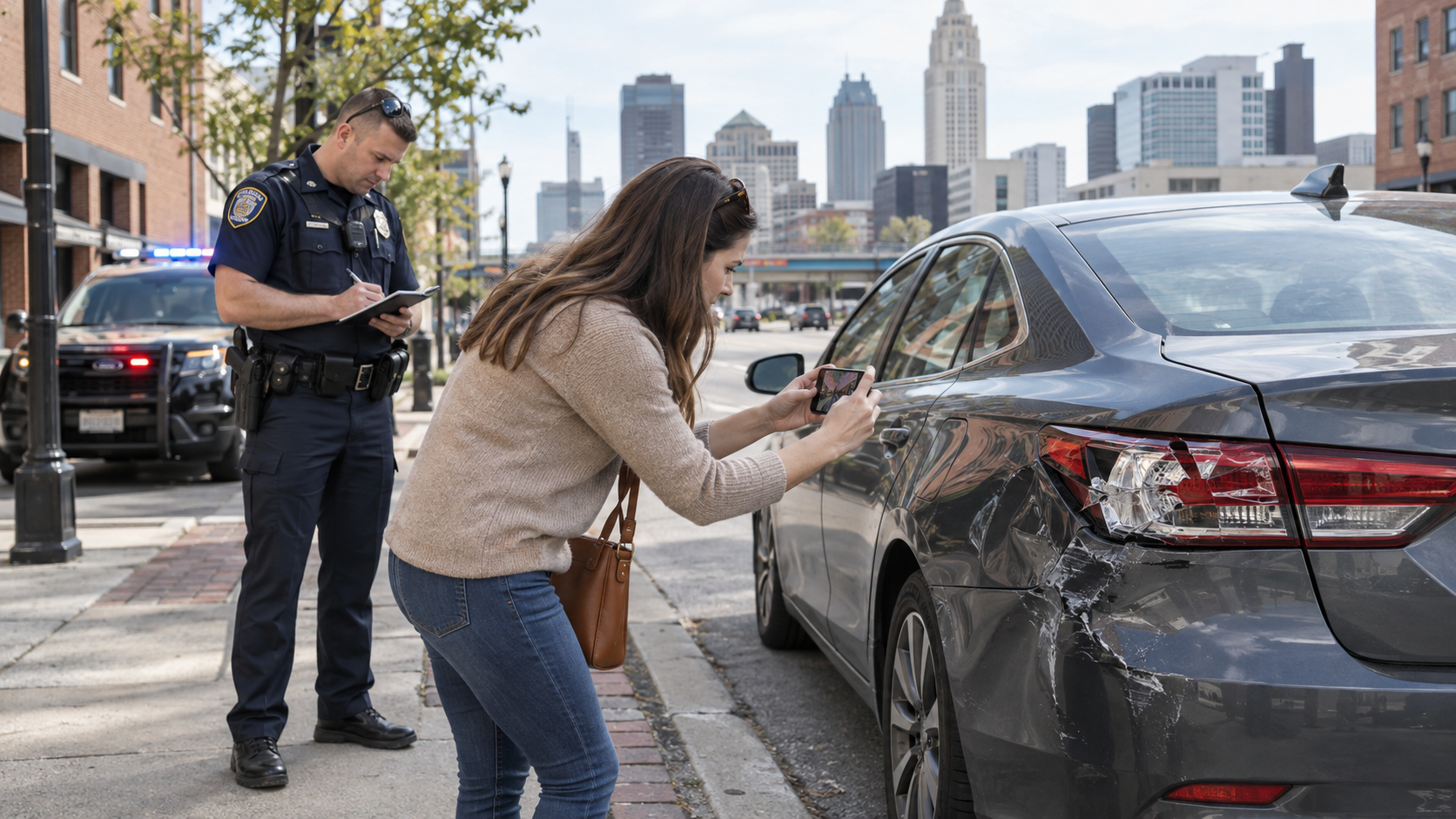
A hit-and-run accident in Columbus, OH, or the neighboring communities can leave you hurt, shaken, and unsure how to prove what happened. The right response is simple but urgent: get to safety, call police, preserve evidence, seek medical care, and notify your insurer before memories, video, and vehicle debris disappear. This guide explains the immediate steps, Ohio hit-and-run laws, possible penalties, and options for hit-and-run victims when the fleeing driver is never found.
Call (614) 482-3793 today to schedule a complimentary consultation with a local Ohio personal injury attorney from Buckeye Law Group.
What Should You Do Immediately After A Hit-and-Run?
First, protect people before property: move out of traffic if you can, call 911 if anyone is injured or in danger, and do not chase the fleeing driver. Chasing can create another crash, weaken your own credibility, and make it harder to document the original collision. If you are searching for help after a “columbus ohio hit and run accident” or “hit and run accident columbus ohio,” the most important thing is to create a clear record from the first few minutes. Use this quick checklist at the scene:
- Call 911 for injuries, road hazards, or disabled vehicles: Give the dispatcher your location, direction of travel, vehicle descriptions, and whether a pedestrian, cyclist, motorcyclist, or child was involved.
- Write down what you remember right away: Include license plate characters, make, model, color, damage location, stickers, loud exhaust, rideshare markings, or the route the driver took.
- Photograph everything: Capture vehicle damage, debris, skid marks, traffic signals, lane position, weather, injuries, and the wider scene.
- Look for witnesses: Ask for names, phone numbers, and whether they have dashcam footage.
- Check for nearby cameras: Gas stations, apartment buildings, COTA buses, parking garages, restaurants, and doorbell cameras may have short retention windows.
- Get medical care: Pain, concussion symptoms, and soft-tissue injuries may become clearer hours later.
- Report the crash to your insurer: Say what you know, but avoid guessing about speed, fault, or injuries before you have medical and police documentation.

Ohio Law Requires Drivers To Stop and Share Information
Ohio hit-and-run laws generally require a driver involved in a crash causing injury or property damage to stop, remain at the scene, and provide identifying information, including the driver’s name, address, and vehicle registration number, to injured people, damaged-vehicle occupants or owners, and police at the scene. Ohio also has rules for crashes on private property and for damage to real or attached property, such as a fence, mailbox, or guardrail.
That means a Columbus hit-and-run can happen on I-70, High Street, a neighborhood road, a shopping-center parking lot, or an apartment complex driveway. If the crash involves unattended property, the driver should take reasonable steps to notify the owner and provide contact and vehicle information rather than simply driving away. These duties matter in ordinary Ohio car accidents, but they become especially important when someone leaves before police, insurance companies, or injured people can identify them.
Penalties Depend on the Harm Caused
A hit-and-run accident Columbus Ohio case can be charged as a misdemeanor or felony depending on where the crash occurred, whether someone was hurt, and what the driver knew. Under Ohio law, failure to stop after a public-road accident can become more serious when the crash results in serious physical harm or death, and license consequences may also apply.
Common reasons drivers flee include fear of an OVI investigation, no insurance, a suspended license, outstanding warrants, panic, or misunderstanding what the law requires. Those reasons may explain behavior, but they do not erase the duty to stop. For an accused driver, the facts that often matter include whether they knew a collision occurred, whether they reasonably believed no damage or injury happened, whether they tried to report soon afterward, and whether the state can prove identity beyond a reasonable doubt.
How Can Victims Recover Compensation if the Driver is Unidentified?
Hit-and-run victims may still have options even when the driver is not located. The first place to look is your own auto policy, especially uninsured motorist coverage, medical payments coverage, collision coverage, or other benefits that may apply. Ohio law allows uninsured and underinsured motorist coverage to be included in auto policies, and it addresses claims involving an unidentified owner or operator when independent corroborative evidence supports the claim.
That “corroborative evidence” is why documentation is so important. A police report, witness statement, dashcam video, nearby surveillance footage, paint transfer, vehicle debris, injury records, and repair estimates can help show that another driver caused the crash. If police later identify the driver, the victim may be able to pursue damages such as medical bills, lost wages, pain and suffering, property damage, and, in some cases, additional damages tied to wrongful conduct.
Insurance companies may still challenge a claim. They may question whether the crash happened as reported, whether your injuries came from the collision, or whether your policy covers property damage as well as bodily injury. Keep copies of every bill, message, claim number, adjuster letter, photo, and medical recommendation.
Evidence Makes or Breaks a Columbus Hit-and-Run Claim
Many Columbus traffic incidents become difficult to prove because the most useful evidence is temporary. Traffic conditions change, debris is cleared, bruising fades, and businesses may overwrite video. The Ohio Department of Public Safety’s crash statistics system also notes that crash data can change over time as reports are submitted and updated, which is a good reminder that early records are useful but may not be the final word. Focus on evidence that answers three questions: what happened, who caused it, and what harm resulted. Helpful sources include:
- Police Documentation: Crash reports, incident numbers, and any later Columbus police updates.
- Witness Accounts: People in nearby cars, pedestrians, store employees, passengers, and rideshare drivers.
- Video Sources: Dashcams, traffic-area cameras, private security systems, and doorbell footage.
- Physical Evidence: Broken lights, mirrors, tire marks, paint transfer, and debris location.
- Medical Proof: Emergency treatment, follow-up visits, imaging, therapy notes, work restrictions, and pain journals.
- Expert Review: Accident reconstruction, vehicle inspection, and motorcycle crash analysis when injuries are severe.
Evidence can be particularly important after a hit-and-run motorcycle accident in Columbus, OH. Riders may suffer serious injuries even when the fleeing vehicle sustains only minor damage. Protective gear, helmet condition, roadway defects, and witness timing can become critical.
Practical Mistakes to Avoid After the Crash
After a hit-and-run accident Columbus victims often feel pressure to “just get it handled.” Slow down enough to protect your claim and your health. Avoid these common mistakes:
- Do not delay medical care because you feel embarrassed or hope soreness will disappear.
- Do not repair or discard damaged parts until photos are taken and your insurer has had a chance to inspect.
- Do not post detailed crash theories online, especially if fault, injuries, or identity are still unclear.
- Do not accept a quick settlement before you understand future medical needs and wage loss.
- Do not rely only on hit-and-run statistics to judge your case. Local trends can show that these crashes are common, but your claim depends on specific proof.
If you were accused of leaving the scene, do not try to “fix” the situation through informal contact with the other driver before getting legal guidance. Statements meant as apologies can be misunderstood, and insurance, criminal, and license issues may overlap.
Steps to Protect Your Health and Legal Rights After a Columbus Hit-and-Run Accident
A Columbus hit-and-run is both a safety emergency and an evidence problem. Call for help, document the scene, get medical attention, report the crash, and preserve every record connected to the collision. Whether the other driver is found or the claim proceeds through your own coverage, fast, organized action gives you the best chance to protect your rights after one of the most stressful kinds of Ohio car accidents.
Call (614) 482-3793 today to schedule a complimentary consultation with a local Ohio personal injury attorney from Buckeye Law Group.
*This page is intended for general educational purposes and does not constitute legal advice tailored to your circumstances. Reading this page or contacting Buckeye Law Group does not, by itself, establish an attorney-client relationship. Your legal rights, filing deadlines, and available remedies depend on the facts of your case and applicable law. Consult a qualified attorney to evaluate your circumstances and discuss the steps necessary to protect your legal interests. Every case is different, and past results do not guarantee a similar outcome.*
What to Do After a Hit-and-Run Accident in Columbus, Ohio
A hit-and-run accident in Columbus, OH, or the neighboring communities can leave you hurt, shaken, and unsure how to prove what happened. The right response is simple but urgent: get
Injured as a Passenger in a Columbus Car Accident? Understanding Your Options
If you were injured as a passenger in a Columbus car accident, you may have more options than you realize. Passengers are usually not the person blamed for the crash,
Who Pays Medical Bills While an Ohio Car Accident Claim Is Pending?
After a crash, medical care cannot wait for an insurance settlement. In Ohio, the person who caused the collision may ultimately be responsible for injury-related losses, but the at-fault driver’s
Cleveland Premises Liability Lawyers: Understanding Property Injury Claims in Ohio
How Cleveland Premises Liability Lawyers Evaluate Property Injury Claims Under Ohio Law A serious injury on someone else’s property can raise immediate questions about medical bills, responsibility, and your next
How Long Does an Auto Accident Settlement Take in Ohio? A Guide to the Claims Process
Ohio Auto Accident Settlement Timeline: What to Expect From Claim to Payout An Ohio auto accident settlement can move quickly when injuries are minor, liability is clear, and records are
How Buckeye Law Group’s Slip and Fall Injury Lawyers Help Injured Ohioans Understand Their Legal Options
Ohio Slip and Fall Injury Lawyers Helping You Understand Your Rights After a Serious Injury A slip and fall can turn an ordinary trip to a store, apartment building, workplace,
How Can an Ohio Truck Accident Lawyer Help You Protect Your Rights After a Commercial Truck Crash?
Legal Guidance After an Ohio Truck Accident: How an Ohio Truck Accident Lawyer Can Support Your Claim A truck accident lawyer from Buckeye Law Group can help injured individuals and
Should You Accept An Insurance Settlement Offer? Why Ohio Injury Victims Should Speak With An Attorney First
After an accident, an insurance settlement offer may provide welcome financial relief while medical bills and lost wages continue to accumulate. However, accepting an offer before the full extent of
What Should You Do After a Pedestrian Accident Near Ohio State University in Columbus?
A pedestrian accident near Ohio State University can leave you hurt, disoriented, and unsure what to do next. In the OSU area, where student foot traffic, Uber & Lyft rideshare
How Do I Choose the Right Dog Bite Lawyer in Columbus, Ohio?
If you were bitten or otherwise injured by a dog in central Ohio, the right lawyer can help determine liability, preserve evidence, communicate with insurance companies, and pursue fair compensation

Buckeye Law Group represents people injured in auto accidents, slip and falls, workplace accidents and more in Ohio. Contact us today to learn more.
© 2026 Todos los derechos reservados | The Buckeye Law Group Inc. Políticade privacidad Mapa del sitio
Ubicaciones de las oficinas
- Akron Office 388 S Main St #400 Akron, OH 44311 (330) 426-0288
- Cincinnati Office 201 E 5th St Ste 1910 Cincinnati, OH 45202 (513) 547-2445
- Cleveland Office 127 Public Square Ste 1540 Cleveland, OH 44114 (216) 677-5490
- Columbus Office 20 E Broad St Suite 300 Columbus, OH 43215 (614) 482-3793
- Dayton Office 70 Birch Alley Ste 240 Dayton, OH 45440 (937) 884-4474
- Euclid Office 25701 N Lakeland Blvd Suite 113-C, Cleveland, OH 44132 (216) 405-2626
- Mansfield Office 305 E Main St Ste 6A, Mansfield, OH 44904 (567) 210-2606
- Findlay Office 7430 Timberstone Dr unit 101a, Findlay, OH 45840 419-873-5119
- Mentor Office 7537 Mentor Ave Ste 101, Mentor, OH 44060 (440) 306-3536
- Middletown Office 300 N Main St #400, Middletown, OH 45042 (326) 800-9150
- Parma Office 1257 Rockside Rd #A, Parma, OH 44131 (216) 279-1664
- Springfield Office 2100 E High St Ste TL3, Springfield, OH 45505 (937) 806-5791
- Toledo Office 3950 Sunforest Ct Ste 200, Toledo, OH 43623 (567) 483-3883
- Westlake Office 26404 Center Ridge Rd Ste B2, Westlake, OH 44145 216-247-0565
- Whitehall Office 5340 E Main St Ste 203, Whitehall, OH 43213 (380) 257-5206
- Youngstown Office 306 Churchill Hubbard Rd, Youngstown, OH 44505 (234) 225-0683
Contáctenos
© 2026 Todos los derechos reservados | The Buckeye Law Group Inc. Políticade privacidad Mapa del sitio