A crash with an uninsured or underinsured driver can turn an ordinary Dayton commute into a confusing insurance problem. Uninsured motorist coverage helps protect you when the at-fault driver has no usable liability insurance, while underinsured motorist coverage can help when the other driver’s limits are too low for the harm caused. Understanding how this coverage works before you need it can make your next steps clearer, faster, and less stressful.
Call (937) 884-4474 or request a free consultation today to speak with an experienced Dayton car accident attorney at Buckeye Law Group.
What does uninsured motorist coverage do after a Dayton car accident?
Uninsured motorist coverage generally steps into the place of the at-fault driver’s missing insurance, but only if you purchased it and your claim fits the policy terms. In Ohio, auto policies may include uninsured motorist and underinsured motorist coverage, but they are not required to include them, so drivers should check their declarations page instead of assuming they are protected. Ohio’s required liability minimums are $25,000 for injury or death to one person, $50,000 for injury or death to two or more people, and $25,000 for property damage, which means even an insured driver may not have enough coverage for a serious crash.
For Dayton drivers comparing Dayton auto insurance or Ohio car insurance options, this distinction matters. Liability insurance protects other people when you cause a crash. Uninsured driver coverage is designed to protect you and covered passengers when someone else causes the crash and cannot pay through insurance.
UM and UIM coverage are similar, but not the same
Uninsured motorist coverage, often called UM, usually applies when the at-fault driver has no bodily injury liability insurance, the insurer denies coverage, the insurer is insolvent, or the driver cannot be identified and the claim meets Ohio’s evidence requirements. Underinsured motorist coverage, often called UIM, applies when the at-fault driver has liability insurance, but the available limits are lower than your UIM limits and not enough to cover the injury claim. Ohio law describes UIM as protection where the available bodily injury liability limits are less than the insured’s underinsured motorist limits, with reductions for amounts available from the responsible driver’s insurance. Here is the practical difference:
- Uninsured Driver: Another motorist runs a red light in Dayton and has no active insurance. If you carry UM coverage, you may make a claim with your own insurer for covered losses.
- Underinsured Driver: The at-fault driver has minimum limits, but your medical bills, lost income, and other damages exceed what their policy can pay. Your UIM coverage may cover part of the gap, up to your policy limits.
- Hit-and-Run Driver: The driver leaves and cannot be identified. UM coverage may apply, but evidence beyond your own statement can be critical.
When reviewing uninsured and underinsured motorist coverage in Dayton, Ohio, drivers should look beyond whether their policy includes this protection and carefully evaluate the available coverage limits. If you are seriously injured in an accident involving an uninsured or underinsured driver, insufficient UM/UIM coverage may leave you responsible for substantial medical expenses, lost wages, and other damages that exceed your policy limits.
How do hit-and-run claims work under Ohio uninsured motorist laws?
A hit-and-run may be treated like an uninsured motorist claim when the at-fault driver cannot be identified, but Ohio law requires independent corroborative evidence showing that the unidentified driver caused the injury. Your testimony alone is not enough unless supported by additional evidence, and Ohio’s uninsured motorist statute specifically addresses this requirement for unidentified drivers.
That evidence can come from several places. A police report, witness statement, nearby business camera, dashcam footage, paint transfer, debris location, 911 call records, or photos of vehicle damage may help support the claim. The sooner you report the crash and preserve evidence, the harder it is for an insurer to argue that the crash cannot be verified. Do not assume a hit-and-run claim is automatically simple because you were not at fault. Your insurer will still evaluate liability, damages, coverage terms, and proof. In many cases, the claim feels like you are dealing with the other driver’s insurance company, even though the claim is being made under your own policy.
Steps to take after a crash with an uninsured driver
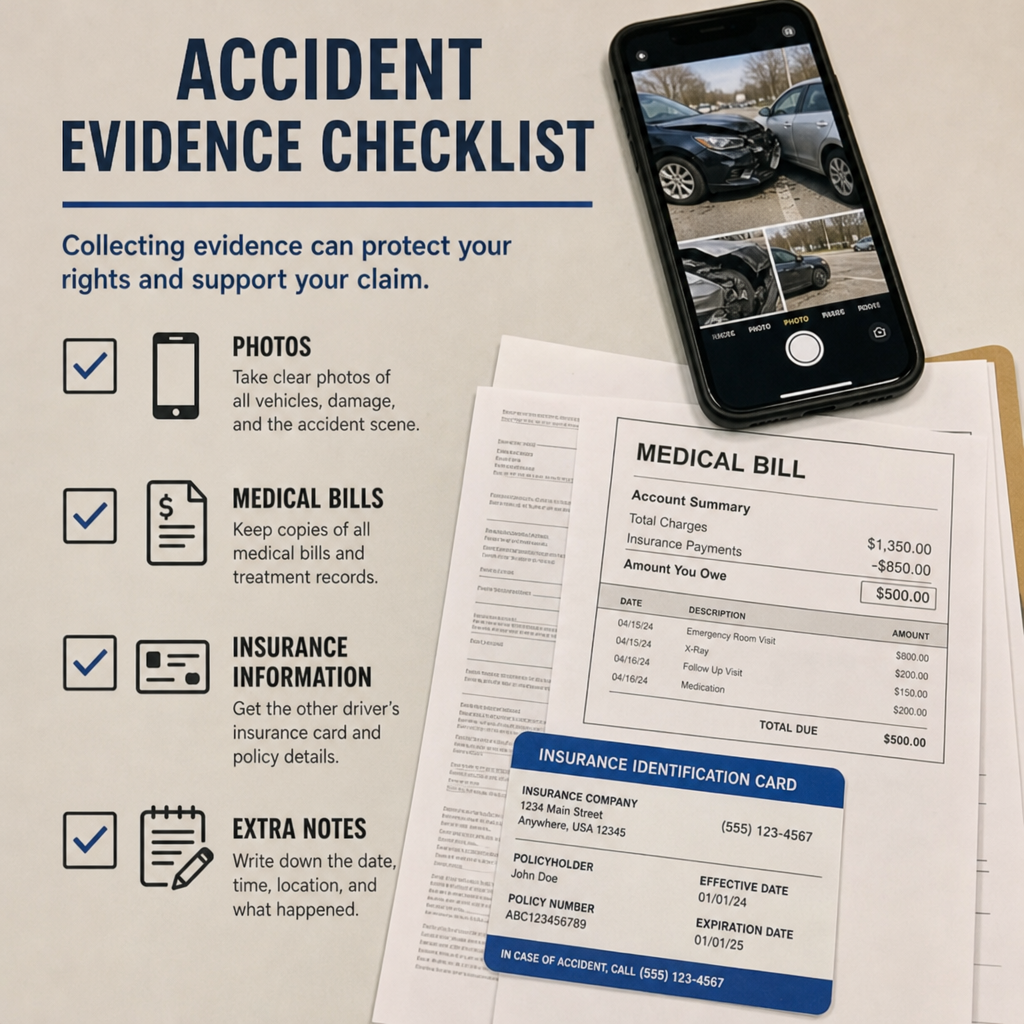
The first few hours after a collision can shape the entire claim. If you are injured, your health comes first; if you are able, focus on documentation and timely notice. Use this checklist after a suspected uninsured, underinsured, or hit-and-run crash:
- Call 911 And Request A Police Report: A formal report can document the drivers, vehicles, location, statements, citations, and insurance information.
- Get Medical Care Promptly: Delayed treatment can make injuries worse and give the insurer room to question whether the crash caused your symptoms.
- Collect Evidence At The Scene: Take photos of vehicles, damage, plates, skid marks, traffic signals, weather, road conditions, and visible injuries.
- Identify Witnesses: Get names and contact information from anyone who saw the collision or the fleeing vehicle.
- Notify Your Insurer Quickly: UM/UIM policies often require prompt notice, cooperation, and proof of loss.
- Do Not Rush A Recorded Statement: Be truthful, but avoid guessing about speed, distance, injury severity, or fault.
- Review Your Policy Before Settling With Anyone: Some policies contain consent-to-settle or subrogation language that can affect a UIM claim.
- Track Every Loss: Save medical bills, repair estimates, wage records, prescription receipts, mileage logs, and correspondence.
This process is not just paperwork. It creates the proof your insurer needs to evaluate coverage and the proof you may need if the insurer disputes your claim.
Dayton, Ohio, Resources for Drivers Injured in Uninsured Motorist Accidents
After a collision involving an uninsured or underinsured driver in Dayton, knowing where to obtain accident reports, report insurance violations, and seek assistance can help protect your claim. Whether the crash occurred on Interstate 75, U.S. Route 35, or a neighborhood street, the following resources may help you document the accident and understand your next steps.
Dayton Police Department: Reporting an Accident
If your accident occurred within the Dayton Police Department’s jurisdiction, you can contact the department at 937-333-2677 for non-emergency assistance. Call 911 when immediate emergency assistance is needed. The department is located at 335 W. Third Street, Dayton, OH 45402.
Dayton’s online crime-reporting system does not accept motor vehicle accident reports. Drivers should contact the police department directly for reporting instructions.
Dayton Police Department – Report a Crime
Obtaining a Dayton Car Accident Report
A traffic crash report may contain important details about the collision, including the drivers involved, vehicle information, witness statements, and insurance information recorded during the investigation.
Drivers can search for Dayton-area crash reports through the Ohio Department of Public Safety. If the Ohio State Highway Patrol investigated the collision, request the report through the Patrol’s crash-report service. For an official report, contact the investigating agency.
Ohio Department of Public Safety – Crash Report Search
Ohio Bureau of Motor Vehicles: Reporting an Uninsured Driver
Under Ohio Revised Code Section 4509.06, individuals involved in an accident may submit an uninsured accident report to the Ohio Bureau of Motor Vehicles within six months of the collision. Ohio BMV Form 3303 allows qualifying accidents involving suspected uninsured drivers to be reported for review. This process is separate from pursuing compensation through an uninsured motorist insurance claim.
Ohio BMV – Uninsured Accident Report Form
Montgomery County Common Pleas Court: Understanding Your Legal Options
If an insurance dispute cannot be resolved through negotiations, filing a civil lawsuit may become necessary. The Montgomery County Common Pleas Court, General Division, located at 41 N. Perry Street, Dayton, OH 45422, handles civil matters within its jurisdiction.
Not every uninsured motorist dispute must be filed in this court. The appropriate court depends on the legal claims, amount involved, and jurisdictional requirements. An attorney can help determine where a lawsuit should be filed and identify applicable deadlines.
Montgomery County Common Pleas Court
Ohio Department of Insurance: Assistance With Insurance Disputes
If your insurer delays, denies, or disputes your UM/UIM claim, the Ohio Department of Insurance offers consumer assistance and a formal complaint process. Dayton residents can contact its Consumer Services Division at 800-686-1526. The department reviews insurance-related complaints but cannot act as your attorney or resolve every disagreement over fault or claim value.
Ohio Department of Insurance – Submit a Complaint
Preserving accident reports, reviewing your policy, and identifying the proper agencies early can make a meaningful difference when an uninsured driver leaves you facing medical expenses and financial uncertainty.
What compensation may be available?
A UM or UIM claim may include many of the same damages that could have been pursued against the at-fault driver. Depending on the policy and facts, this may involve medical expenses, future treatment needs, lost wages, reduced earning ability, pain and suffering, and other crash-related losses. Property damage may depend on whether your policy includes uninsured motorist property damage, collision coverage, or another applicable coverage.
Ohio’s comparative fault rule can also matter. Under Ohio Revised Code Section 2315.33, compensatory damages are reduced by the injured person’s percentage of fault, and recovery is barred if the injured person’s contributory fault is greater than the combined fault of others responsible. For example, if an insurer argues you were speeding or failed to keep a lookout, it may try to reduce the value of your claim. That is one reason accident reconstruction details, photos, and witness statements can be valuable even when the other driver was uninsured.
The claim process can be more adversarial than people expect
Many people assume their own insurance company will simply pay because premiums were paid on time. In reality, a UM/UIM claim is still a claim for money, and the insurer may investigate fault, medical causation, treatment costs, prior injuries, policy exclusions, and limits. Ohio’s UM/UIM statute also allows policies to include certain terms, exclusions, anti-stacking provisions, and time limits for bringing UM/UIM claims, so the policy language matters. Common disputes include:
- Whether the uninsured driver was actually at fault;
- Whether a hit-and-run is supported by independent evidence;
- Whether the medical treatment was necessary and crash-related;
- Whether your damages exceed the at-fault driver’s limits in a UIM claim;
- Whether you gave timely notice to your insurer;
- Whether a settlement with the liability insurer affected your UIM rights.
Ohio law generally gives two years for actions involving bodily injury or injury to personal property, but UM/UIM policies may contain their own claim or suit deadlines, including terms allowed under Ohio’s uninsured motorist statute. Do not rely on a general deadline without checking the policy and getting advice about your specific facts.
When legal help becomes especially important
Legal help becomes more important when injuries are serious, the at-fault driver has no insurance, the insurer questions fault, the crash was a hit-and-run, or the settlement offer does not reflect the full impact of the accident.
A lawyer can help identify all possible insurance sources, communicate with adjusters, gather evidence, calculate damages, protect against policy traps, and file suit if negotiations fail. If you searched for “Dayon uninsured motorist attorney,” you likely meant a Dayton uninsured motorist attorney who handles these exact coverage disputes. That local focus can matter because the case may involve Dayton roads, Montgomery County evidence sources, Ohio insurance policy language, and Ohio court deadlines.
Legal guidance can also help if your insurer delays, denies, or undervalues a claim without a reasonable basis. Bad-faith disputes are fact-specific, but Ohio courts have addressed claims involving the handling and valuation of uninsured motorist benefits.
Review your coverage before a crash happens
The best time to understand UM/UIM coverage is before you are sitting at the roadside after a collision. Look at your declarations page and confirm whether you have UM, UIM, uninsured motorist property damage, collision, medical payments, rental reimbursement, and any umbrella coverage. Then compare the limits to your real risk, including your commute, household vehicles, health insurance situation, income, and whether family members regularly ride with you. Ask your agent direct questions:
- Do I have both uninsured and underinsured motorist coverage?
- Are the limits the same as my liability limits?
- Does the policy cover hit-and-run crashes, and what evidence is required?
- Is property damage covered under UM, collision, or both?
- Are there exclusions for household vehicles, work use, delivery driving, or rideshare activity?
- What notice deadlines apply after a crash?
Small policy details can create large differences after an accident. The goal is not to buy every possible add-on blindly, but to understand what protection you actually have.
How Uninsured and Underinsured Motorist Coverage Can Protect Dayton Drivers After a Car Accident
Ohio requires drivers to carry liability insurance or other proof of financial responsibility, but that does not guarantee the driver who hits you will have enough coverage to pay for your injuries. UM and UIM coverage can be an important safety net, especially in hit-and-run, no-insurance, and minimum-limit crash scenarios. If you are reviewing Ohio car insurance, ask specifically about uninsured driver coverage and how the limits work. If you have already been hurt in a Dayton crash, report the accident, preserve evidence, get medical care, review your policy, and consider speaking with a qualified attorney before accepting a settlement.
Call (937) 884-4474 or request a free consultation today to speak with an experienced Dayton car accident attorney at Buckeye Law Group.
*This article provides general information about how Dayton car accident attorneys may assist individuals injured in collisions involving uninsured or underinsured drivers throughout Dayton and Montgomery County, Ohio. It is intended for educational purposes only and does not constitute legal advice. Reading this article or contacting Buckeye Law Group does not, by itself, establish an attorney-client relationship. Uninsured and underinsured motorist (UM/UIM) claims may involve disputed liability, insufficient insurance coverage, medical expenses, lost wages, and applicable Ohio legal deadlines. Evaluating these claims may require reviewing accident reports, insurance policies, medical records, witness statements, and evidence establishing fault. Available compensation depends on the circumstances of the collision and applicable insurance coverage. A Dayton car accident attorney at Buckeye Law Group may help injured individuals investigate negligence, identify available insurance coverage, preserve evidence, evaluate potential compensation, negotiate with insurers, and understand their rights under Ohio law. Every case is different, and prior results do not guarantee a similar outcome.*
How Uninsured Motorist Coverage Works After a Car Accident in Dayton, Ohio
A crash with an uninsured or underinsured driver can turn an ordinary Dayton commute into a confusing insurance problem. Uninsured motorist coverage helps protect you when the at-fault driver has
Whiplash Symptoms After a Cleveland Car Accident: What Injured Drivers Should Know
Whiplash is one of the most common neck injuries people worry about after a car accident, especially after a rear-end collision. For Cleveland drivers, the challenge is that auto accident
Uninsured Motorist Coverage in Ohio: What Cleveland Drivers Need to Know
Ohio requires drivers to prove financial responsibility, but that does not mean every driver on I-90, I-71, or a Cleveland surface street has enough insurance to pay for the harm
Rear-End Collisions in Columbus: Who Is at Fault and What Evidence Matters?
Rear-end crashes can look simple from the outside, but fault still depends on what each driver did, what the road conditions were, and what the evidence shows. In Columbus, Ohio,
How to Prove a Slip-and-Fall Injury Claim in Cincinnati Ohio
A slip-and-fall injury claim in Cincinnati, Ohio, usually turns on proof: what caused the fall, who controlled the property, what the owner or occupier knew or should have known, and
What to Do After a Truck Accident in Cleveland, Ohio: A Step-by-Step Guide
A serious truck crash can leave you shaken, injured, and unsure what to do next. This Cleveland truck accident guide walks you through the practical steps to protect your health,
Are Personal Injury Settlements Taxable in Ohio?
A personal injury settlement in Ohio is often not taxable when the money compensates you for physical injuries or physical sickness. But some parts of a settlement can be taxable,
Is It Worth Hiring a Cincinnati Car Accident Attorney After a Minor Crash?
A minor crash can feel like something you should be able to handle with a few phone calls and a repair estimate. Sometimes that is true. But if pain appears
Does Homeowners Insurance Cover Dog Bite Injuries in Cincinnati?
Homeowners insurance often provides coverage for dog bite injuries in Cincinnati, Ohio. However, coverage is not guaranteed. Whether an insurance policy covers a particular incident depends on its liability provisions,
Who Is Responsible for a Multi-Vehicle Car Accident on I-480 Near Cleveland?
A multi-vehicle crash on I-480 can feel chaotic from the first second: traffic stops, drivers swerve, several insurers get involved, and everyone has a different version of what happened. Responsibility
Buckeye Law Group represents people injured in auto accidents, slip and falls, workplace accidents and more in Ohio. Contact us today to learn more.
© 2026 Todos los derechos reservados | The Buckeye Law Group Inc. Políticade privacidad Mapa del sitio
Ubicaciones de las oficinas
- Akron Office 388 S Main St #400 Akron, OH 44311 (330) 426-0288
- Cincinnati Office 201 E 5th St Ste 1910 Cincinnati, OH 45202 (513) 547-2445
- Cleveland Office 127 Public Square Ste 1540 Cleveland, OH 44114 (216) 677-5490
- Columbus Office 20 E Broad St Suite 300 Columbus, OH 43215 (614) 482-3793
- Dayton Office 70 Birch Alley Ste 240 Dayton, OH 45440 (937) 884-4474
- Euclid Office 25701 N Lakeland Blvd Suite 113-C, Cleveland, OH 44132 (216) 405-2626
- Mansfield Office 305 E Main St Ste 6A, Mansfield, OH 44904 (567) 210-2606
- Findlay Office 7430 Timberstone Dr unit 101a, Findlay, OH 45840 419-873-5119
- Mentor Office 7537 Mentor Ave Ste 101, Mentor, OH 44060 (440) 306-3536
- Middletown Office 300 N Main St #400, Middletown, OH 45042 (326) 800-9150
- Parma Office 1257 Rockside Rd #A, Parma, OH 44131 (216) 279-1664
- Springfield Office 2100 E High St Ste TL3, Springfield, OH 45505 (937) 806-5791
- Toledo Office 3950 Sunforest Ct Ste 200, Toledo, OH 43623 (567) 483-3883
- Westlake Office 26404 Center Ridge Rd Ste B2, Westlake, OH 44145 216-247-0565
- Whitehall Office 5340 E Main St Ste 203, Whitehall, OH 43213 (380) 257-5206
- Youngstown Office 306 Churchill Hubbard Rd, Youngstown, OH 44505 (234) 225-0683
Contáctenos
© 2026 Todos los derechos reservados | The Buckeye Law Group Inc. Políticade privacidad Mapa del sitio