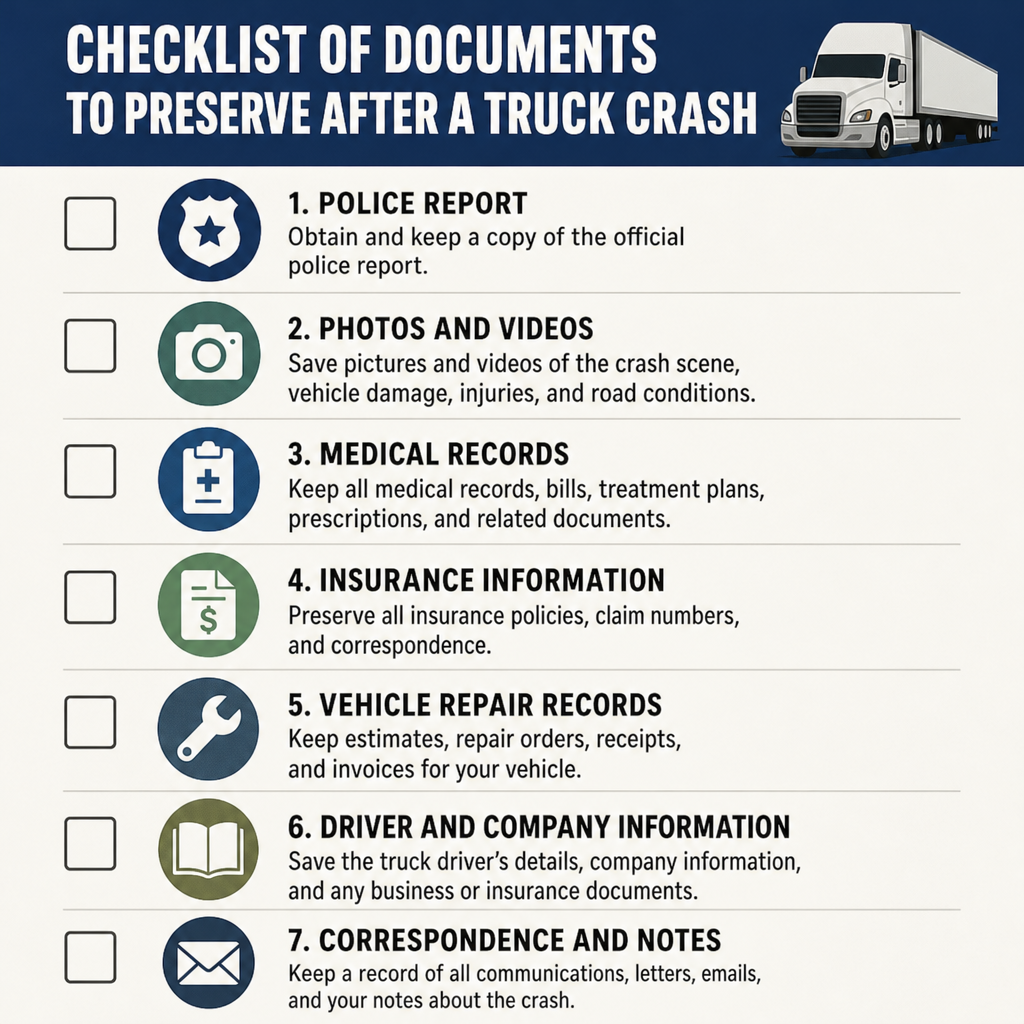
A serious truck crash can leave you shaken, injured, and unsure what to do next. This Cleveland truck accident guide walks you through the practical steps to protect your health, document what happened, and start organizing a possible insurance or legal claim. It is general information, not legal advice, but it can help you make calmer decisions after a collision involving a commercial vehicle.
Call (216) 677-5490 or request a free consultation to speak with a local Cleveland truck accident attorney at Buckeye Law Group today.
What should you do first at the scene?
Your first priority is safety: get medical help, call 911, and avoid standing in traffic or near leaking fuel, unstable cargo, or damaged vehicles. Ohio Revised Code § 4549.02 generally requires a driver involved in a crash on a public road to stop, remain at the scene, and provide identifying information to injured people, other involved drivers or owners, and the police officer at the scene. If someone is injured and cannot record information, the other driver must notify the nearest police authority and remain until police arrive unless removed by emergency transport.
Follow these steps after a Cleveland truck accident
1. Move To A Safer Spot And Check For Injuries: If you can move without making an injury worse, get yourself and passengers away from active lanes. Turn on hazard lights, use flares or warning triangles if available, and wait for emergency responders in a protected area. Do not try to inspect the truck, cargo, or roadway debris if doing so puts you closer to traffic. Call 911 if anyone is hurt, trapped, disoriented, or complaining of pain. Truck crashes can involve heavy forces, so take headaches, neck pain, abdominal pain, dizziness, numbness, and confusion seriously. If emergency medical technicians recommend transport, consider following that advice and keep copies of discharge papers and treatment instructions.
2. Call Police And Make Sure A Crash Report Is Created: A police report can become one of the most useful truck accident resources because it may identify drivers, vehicles, insurance information, witnesses, citations, and the investigating agency. In Cleveland, if a report needs to be filed or updated, the City says accident reports can be handled through Cleveland police resources, and its FAQ notes that accidents occurring within city limits may be reported at any Cleveland police station. If the crash happened on a highway or outside Cleveland city limits, another agency may investigate, such as the Ohio State Highway Patrol or a suburban police department. Ohio law requires law enforcement agencies investigating certain crashes involving a fatality, personal injury, or property damage over $1,000 to forward a written report to the Ohio Department of Public Safety within five days.
3. Exchange Information Without Arguing Fault: Get the truck driver’s name, phone number, driver’s license information, employer or motor carrier name, insurance details, license plate, trailer number, and any USDOT or company identification printed on the cab. Also collect the names and contact information for passengers, witnesses, and other involved drivers. If the truck driver says they were hauling for a broker, shipper, or another company, write that down too. Keep your words simple. Ask if everyone is safe, exchange information, and cooperate with police. Avoid statements like “I’m fine,” “I didn’t see you,” or “I’m sorry,” because casual comments can be repeated later without context.
4. Document The Scene Before Evidence Changes: If it is safe, take photos and video from several angles before vehicles are moved. Capture the truck, trailer, underride damage, skid marks, roadway conditions, traffic lights, signs, construction zones, debris, cargo spills, and the final resting position of all vehicles. Take close-up and wide shots so the location and scale are clear. A quick evidence checklist helps when your mind is racing:
- Photos of all vehicle damage, including your car’s interior if airbags deployed.
- The truck cab, trailer, license plates, company markings, and USDOT number.
- Road signs, lane markings, traffic signals, weather conditions, and lighting.
- Names, phone numbers, and short notes from witnesses.
- Your visible injuries over the first few days as bruising or swelling develops.
- Towing receipts, rental car paperwork, repair estimates, and damaged property.
This documentation matters because truck accident claims often involve more than two drivers. A motor carrier, maintenance contractor, cargo loader, broker, or parts manufacturer may become relevant depending on what caused the crash.
5. Get Medical Care And Follow Through: Even if you walked away from the scene, schedule a medical evaluation as soon as possible. Some injuries are easier to connect to a crash when they are documented early and treated consistently. Gaps in care can also make it easier for an insurer to argue that the crash did not cause your symptoms or that you recovered sooner than you did. Tell each provider that you were in a truck accident and describe all symptoms, not just the worst one. Keep a simple recovery journal with pain levels, missed work, sleep problems, mobility limits, appointments, prescriptions, and daily tasks you cannot do. Those details may later support damages for medical costs, lost income, pain, and reduced function.
6. Notify Your Insurer Carefully: Most auto policies require prompt notice after a crash, so report the collision to your insurance company. Give basic facts: date, time, location, vehicles involved, injuries known so far, and the investigating police agency. Do not guess about speed, distance, fault, or the full extent of your injuries. If the trucking company’s insurer calls, be cautious. You are not required to give a recorded statement to another party’s insurer before you understand your injuries and rights. If you are unsure, speak with a Cleveland truck accident attorney before signing releases, giving broad medical authorizations, or accepting an early settlement.
7. Preserve Trucking Evidence Quickly: Commercial trucking cases can involve records that ordinary car crashes do not. FMCSA materials explain that motor carriers must retain records of duty status and supporting documents for six months, and those supporting documents can include bills of lading, dispatch records, trip records, electronic mobile communication records, expense receipts, and payroll records. Because some records may be overwritten or discarded on business schedules, preservation matters. A lawyer may send a spoliation or preservation letter asking the carrier to keep electronic logging device data, driver qualification files, maintenance records, inspection reports, dashcam video, driver phone data, cargo documents, and post-crash drug or alcohol testing materials if applicable.
8. Find And Request The Correct Crash Report: Start by identifying the agency that responded at the scene. The Ohio Department of Public Safety offers an online crash report search, but ODPS states those reports are for statistical purposes, may take up to six weeks to appear, and are not official documents; to obtain the official report, you should contact the investigating agency. For Cleveland crashes, the City’s FAQ says accident reports are available online or in person on the third floor of the Justice Center at 1300 Ontario Street during listed weekday hours, with copies charged by page. If the Ohio State Highway Patrol investigated, OSHP says to wait at least seven business days before ordering crash reports or photos, because some crashes require additional investigation.
9. Track Losses From The Beginning: Create one folder for every crash-related document. Include medical bills, explanation-of-benefits forms, pay stubs, employer emails about missed work, repair estimates, total-loss paperwork, rental car receipts, transportation expenses, and photos of damaged personal items. Save every insurer letter and write down claim numbers, adjuster names, and call dates. Also track non-financial effects. Note missed family obligations, difficulty driving, anxiety near trucks, sleep disruption, or limits on hobbies and household tasks. These details help show the human impact of the collision, not just the repair bill.
10. Speak With A Truck Accident Lawyer Before Major Decisions: A truck crash can become complicated fast because federal safety rules, commercial insurance, multiple companies, and serious injuries may all overlap. FMCSA states that insurance requirements for motor carriers vary by entity type, operating authority, cargo, and vehicle type; for example, for-hire non-hazardous property carriers with GVWR of 10,001 pounds or more are listed with a $750,000 bodily injury and property damage requirement. A Cleveland truck accident lawyer can help identify responsible parties, preserve records, calculate damages, manage insurer communications, and evaluate whether a settlement accounts for future medical care or lost earning capacity. You do not need to know every legal theory before asking for help. Bring your report number, photos, medical paperwork, insurance letters, and the trucking company information you collected.
How long do you have to file truck accident claims in Ohio?
Ohio’s general deadline for many bodily injury or personal property injury claims is two years after the cause of action accrues, but exceptions can apply depending on the parties, injuries, and facts. Wrongful death cases also generally must be commenced within two years after the decedent’s death. Do not wait until the deadline is close, because evidence, witnesses, and commercial trucking records may become harder to secure.
Use these truck accident resources to stay organized
A simple plan can reduce stress while your claim develops. Save these items in a digital folder and a physical folder if possible:
- Crash Details: date, time, location, weather, lane of travel, and responding agency.
- People Involved: truck driver, carrier, insurer, witnesses, passengers, and adjusters.
- Medical File: diagnoses, treatment plans, bills, prescriptions, referrals, and work restrictions.
- Property File: photos, repair estimates, towing, rental, storage, and total-loss documents.
- Income File: missed shifts, reduced hours, PTO used, business losses, and employer notes.
- Communication Log: every call, email, letter, settlement offer, and document request.
This organization will make conversations with insurers, doctors, and a Cleveland truck accident attorney more productive.
Avoid these Common Mistakes
Do not leave the scene without meeting your legal duties, do not delay medical care, and do not rely on the trucking company to gather all evidence for you. Avoid posting crash details, injury updates, or vehicle photos on social media while a claim is open. Do not sign broad releases or accept a quick payment unless you understand what rights you may be giving up. Most importantly, do not assume the crash is “simple” because the police report lists one driver at fault. In truck accident claims, deeper investigation may reveal driver fatigue, unsafe loading, poor maintenance, inadequate training, or pressure from a carrier’s schedule. A focused truck accident guide is useful on day one, but legal guidance becomes especially important before recorded statements, settlement talks, or litigation deadlines.
Call (216) 677-5490 or request a free consultation today to speak with a local Cleveland truck accident attorney at Buckeye Law Group.
*This article provides general information about how Cleveland truck accident attorneys may assist individuals injured in commercial truck collisions throughout Cleveland and Cuyahoga County, Ohio. It is intended for educational purposes only and does not constitute legal advice. Reading this article or contacting Buckeye Law Group does not establish an attorney-client relationship. Truck accident claims may involve disputed liability, commercial insurance policies, federal trucking regulations, medical expenses, lost income, and applicable Ohio legal deadlines. Investigating these collisions may require reviewing police reports, driver logs, electronic vehicle data, maintenance records, medical documentation, and witness statements. Depending on the circumstances, multiple parties may share responsibility. A Cleveland truck accident attorney at Buckeye Law Group may help injured individuals investigate negligence, preserve critical evidence, evaluate potential compensation, negotiate with insurance companies, and understand their legal options under Ohio law. Every case is different, and prior results do not guarantee a similar outcome.*
What to Do After a Truck Accident in Cleveland, Ohio: A Step-by-Step Guide
A serious truck crash can leave you shaken, injured, and unsure what to do next. This Cleveland truck accident guide walks you through the practical steps to protect your health,
Are Personal Injury Settlements Taxable in Ohio?
A personal injury settlement in Ohio is often not taxable when the money compensates you for physical injuries or physical sickness. But some parts of a settlement can be taxable,
Is It Worth Hiring a Cincinnati Car Accident Attorney After a Minor Crash?
A minor crash can feel like something you should be able to handle with a few phone calls and a repair estimate. Sometimes that is true. But if pain appears
Does Homeowners Insurance Cover Dog Bite Injuries in Cincinnati?
Homeowners insurance often provides coverage for dog bite injuries in Cincinnati, Ohio. However, coverage is not guaranteed. Whether an insurance policy covers a particular incident depends on its liability provisions,
Who Is Responsible for a Multi-Vehicle Car Accident on I-480 Near Cleveland?
A multi-vehicle crash on I-480 can feel chaotic from the first second: traffic stops, drivers swerve, several insurers get involved, and everyone has a different version of what happened. Responsibility
How to prove liability in a Toledo slip and fall accident
How to prove liability in a Toledo slip and fall accident comes down to evidence: what caused the fall, who controlled the property, what they knew or should have known,
How Long Does a Car Accident Settlement Take in Toledo Ohio?
If you were hurt in a crash in Toledo, the settlement timeline depends on the injury, the insurance coverage, the evidence, and whether the insurer accepts responsibility. A straightforward claim
PTSD After a Columbus Car Accident: Can Psychological Injuries Support Compensation?
A Columbus car accident can cause more than physical injuries. The psychological effects of a serious collision may persist long after visible injuries have healed. Individuals may experience recurring nightmares,
Can You Recover Compensation After a Motorcycle Accident in Dayton if You Were Not Wearing a Helmet?
A missing helmet does not automatically prevent an injured rider from seeking compensation after a motorcycle crash in Dayton. Ohio law looks at who caused the collision, whether the rider
Who Can File a Wrongful Death Lawsuit in Toledo, Ohio?
When someone dies as a result of another person’s negligence, recklessness, or wrongful conduct, Ohio law may allow surviving family members to seek compensation through a civil claim known as

Buckeye Law Group represents people injured in auto accidents, slip and falls, workplace accidents and more in Ohio. Contact us today to learn more.
© 2026 Todos los derechos reservados | The Buckeye Law Group Inc. Políticade privacidad Mapa del sitio
Ubicaciones de las oficinas
- Akron Office 388 S Main St #400 Akron, OH 44311 (330) 426-0288
- Cincinnati Office 201 E 5th St Ste 1910 Cincinnati, OH 45202 (513) 547-2445
- Cleveland Office 127 Public Square Ste 1540 Cleveland, OH 44114 (216) 677-5490
- Columbus Office 20 E Broad St Suite 300 Columbus, OH 43215 (614) 482-3793
- Dayton Office 70 Birch Alley Ste 240 Dayton, OH 45440 (937) 884-4474
- Euclid Office 25701 N Lakeland Blvd Suite 113-C, Cleveland, OH 44132 (216) 405-2626
- Mansfield Office 305 E Main St Ste 6A, Mansfield, OH 44904 (567) 210-2606
- Findlay Office 7430 Timberstone Dr unit 101a, Findlay, OH 45840 419-873-5119
- Mentor Office 7537 Mentor Ave Ste 101, Mentor, OH 44060 (440) 306-3536
- Middletown Office 300 N Main St #400, Middletown, OH 45042 (326) 800-9150
- Parma Office 1257 Rockside Rd #A, Parma, OH 44131 (216) 279-1664
- Springfield Office 2100 E High St Ste TL3, Springfield, OH 45505 (937) 806-5791
- Toledo Office 3950 Sunforest Ct Ste 200, Toledo, OH 43623 (567) 483-3883
- Westlake Office 26404 Center Ridge Rd Ste B2, Westlake, OH 44145 216-247-0565
- Whitehall Office 5340 E Main St Ste 203, Whitehall, OH 43213 (380) 257-5206
- Youngstown Office 306 Churchill Hubbard Rd, Youngstown, OH 44505 (234) 225-0683
Contáctenos
© 2026 Todos los derechos reservados | The Buckeye Law Group Inc. Políticade privacidad Mapa del sitio