Following a car accident in Columbus, Ohio, that may have been caused by another driver’s negligence, taking appropriate steps can help protect your health, preserve important evidence, and safeguard your legal rights. Seek medical attention when necessary, report the collision to the appropriate law enforcement agency, document vehicle damage and injuries, and notify your insurance company promptly. Retain photographs, witness information, medical records, and accident-related expenses, as these documents may become important when establishing liability and evaluating compensation.
Ohio follows an at-fault insurance system, meaning the driver whose negligence caused a collision may be financially responsible for resulting damages. However, disputed liability, shared fault, and available insurance coverage can affect your ability to recover compensation. Understanding the claims process is particularly important when the responsible driver leaves the scene, lacks insurance, or denies responsibility. The following steps explain how Columbus accident victims can document their losses, navigate insurance claims, and make informed decisions about their legal options under Ohio law.
Call (614) 482-3793 or request a free consultation today to speak with an experienced Columbus car accident attorney at Buckeye Law Group.
What should you do immediately after a Columbus car accident?
Stop, check for injuries, get to safety, and contact emergency services when needed. Exchange information with the other driver, collect evidence without putting yourself at risk, and arrange appropriate medical care. Stick to facts rather than arguing about blame or promising that you are uninjured. Ohio’s crash guidance recommends exchanging information without discussing fault. Following a collision, consider the following steps to protect your safety, document the circumstances of the accident, and preserve important information that may support your insurance claim or legal case.
- Address Immediate Danger: Call 911 for injuries, a medical emergency, or another immediate threat. Follow dispatch instructions rather than standing in traffic to take photographs.
- Exchange Identifying Information: Record names, contact details, license plates, and insurance information. Photograph documents with permission instead of relying on hurried handwritten notes.
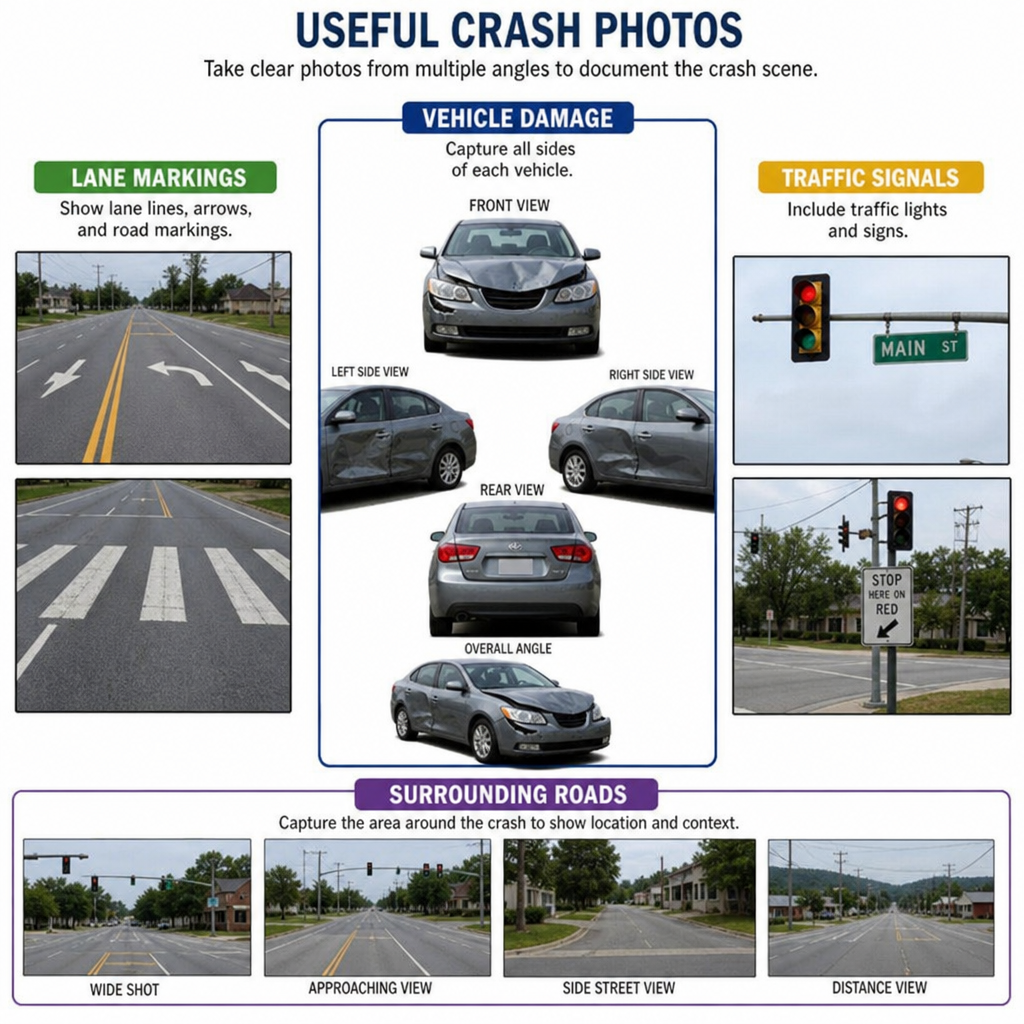
- Capture The Scene Safely: Photograph vehicle damage, final positions, lane markings, signals, debris, and the surrounding roadway. Include wide views that show where the collision happened.
- Find Independent Witnesses: Ask for names and contact information. Note where each person stood and what they actually observed.
- Keep The Reporting Details: Ask for the responding agency’s name and report number, and save any instructions you receive. These records belong with your insurance paperwork.
For non-emergency police assistance following a motor vehicle accident in Columbus, Ohio, contact the Columbus Division of Police at (614) 645-4545. When speaking with dispatch, provide the collision’s location and explain whether anyone has sustained injuries, a vehicle is disabled or obstructing traffic, or another driver has fled the scene. Providing accurate information helps dispatch personnel assess the circumstances and determine the appropriate police response. For serious injuries, immediate safety hazards, or other emergencies, call 911.
Reporting a Columbus traffic accident
Columbus offers online crash reporting for documentation and insurance purposes. However, the city explicitly states that reports submitted through that process receive no investigative follow-up. If the other driver fled or you need police assistance, contact dispatch rather than assuming an online submission starts an investigation. Include an email address when filing online to receive the processed report.
How Can the Location of a Columbus Car Accident Affect Your Injury Claim?
The location of a car accident in Columbus, Ohio, can influence what evidence is available, which law enforcement agency investigates the collision, and how disputed liability is evaluated. For example, collisions along Interstate 70, Interstate 71, State Route 315, and the downtown Columbus interchange may involve merging traffic, entrance ramps, changing lane configurations, or construction-related conditions. Documenting the exact location, direction of travel, lane markings, and applicable traffic controls can help clarify how a collision occurred.
For accidents on local streets, including High Street and Broad Street, identify the nearest intersection, photograph traffic signals, and note nearby businesses that may have surveillance footage. Requesting preservation of relevant recordings promptly may prevent important evidence from being lost.
Obtaining a Columbus Accident Report
The Columbus Division of Police submits electronic crash reports to the Ohio Department of Public Safety. Once available, copies can be located through the state’s crash report search. However, the state’s searchable copies are provided for statistical purposes and are not official records. For official reports or supplemental materials, contact the investigating agency directly. Preserving location-specific evidence can help an injured person and their attorney evaluate disputed fault, insurance coverage, and potential compensation under Ohio law.
How does Ohio determine fault and compensation?
Ohio uses an at-fault framework. A driver whose negligence causes a collision may be responsible for resulting losses. Under Ohio’s modified comparative negligence rule, you generally can recover if your share of fault is 50% or less, but your damages are reduced by that percentage. Fault greater than 50% generally bars recovery against the other responsible parties.
For illustrative purposes, if you sustain $20,000 in proven damages and are found 20% responsible for a collision, your potential recovery would be reduced to $16,000 before other applicable considerations. If you are found 50% responsible, your potential recovery would be reduced by half.
Important Note: These calculations are hypothetical examples provided solely to explain Ohio’s comparative negligence laws. They do not represent a promise, guarantee, or prediction of the compensation you may receive. Every personal injury case is unique, and actual outcomes depend on the specific facts, available evidence, applicable insurance coverage, and relevant Ohio law.
An insurance adjuster’s determination of fault is not necessarily final. Additionally, receiving a traffic citation does not automatically establish that a driver bears full responsibility for a collision. If an insurance company assigns you partial fault, request an explanation of the evidence supporting its determination and provide any relevant documentation that may help clarify the circumstances of the accident.
Potential compensation includes documented medical expenses, lost earnings, vehicle-related losses, and noneconomic harm such as pain and suffering. Recovery depends on proving that the crash caused those losses; Ohio also limits certain noneconomic damages, with exceptions. Keep bills, treatment records, wage documentation, and repair estimates rather than relying on a rough total.
Ohio’s minimum liability insurance limits are $25,000 per injured person, $50,000 per accident for bodily injury, and $25,000 for property damage. Those limits describe minimum coverage, not a guaranteed settlement or the value of your injuries.
Which insurance coverage applies if the other driver flees or has no insurance?
The coverage available depends on whether the responsible driver is identified, insured, and covered for the collision, and on your own policy. Optional uninsured motorist coverage may help with injuries caused by uninsured or unidentified drivers. Collision coverage generally addresses damage to your vehicle, subject to policy terms and a deductible. For Columbus car accident claims, distinguish these situations:
- Identified And Insured: Present a liability claim to the responsible driver’s insurer. Provide evidence of both fault and your losses.
- Identified But Uninsured: Notify your own insurer and ask about uninsured motorist bodily injury coverage and collision coverage. Do not assume knowing the driver’s identity means insurance money is available.
- Unknown Hit-And-Run Driver: Report the incident promptly, preserve identifying details, and ask your insurer about applicable uninsured motorist and collision benefits. Do not chase the fleeing vehicle.
- Identified Driver Who Denies Fault: Treat this as an evidence dispute. A denial of responsibility is different from having no insurance; submit photographs, witness details, and other supporting records.
Uninsured motorist coverage is optional in Ohio, not automatically part of every Columbus auto insurance policy. For an unidentified driver, Ohio law includes an independent corroborating evidence requirement; your unsupported account alone may not satisfy it. Policy language matters, so request the coverage provisions and reporting requirements in writing.
Preserve evidence beyond the roadside
Make evidence preservation an early task, not something to revisit only after a denial. Save original dashcam files, make a backup, and retain surrounding footage rather than only a short impact clip. If nearby businesses or homes have cameras, ask promptly whether relevant footage exists and request that it be preserved. These are practical ways to assemble supporting evidence, especially when an unidentified driver is involved. Create one folder for the report, photographs, correspondence, bills, and receipts. Write a factual timeline while your memory is fresh: direction of travel, lane, signal, impact, and what each driver said. Separate what you personally saw from what someone else told you.
Seek appropriate medical evaluation and follow your clinician’s instructions. Tell the clinician how the collision occurred and describe symptoms accurately. Keep a dated record of treatment, missed work, and activity restrictions to help document the losses you are claiming.
Keep the insurance claims process organized
Notify your insurer promptly even when you believe someone else caused the crash. Ask which coverages may apply, what documentation is needed, and what deadlines your policy imposes. Early notice is particularly important when you may need benefits from your own policy. Use a claim log with the following fields:
- Claim Identification: Claim number, insurer, adjuster, and contact details.
- Evidence Submitted: File names, submission dates, and confirmation of receipt.
- Open Questions: Coverage decisions, inspection arrangements, and missing records.
- Next Action: Who must respond, what they need, and the agreed follow-up date.
Before authorizing repairs, notify the insurer and clarify inspection arrangements. Ask the repair shop for an itemized estimate and retain invoices. Ohio’s motor vehicle repair regulator advises notifying your carrier before authorizing accident-related repairs.
If an offer appears incomplete, identify the missing expense or disputed evidence rather than simply demanding more. Request a written explanation of a denial or reduction. The Ohio Department of Insurance offers consumer assistance at (800) 686-1526, although it cannot decide factual disputes about fault or damage value.
Get legal guidance before deadlines or settlement decisions
Consider speaking with a Columbus car accident attorney when injuries are serious, fault is contested, coverage is disputed, or the responsible driver cannot be identified. Bring your policy, report, photographs, medical records, and insurer correspondence. Ask what additional investigation is needed, how fees and expenses work, and what a proposed settlement would resolve.
Ohio generally allows two years to file a lawsuit for bodily injury or damage to personal property, usually measured from when the injury or loss occurred. Exceptions can change that calculation, and policy reporting requirements are separate. Do not treat an open insurance claim as confirmation that every deadline is protected.
Focus on the next documented step
Following a car accident in Columbus, Ohio, protecting your health and preserving important evidence should be your immediate priorities. Seek appropriate medical attention, obtain a copy of the accident report, and document your injuries, medical expenses, lost wages, and communications with insurance companies. These records may help establish liability and support your claim for compensation.
Under Ohio law, deadlines and insurance policy requirements can affect your legal options. If fault is disputed, injuries are significant, or an insurer offers a settlement that may not fully account for your losses, consider consulting a Columbus car accident attorney at Buckeye Law Group. An attorney can review the circumstances of your collision, explain your rights, and help you make informed decisions before accepting a settlement or allowing important legal deadlines to pass.
Call (614) 482-3793 or request a free consultation today to speak with an experienced Columbus car accident attorney at Buckeye Law Group.
Legal Disclaimer: This article provides general educational information about Columbus car accidents and how Buckeye Law Group’s car accident attorneys may assist injured individuals and families throughout Columbus and Franklin County, Ohio. This content is not legal advice. Reading this article or contacting the firm does not establish an attorney-client relationship. Car accident claims may involve rear-end, T-bone, head-on, or hit-and-run collisions caused by driver negligence. Establishing liability generally requires evidence of negligence, causation, and damages. Under Ohio Revised Code § 2305.10, personal injury lawsuits generally have a two-year filing deadline, subject to exceptions. Ohio Revised Code § 2315.33 establishes comparative negligence rules that may affect compensation. Buckeye Law Group’s Columbus car accident attorneys may investigate collisions, preserve evidence, review medical records, evaluate insurance coverage, assess damages, and negotiate with insurers. Every case involves unique circumstances, and prior results do not guarantee similar outcomes.
Not at Fault in a Columbus Car Accident? What Ohio Drivers Should Do Next
Following a car accident in Columbus, Ohio, that may have been caused by another driver’s negligence, taking appropriate steps can help protect your health, preserve important evidence, and safeguard your
Is Personal Injury Mediation Legally Binding in Ohio?
Personal injury mediation in Ohio does not automatically create a binding outcome, but a settlement reached through mediation can be legally enforceable. The distinction is between negotiating a resolution and
How to Obtain an Ohio Crash Report After an Accident in Dayton
After an accident in Dayton, start with Ohio’s Crash Retrieval system to locate a report, then contact the investigating agency if you need an official copy. The Ohio Department of
T-Bone Accidents in Columbus Ohio: Who Is at Fault and What Evidence Matters?
T-bone collisions are often among the most disputed Columbus car accidents because both drivers may tell very different stories about the same intersection. Fault usually depends on who had the
Medical Negligence in Dayton: When a Medical Error May Support an Ohio Malpractice Claim
A bad medical outcome does not always mean a provider committed malpractice, but some errors may support an Ohio medical malpractice claim. For patients and families in Dayton, the key
Fatal Cleveland Bicycle Hit-and-Run: Honoring a Life Lost and Raising Awareness About Roadway Safety
The tragic death of a bicyclist following an October 18, 2026, hit-and-run collision near West 25th Street and Detroit Avenue in Cleveland has left loved ones grieving an irreplaceable loss
Gregory E. Gudin’s $12 Million USAA Insurance Settlement
In 2021, attorney Gregory E. Gudin handled a case involving USAA, one of the nation’s most recognized insurance companies, that resulted in a $12 million settlement. This significant result is
Gregory E. Gudin’s $14.5 Million Progressive Insurance Settlement
Gregory E. Gudin has spent his legal career representing individuals whose cases involve serious financial consequences. Among the significant settlements on his professional portfolio is a $14.5 million settlement involving
Wrongful Death Lawsuits in Columbus, Ohio: Who Can File and What Compensation Is Available?
The wrongful death of a loved one can leave a family facing significant emotional and financial hardships, particularly when the loss results from another party’s negligence. Under Ohio law, surviving
Injured in an Uber Accident in Toledo? Understanding Insurance Coverage and Liability
A Toledo Uber accident can feel more confusing than a typical car crash because several insurance policies may be involved. The most important issue is usually the driver’s app status

Buckeye Law Group represents people injured in auto accidents, slip and falls, workplace accidents and more in Ohio. Contact us today to learn more.
© 2026 Todos los derechos reservados | The Buckeye Law Group Inc. Políticade privacidad Mapa del sitio
Ubicaciones de las oficinas
- Akron Office 388 S Main St #400 Akron, OH 44311 (330) 426-0288
- Cincinnati Office 201 E 5th St Ste 1910 Cincinnati, OH 45202 (513) 547-2445
- Cleveland Office 127 Public Square Ste 1540 Cleveland, OH 44114 (216) 677-5490
- Columbus Office 20 E Broad St Suite 300 Columbus, OH 43215 (614) 482-3793
- Dayton Office 70 Birch Alley Ste 240 Dayton, OH 45440 (937) 884-4474
- Euclid Office 25701 N Lakeland Blvd Suite 113-C, Cleveland, OH 44132 (216) 405-2626
- Mansfield Office 305 E Main St Ste 6A, Mansfield, OH 44904 (567) 210-2606
- Findlay Office 7430 Timberstone Dr unit 101a, Findlay, OH 45840 419-873-5119
- Mentor Office 7537 Mentor Ave Ste 101, Mentor, OH 44060 (440) 306-3536
- Middletown Office 300 N Main St #400, Middletown, OH 45042 (326) 800-9150
- Parma Office 1257 Rockside Rd #A, Parma, OH 44131 (216) 279-1664
- Springfield Office 2100 E High St Ste TL3, Springfield, OH 45505 (937) 806-5791
- Toledo Office 3950 Sunforest Ct Ste 200, Toledo, OH 43623 (567) 483-3883
- Westlake Office 26404 Center Ridge Rd Ste B2, Westlake, OH 44145 216-247-0565
- Whitehall Office 5340 E Main St Ste 203, Whitehall, OH 43213 (380) 257-5206
- Youngstown Office 306 Churchill Hubbard Rd, Youngstown, OH 44505 (234) 225-0683
Contáctenos
© 2026 Todos los derechos reservados | The Buckeye Law Group Inc. Políticade privacidad Mapa del sitio