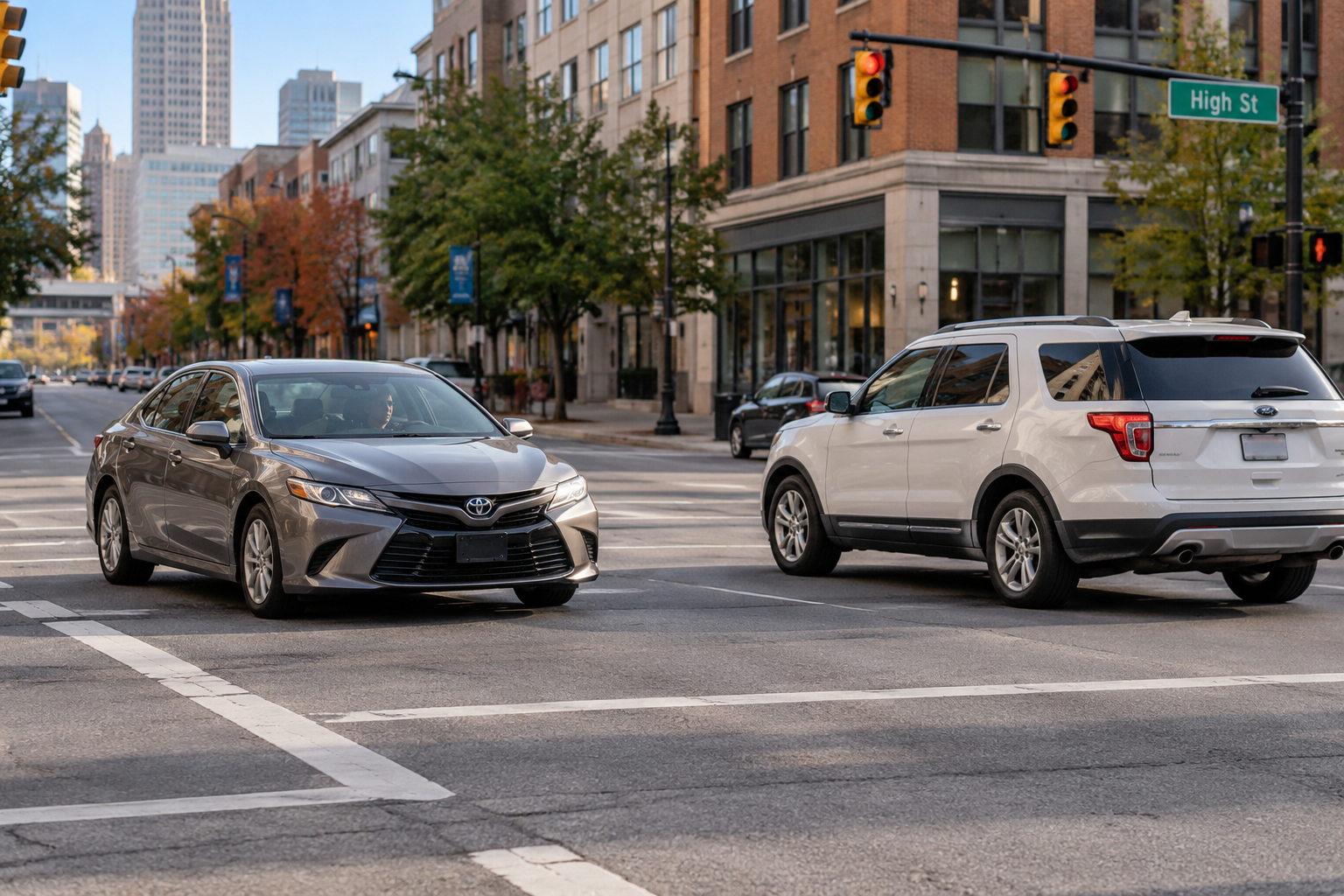
T-bone collisions are often among the most disputed Columbus car accidents because both drivers may tell very different stories about the same intersection. Fault usually depends on who had the right of way, whether a driver ignored a signal or stop sign, and what the physical evidence shows. If you were hurt in a Columbus T-bone accident, the right steps early on can protect your health, your insurance claim, and your ability to prove what happened.
Call (614) 482-3793 or request a free consultation today to speak with an experienced Columbus car accident attorney at Buckeye Law Group.
Who is usually at fault in a Columbus T-bone accident?
The at-fault driver is often the one who failed to stop, failed to yield, turned left into oncoming traffic, entered from a driveway unsafely, or ran a red light. Ohio’s right-of-way rules matter: at certain intersections, the driver on the left must yield to the vehicle on the right, and a driver turning left must yield when an approaching vehicle is in the intersection or close enough to be an immediate hazard.
That does not mean every T-bone case is simple. A driver with the right of way can still share fault if they were speeding, distracted, impaired, or entered the intersection after the light changed. In other cases, a confusing work zone, blocked sign, defective brake system, or poorly timed signal may raise questions beyond the conduct of the two drivers. Common fault scenarios in t-bone crashes include:
- Red-Light Or Stop-Sign Violations: One driver enters the intersection when cross traffic has the right of way.
- Left-Turn Collisions: A turning driver misjudges the speed or distance of an oncoming vehicle.
- Failure To Yield From A Driveway Or Parking Lot: A driver pulls onto a road without enough space.
- Distracted Driving: A phone, navigation screen, passenger, or in-car system delays a driver’s reaction time.
- Speeding Through Intersections: Excess speed can make a crash more severe and may affect fault allocation.
Columbus intersections create real evidence challenges
Side-impact crashes often happen quickly, and the most important proof can disappear just as fast. Columbus has high-volume corridors, complex freeway ramps, busy commercial entrances, and neighborhoods where pedestrians, cyclists, buses, and turning vehicles all compete for limited space. The City’s Vision Zero work identifies priority intersections and high-injury locations, including projects such as Livingston Avenue and Courtright Road, where serious crash history shapes safety planning.
Although Ohio traffic crash statistics can provide valuable insight into roadway hazards, high-risk intersections, and recurring collision patterns, they do not, by themselves, establish liability in an individual accident. Determining fault requires a thorough examination of the circumstances surrounding the specific collision. Critical evidence may include vehicle positioning, traffic signal sequences, points of impact, vehicle damage, skid marks, eyewitness statements, and available electronic data. When evaluated together, this evidence can help reconstruct how the collision occurred, identify potential violations of Ohio traffic laws, and establish whether a driver’s negligence contributed to the resulting injuries. A well-supported personal injury claim relies on documented facts and credible evidence, not general accident statistics or assumptions about fault.
What evidence matters most after T-bone collisions?
The best evidence is the evidence that answers three questions: who had the right of way, what each driver did seconds before impact, and whether the injuries and vehicle damage match the crash story. A police report is important, especially if it notes citations or driver statements, but it is rarely the only proof needed. Ohio’s public crash systems can help locate Columbus accident reports and statewide crash data after reports are submitted. Evidence that can strengthen a claim includes:
- Police Crash Report And Citations: The report may document road conditions, diagrams, witness names, insurance details, suspected violations, and whether anyone was cited. Review it for accuracy because small errors can create big disputes.
- Photos And Video: Photograph vehicle positions, damage patterns, debris, traffic lights, signs, lane markings, skid marks, weather, and visible injuries. Dashcam, business security, doorbell, bus, rideshare, or traffic camera footage may be even more persuasive.
- Witness Information: Independent witnesses can confirm who entered first, which light was green, whether a driver was speeding, or whether a vehicle never stopped. Get names and phone numbers before people leave.
- Medical Records: Prompt treatment helps connect injuries to the crash. T-bone crashes can cause neck and back injuries, fractures, shoulder trauma, concussions, internal injuries, and symptoms that worsen after the adrenaline fades.
- Vehicle And Digital Evidence: Damage location, airbag deployment, event data recorders, phone records, and infotainment data may help reconstruct speed, braking, steering, and distraction issues.
Fast action helps preserve video and records
Video is time-sensitive. ODOT says its traffic management center generally keeps only a 72-hour buffer for ODOT-controlled camera recordings, and some cameras shown through OHGO in urban areas may be operated by municipalities rather than retained by ODOT. Requests should identify the specific camera, date, time, and duration. After a crash, take these steps if you can do so safely:
- Call 911 and request medical help if anyone may be hurt.
- Move to a safe location when possible, but do not leave the scene.
- Exchange driver, insurance, and vehicle information.
- Photograph the scene before vehicles are moved if it is safe.
- Ask witnesses for contact details.
- Look for nearby cameras on businesses, buses, homes, parking lots, and traffic poles.
- Seek medical care promptly and follow treatment recommendations.
- Notify your insurer, but avoid recorded speculation about fault.
- Keep repair estimates, medical bills, missed-work records, and pain notes.
Columbus Resources and Local Support After a T-Bone Accident
A serious T-bone collision can leave injured motorists and their families facing medical concerns, unexpected expenses, transportation difficulties, and uncertainty about their legal rights. For individuals involved in side-impact accidents throughout Columbus and Franklin County, several local organizations provide resources that may assist with medical treatment, accident documentation, and essential services. The following Columbus-area resources may help individuals and families navigate the aftermath of a collision:
- Columbus Division of Police: For emergencies involving injuries or immediate danger, call 911. For non-emergency police assistance within Columbus, contact the Division of Police at (614) 645-4545. The responding agency’s documentation may provide important information about the collision, including statements, roadway conditions, and other reported circumstances.
- OhioHealth Grant Medical Center: Located at 111 S. Grant Avenue, Columbus, OH 43215, Grant Medical Center operates a verified Level 1 adult trauma center equipped to evaluate and treat serious injuries. Individuals injured in T-bone crashes may require emergency assessment for fractures, head injuries, internal trauma, or other conditions that are not immediately apparent.
- The Ohio State University Wexner Medical Center: The emergency department at 2050 Kenny Rd, Columbus, OH 43221 provides 24-hour emergency care and access to Level 1 adult trauma services. Prompt medical evaluation is important because certain injuries may produce delayed symptoms following a side-impact collision.
- Ohio Department of Public Safety — Crash Reports: Individuals can search for available collision reports through the Ohio Crash Report Search. Columbus Division of Police electronic crash reports are submitted to the state. Reports may take time to appear, and individuals needing an official report or supplemental records should contact the investigating law enforcement agency.
- Columbus 311 Customer Service Center: If a collision raises concerns about malfunctioning traffic signals, damaged signage, or roadway maintenance, residents can submit non-emergency service requests through Columbus 311 or call (614) 645-3111. Documenting a roadway concern may be useful, but submitting a service request does not establish fault or replace a formal investigation.
- LSS 211 Central Ohio: A serious accident can create financial and practical hardships beyond medical treatment. Individuals and families in Franklin County can call 211 or visit LSS 211 Central Ohio for referrals to available community services, including food assistance, housing resources, transportation assistance, and other support programs.
For injured motorists who cannot immediately return to driving, the Central Ohio Transit Authority (COTA) also provides public transportation options, including accessible services for eligible riders.
Preserving Evidence and Protecting Your Rights
Accessing local resources is an important part of recovery, but injured individuals should also retain copies of medical records, police reports, photographs, transportation expenses, and communications concerning the accident. When liability is disputed, these materials may help establish the circumstances of the collision and document its financial and medical consequences.
An experienced Columbus personal injury attorney can evaluate the available evidence, identify additional records that may need to be preserved, and explain how Ohio law applies to the specific circumstances of the accident.
Shared fault can reduce or block compensation
Ohio follows a comparative fault rule. In general, compensation can be reduced by the injured person’s percentage of fault, and recovery may be barred if that person’s fault is greater than the combined fault of the other parties.
This is why insurers often focus on details such as speed, lookout, distraction, or whether a driver could have avoided impact. A driver who was T-boned may still face an argument that they accelerated through a yellow light, failed to brake, or entered the intersection too late. The practical goal is not simply to say “the other driver hit me,” but to build a record that shows why the other driver’s conduct caused the collision.
When legal help may make sense
A personal injury attorney can help when liability is disputed, injuries are serious, multiple vehicles are involved, video must be preserved, or an insurer is pushing for a quick settlement before the full medical picture is known. A local Ohio personal injury attorney may also understand how Columbus accident reports, municipal records, nearby businesses, and local traffic patterns fit into a T-bone claim.
Timing matters. Ohio law generally gives two years to file an action for bodily injury or injury to personal property, though specific facts can affect deadlines. Waiting can make it harder to find witnesses, preserve video, inspect vehicles, and document injuries.
Protecting Your Rights After a T-Bone Accident in Columbus, Ohio
Fault in Columbus T-bone accidents usually turns on right of way, driver conduct, and fast-preserved evidence. Police reports, photos, video, witnesses, medical records, and vehicle data can make the difference between a disputed claim and a well-supported one. Treat the crash as both a health event and an evidence event: get care, document everything, and seek legal guidance if the facts or injuries are significant.
Call (614) 482-3793 or request a free consultation today to speak with an experienced Columbus car accident attorney at Buckeye Law Group.
Legal Disclaimer: This article provides general information about how Columbus car accident attorneys at Buckeye Law Group may assist individuals and families injured in motor vehicle collisions throughout Columbus and Franklin County, Ohio. It is intended for educational purposes only and does not constitute legal advice. Reading this article or contacting Buckeye Law Group does not establish an attorney-client relationship. Car accident claims may involve rear-end collisions, T-bone accidents, head-on crashes, distracted driving, speeding, impaired driving, or other forms of driver negligence. Establishing liability generally requires demonstrating that another party owed a duty of care, breached that duty, and caused injuries or damages as a result. Under Ohio Revised Code § 2305.10, personal injury claims arising from car accidents are generally subject to a two-year statute of limitations, although certain exceptions may apply. Additionally, Ohio Revised Code § 2315.33 establishes comparative negligence rules that may affect an injured individual’s ability to recover compensation. Columbus car accident attorneys at Buckeye Law Group may investigate the circumstances surrounding a collision, review police reports and medical records, preserve critical evidence, identify potentially liable parties, evaluate available insurance coverage, assess recoverable damages, negotiate with insurance companies, and help injured individuals understand their legal rights under Ohio law. Every case is different, and prior results do not guarantee a similar outcome.
T-Bone Accidents in Columbus Ohio: Who Is at Fault and What Evidence Matters?
T-bone collisions are often among the most disputed Columbus car accidents because both drivers may tell very different stories about the same intersection. Fault usually depends on who had the
Medical Negligence in Dayton: When a Medical Error May Support an Ohio Malpractice Claim
A bad medical outcome does not always mean a provider committed malpractice, but some errors may support an Ohio medical malpractice claim. For patients and families in Dayton, the key
Fatal Cleveland Bicycle Hit-and-Run: Honoring a Life Lost and Raising Awareness About Roadway Safety
The tragic death of a bicyclist following an October 18, 2026, hit-and-run collision near West 25th Street and Detroit Avenue in Cleveland has left loved ones grieving an irreplaceable loss
Gregory E. Gudin’s $12 Million USAA Insurance Settlement
In 2021, attorney Gregory E. Gudin handled a case involving USAA, one of the nation’s most recognized insurance companies, that resulted in a $12 million settlement. This significant result is
Gregory E. Gudin’s $14.5 Million Progressive Insurance Settlement
Gregory E. Gudin has spent his legal career representing individuals whose cases involve serious financial consequences. Among the significant settlements on his professional portfolio is a $14.5 million settlement involving
Wrongful Death Lawsuits in Columbus, Ohio: Who Can File and What Compensation Is Available?
The wrongful death of a loved one can leave a family facing significant emotional and financial hardships, particularly when the loss results from another party’s negligence. Under Ohio law, surviving
Injured in an Uber Accident in Toledo? Understanding Insurance Coverage and Liability
A Toledo Uber accident can feel more confusing than a typical car crash because several insurance policies may be involved. The most important issue is usually the driver’s app status
Does Renters Insurance Cover Dog Bites in Ohio? What Cleveland Residents Should Know
In Ohio, renters insurance may cover dog bite claims through the policy’s personal liability section, but coverage depends on the policy language, the dog’s history, and any exclusions. Cleveland renters
How Uninsured Motorist Coverage Works After a Car Accident in Dayton, Ohio
A crash with an uninsured or underinsured driver can turn an ordinary Dayton commute into a confusing insurance problem. Uninsured motorist coverage helps protect you when the at-fault driver has
Whiplash Symptoms After a Cleveland Car Accident: What Injured Drivers Should Know
Whiplash is one of the most common neck injuries people worry about after a car accident, especially after a rear-end collision. For Cleveland drivers, the challenge is that auto accident

Buckeye Law Group represents people injured in auto accidents, slip and falls, workplace accidents and more in Ohio. Contact us today to learn more.
© 2026 Todos los derechos reservados | The Buckeye Law Group Inc. Políticade privacidad Mapa del sitio
Ubicaciones de las oficinas
- Akron Office 388 S Main St #400 Akron, OH 44311 (330) 426-0288
- Cincinnati Office 201 E 5th St Ste 1910 Cincinnati, OH 45202 (513) 547-2445
- Cleveland Office 127 Public Square Ste 1540 Cleveland, OH 44114 (216) 677-5490
- Columbus Office 20 E Broad St Suite 300 Columbus, OH 43215 (614) 482-3793
- Dayton Office 70 Birch Alley Ste 240 Dayton, OH 45440 (937) 884-4474
- Euclid Office 25701 N Lakeland Blvd Suite 113-C, Cleveland, OH 44132 (216) 405-2626
- Mansfield Office 305 E Main St Ste 6A, Mansfield, OH 44904 (567) 210-2606
- Findlay Office 7430 Timberstone Dr unit 101a, Findlay, OH 45840 419-873-5119
- Mentor Office 7537 Mentor Ave Ste 101, Mentor, OH 44060 (440) 306-3536
- Middletown Office 300 N Main St #400, Middletown, OH 45042 (326) 800-9150
- Parma Office 1257 Rockside Rd #A, Parma, OH 44131 (216) 279-1664
- Springfield Office 2100 E High St Ste TL3, Springfield, OH 45505 (937) 806-5791
- Toledo Office 3950 Sunforest Ct Ste 200, Toledo, OH 43623 (567) 483-3883
- Westlake Office 26404 Center Ridge Rd Ste B2, Westlake, OH 44145 216-247-0565
- Whitehall Office 5340 E Main St Ste 203, Whitehall, OH 43213 (380) 257-5206
- Youngstown Office 306 Churchill Hubbard Rd, Youngstown, OH 44505 (234) 225-0683
Contáctenos
© 2026 Todos los derechos reservados | The Buckeye Law Group Inc. Políticade privacidad Mapa del sitio