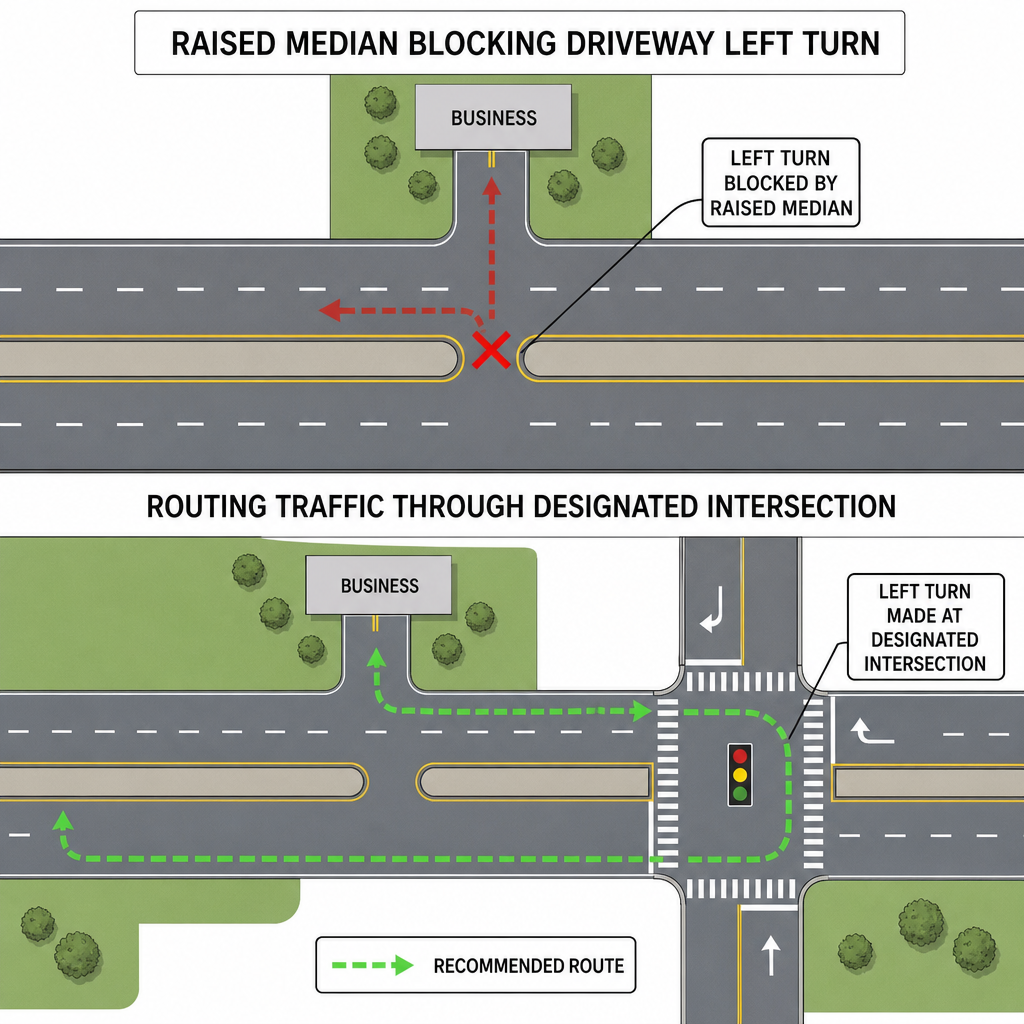
South Limestone Street in Springfield, Ohio, is the focus of safety improvements intended to reduce conflicts between vehicles entering, leaving, and traveling along the corridor. The Ohio Department of Transportation’s project listing identifies raised medians between Leffel Lane and Lansdowne Avenue, with construction scheduled from spring 2026 through summer 2027. For drivers, the key is understanding how median restrictions affect turns, and checking current traffic notices before traveling. (transportation.ohio.gov)
Call (937) 806-5791 or request a free consultation to speak with our experienced Springfield car accident lawyers at Buckeye Law Group today.
What is changing on South Limestone Street?
ODOT describes the South Limestone Street Reconstruction project as a safety improvement involving raised medians from Leffel Lane to Lansdowne Avenue. Its listing identifies project number 113792 and places the work in the construction stage. Those details help drivers distinguish this project from other Springfield street improvement plans or older corridor proposals. The current listing provides these planning details:
- Location: South Limestone Street between Leffel Lane and Lansdowne Avenue.
- Primary Improvement: Raised medians intended to improve safety.
- Published Construction Window: Spring 2026 through summer 2027.
- Traffic Updates: ODOT directs travelers to its weekly Clark County traffic-impact notices.
Older city materials describe a broader reconstruction concept extending between Interstate 70 and Singer Street. Those materials discussed alternatives, potential phases, and turning arrangements during an earlier public-involvement process. They offer useful background, but their proposed schedules and design details should not be treated as confirmation of today’s construction arrangements.
For trip planning, separate the permanent design from temporary construction controls. A project description explains the intended improvement; a current traffic notice addresses immediate travel conditions. Before leaving, look for notices that specifically name South Limestone Street, the relevant intersections, and your travel date rather than relying on an older project illustration. ODOT identifies its county traffic notices as the source for current and upcoming impacts.
Why are raised medians part of the safety plan?
Raised medians separate opposing traffic and restrict certain turning movements across the roadway. Their safety purpose is to reduce conflict points: places where vehicles crossing, turning, or entering traffic can collide. Federal Highway Administration guidance identifies corridor access management as a proven safety countermeasure, with medians among the tools used to manage those conflicts. (highways.dot.gov)
Consider a driver leaving a driveway and attempting to turn left across several lanes. That maneuver requires judging traffic approaching from different directions. A median can prevent that direct crossing and route the driver toward an intersection or another designated turning location instead. The trade-off is straightforward: some trips become less direct, while fewer crossing movements occur at individual driveways.
That does not mean every median opening permits every maneuver. Treat the signs, lane arrows, and signals at each location as your instructions, and use only movements permitted there. Never assume an opening is an invitation to make a U-turn simply because your destination is on the opposite side. Ohio’s driving guidance explains the role of traffic signs and requires drivers to follow applicable traffic controls. (publicsafety.ohio.gov)
Business access may require a different approach
Access changes can be the most noticeable part of median projects for regular customers and delivery drivers. Transportation guidance acknowledges that raised medians can restrict direct left-turn access and require indirect routes to some properties. That makes the approach to a destination worth planning, not just the destination itself. Before visiting a business along the affected segment, use this practical planning checklist:
- Check The Entrance: Ask the business which driveway customers should use during construction.
- Confirm Your Approach: Ask whether approaching from a particular direction will make access easier.
- Plan The Return Trip: Consider how you will leave the property, especially if your usual route involved turning left.
- Prepare Delivery Instructions: Give drivers the business name, entrance location, and any confirmed access guidance before they arrive.
These are preparation steps, not a substitute for roadside directions. If an entrance is blocked or a planned turn is prohibited, continue along the signed route and reassess from a safe stopping place. Ohio’s rules-of-the-road guidance emphasizes following work-zone directions and staying out of areas closed by barriers, cones, or drums. (publicsafety.ohio.gov)
Work-zone driving calls for deliberate habits
During construction, the temporary layout deserves as much attention as the finished infrastructure improvements. Ohio’s traffic-safety guidance explains that work zones can involve lane shifts, narrow lanes, shoulder closures, reduced speeds, and equipment close to traffic. These are general work-zone possibilities, not a claim that every condition is present on South Limestone Street on a given day. (otso.ohio.gov) A safer approach begins before reaching the first barrel:
- Read Advance Warnings Early: Reduce speed and prepare for a changed traffic pattern rather than waiting until the lane narrows.
- Leave Room Ahead: Maintain enough space to respond if traffic brakes or stops unexpectedly.
- Limit Lane Changes: Choose your lane using posted directions and avoid unnecessary movement through restricted space.
- Follow Merge Instructions: Ohio guidance recommends following signs; when traffic backs up, drivers may be directed to use available lanes and take turns at the merge.
- Keep Distractions Out Of Reach. Set navigation before departure and leave messages unanswered until safely parked. (otso.ohio.gov)
Remain cautious even when workers are not visible. Altered lanes and roadway conditions still require attention, and Ohio guidance tells drivers to be ready for sudden stops. Follow directions from authorized personnel rather than trying to preserve your usual path through an intersection. (publicsafety.ohio.gov)
Pedestrian safety remains part of the picture
Street safety is not only about keeping vehicles moving. FHWA explains that appropriately designed medians and pedestrian refuge islands can help people cross wider roads in stages, reducing the number of traffic streams they must assess at once. However, a raised median is not automatically a designated pedestrian crossing or refuge. (highways.fhwa.dot.gov)
For drivers, the practical takeaway is to keep looking for people while preparing to turn, not just for gaps between vehicles. Ohio’s rules-of-the-road guidance addresses pedestrian right-of-way and emphasizes caution around people crossing the road. A turn should not become an opportunity to accelerate past someone approaching your path. (publicsafety.ohio.gov)
The city’s earlier South Limestone planning materials identified a safer corridor for pedestrians and motorists as a project goal. That background helps explain why traffic safety measures should be evaluated beyond pavement appearance or driving convenience alone. It does not establish which pedestrian features are included in the current construction contract; consult current project materials for those details. (springfieldohio.gov)
What should you do after a crash near construction?
After a crash, prioritize immediate safety, check for injuries, and contact emergency services if anyone is hurt. Ohio’s driver guidance advises moving vehicles out of traffic when a minor crash allows that to be done safely, remaining at the scene, and exchanging contact and insurance information. Notify the appropriate law-enforcement agency and avoid arguing about responsibility at the roadside. (publicsafety.ohio.gov)
Once immediate safety needs are addressed, record useful details without stepping into traffic or entering the work area. Note the location, direction of travel, weather, road conditions, and traffic controls. Collect witness contact information when available, and notify your insurer promptly. These details are consistent with Ohio’s recommended crash documentation.
If you choose to consult a Springfield car accident attorney, bring the information you collected and ask what additional records may be needed. Useful questions include how to preserve relevant evidence, how communications with insurers should be handled, and which deadlines require attention. Keep the discussion specific to your circumstances rather than assuming that construction alone answers who was responsible.
Make the new route part of your routine
The best preparation is simple: check ODOT’s current Clark County traffic notices, confirm access to your destination, and approach the corridor ready to follow the posted layout. The published construction window is useful background, but it is not a day-by-day lane-closure schedule. Use current notices to plan each trip.
Give yourself permission to miss a driveway rather than force a maneuver. Follow the signed route, find a safe place to reassess, and make the next approach calmly. Ohio’s work-zone guidance emphasizes alertness, space, and predictable driving, habits worth keeping after construction ends. (publicsafety.ohio.gov)
Call (937) 806-5791 or request a free consultation today to speak with our experienced Springfield car accident lawyers at Buckeye Law Group.
Legal Disclaimer: This article is provided by Buckeye Law Group for general educational and informational purposes and does not constitute individualized legal or medical advice. The content discusses Springfield, Ohio, roadway safety initiatives, South Limestone Street infrastructure improvements, local traffic conditions, motor vehicle accidents, and legal considerations involving personal injury claims. References to Ohio traffic laws, accident reporting procedures, insurance coverage, negligence, potential compensation, and filing deadlines are intended to help Springfield and Clark County residents better understand their legal rights and available resources following a car accident. Every personal injury case involves unique circumstances, and determining liability or eligibility for compensation requires an evaluation of the available evidence, applicable Ohio laws, and individual facts. Reading this article or contacting Buckeye Law Group’s Springfield car accident lawyers does not, by itself, establish an attorney-client relationship. Individuals seeking guidance about their specific circumstances should consult a qualified Ohio personal injury attorney. Past case results do not guarantee or predict future outcomes.
Springfield’s South Limestone Street Safety Improvements: What Drivers Should Know
South Limestone Street in Springfield, Ohio, is the focus of safety improvements intended to reduce conflicts between vehicles entering, leaving, and traveling along the corridor. The Ohio Department of Transportation’s
Middletown’s 2026 Safe Streets and Roads for All Initiative: What Residents Should Know
Middletown, Ohio’s Safe Streets and Roads for All (SS4A) effort is best understood as a road-safety planning-and-delivery process funded through the U.S. Department of Transportation. For residents following this community
Euclid’s Lakeshore Boulevard Pedestrian Safety Improvements: What Drivers and Walkers Should Know
Euclid’s Lakeshore Boulevard pedestrian safety improvements aim to enhance roadway visibility, provide safer crossing opportunities, and strengthen connections between Downtown Euclid, Sims Park, and the Lake Erie waterfront. The City
Cincinnati’s Victory Parkway Safety Improvements: What Drivers and Pedestrians Should Know in 2026
Cincinnati’s Victory Parkway Improvement Project represents a significant investment in roadway safety, pedestrian accessibility, and transportation infrastructure. Overseen by the Cincinnati Department of Transportation & Engineering (DOTE), the project includes
What Greater Akron’s latest crash data reveals about roadway safety and serious injuries
Greater Akron’s latest regional crash report shows fewer crashes overall, but serious injuries remain a concern. The Akron Metropolitan Area Transportation Study’s 2022–2024 analysis separates encouraging declines in fatalities from
Why Is St. Clair Avenue One of Cleveland’s Most Dangerous Roads? Crash Data and Safety Improvements Explained
St. Clair Avenue’s danger comes into focus when you look beyond fender-benders to deaths and life-changing injuries. Cleveland reports at least 14 people killed and 79 seriously injured between East
Dayton’s 2026 Road Safety Action Plan: What Local Crash Data Reveals About Dangerous Driving Conditions
The City of Dayton, Ohio, has adopted a comprehensive Safe Streets and Roads for All (SS4A) Safety Action Plan to address traffic fatalities, serious injuries, and hazardous roadway conditions throughout
Cleveland’s 2026 Daylight Saving Time Change: Earlier Darkness, Pedestrian Safety, and Ohio Traffic Laws
Cleveland’s daylight saving time ends on Sunday, November 1, 2026, at 2:00 a.m., when clocks move backward one hour and Northeast Ohio returns to Eastern Standard Time (EST). While the
Halloween Weekend 2026 in Dayton: Impaired Driving Risks, Free Rideshare Resources, and Ohio Accident Laws
Halloween weekend brings celebrations throughout Dayton, Ohio, but increased nighttime traffic, pedestrians, and alcohol-related activities also create important safety concerns. Whether you are attending an event in downtown Dayton, visiting
Halloween Pedestrian Safety Near Ohio State University: Columbus Crosswalk Laws, Accident Risks, and What to Do If You’re Injured
Halloween weekend brings students, residents, and visitors throughout Columbus, particularly around The Ohio State University and the surrounding University District. As people travel between campus, restaurants, residential neighborhoods, and entertainment

Buckeye Law Group represents people injured in auto accidents, slip and falls, workplace accidents and more in Ohio. Contact us today to learn more.
© 2026 Todos los derechos reservados | The Buckeye Law Group Inc. Políticade privacidad Mapa del sitio
Ubicaciones de las oficinas
- Akron Office 388 S Main St #400 Akron, OH 44311 (330) 426-0288
- Cincinnati Office 201 E 5th St Ste 1910 Cincinnati, OH 45202 (513) 547-2445
- Cleveland Office 127 Public Square Ste 1540 Cleveland, OH 44114 (216) 677-5490
- Columbus Office 20 E Broad St Suite 300 Columbus, OH 43215 (614) 482-3793
- Dayton Office 70 Birch Alley Ste 240 Dayton, OH 45440 (937) 884-4474
- Euclid Office 25701 N Lakeland Blvd Suite 113-C, Cleveland, OH 44132 (216) 405-2626
- Mansfield Office 305 E Main St Ste 6A, Mansfield, OH 44904 (567) 210-2606
- Findlay Office 7430 Timberstone Dr unit 101a, Findlay, OH 45840 419-873-5119
- Mentor Office 7537 Mentor Ave Ste 101, Mentor, OH 44060 (440) 306-3536
- Middletown Office 300 N Main St #400, Middletown, OH 45042 (326) 800-9150
- Parma Office 1257 Rockside Rd #A, Parma, OH 44131 (216) 279-1664
- Springfield Office 2100 E High St Ste TL3, Springfield, OH 45505 (937) 806-5791
- Toledo Office 3950 Sunforest Ct Ste 200, Toledo, OH 43623 (567) 483-3883
- Westlake Office 26404 Center Ridge Rd Ste B2, Westlake, OH 44145 216-247-0565
- Whitehall Office 5340 E Main St Ste 203, Whitehall, OH 43213 (380) 257-5206
- Youngstown Office 306 Churchill Hubbard Rd, Youngstown, OH 44505 (234) 225-0683
Contáctenos
© 2026 Todos los derechos reservados | The Buckeye Law Group Inc. Políticade privacidad Mapa del sitio