South Limestone Street in Springfield, Ohio, is the focus of safety improvements intended to reduce conflicts between vehicles entering, leaving, and traveling along the corridor. The Ohio Department of Transportation’s project listing identifies raised medians between Leffel Lane and Lansdowne Avenue, with construction scheduled from spring 2026 through summer 2027. For drivers, the key is understanding how median restrictions affect turns, and checking current traffic notices before traveling. (transportation.ohio.gov)
Call (937) 806-5791 or request a free consultation to speak with our experienced Springfield car accident lawyers at Buckeye Law Group today.
What is changing on South Limestone Street?
ODOT describes the South Limestone Street Reconstruction project as a safety improvement involving raised medians from Leffel Lane to Lansdowne Avenue. Its listing identifies project number 113792 and places the work in the construction stage. Those details help drivers distinguish this project from other Springfield street improvement plans or older corridor proposals. The current listing provides these planning details:
- Location: South Limestone Street between Leffel Lane and Lansdowne Avenue.
- Primary Improvement: Raised medians intended to improve safety.
- Published Construction Window: Spring 2026 through summer 2027.
- Traffic Updates: ODOT directs travelers to its weekly Clark County traffic-impact notices.
Older city materials describe a broader reconstruction concept extending between Interstate 70 and Singer Street. Those materials discussed alternatives, potential phases, and turning arrangements during an earlier public-involvement process. They offer useful background, but their proposed schedules and design details should not be treated as confirmation of today’s construction arrangements.
For trip planning, separate the permanent design from temporary construction controls. A project description explains the intended improvement; a current traffic notice addresses immediate travel conditions. Before leaving, look for notices that specifically name South Limestone Street, the relevant intersections, and your travel date rather than relying on an older project illustration. ODOT identifies its county traffic notices as the source for current and upcoming impacts.
Why are raised medians part of the safety plan?
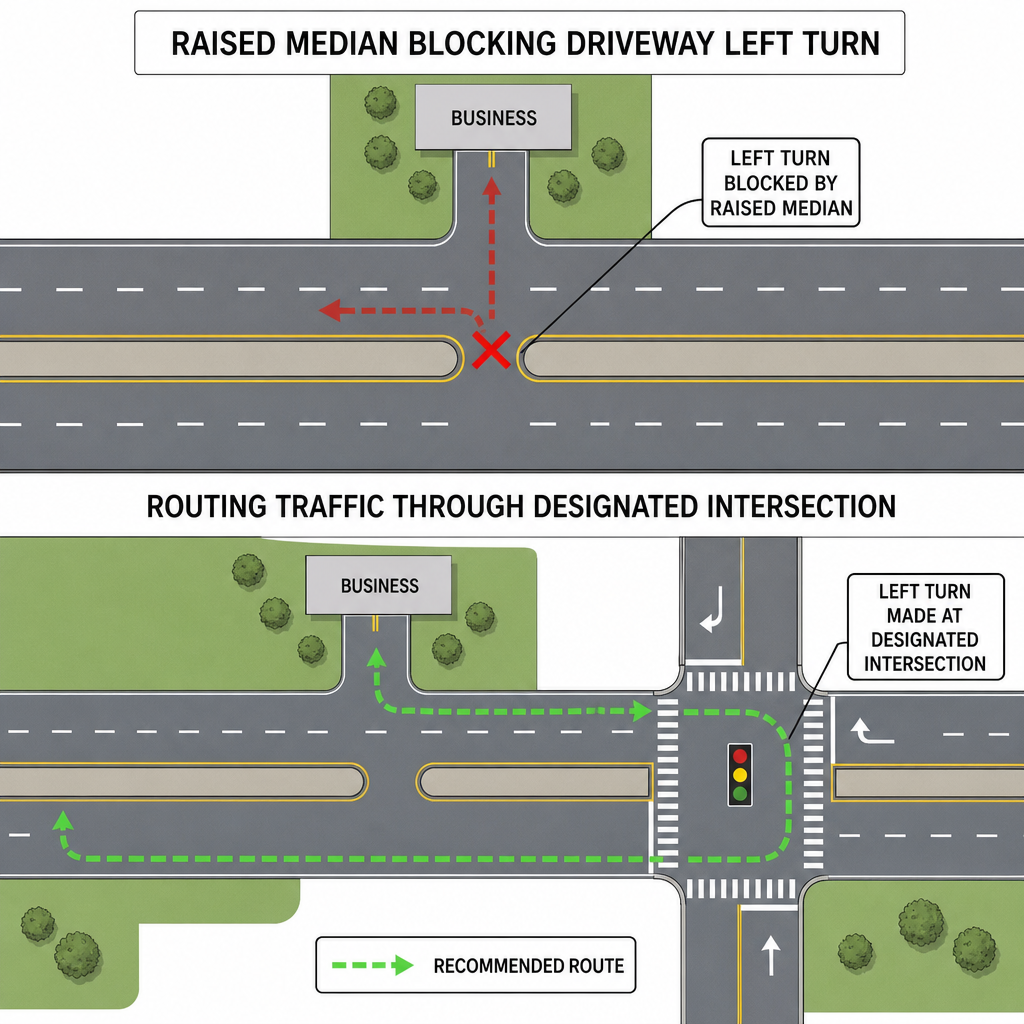
Raised medians separate opposing traffic and restrict certain turning movements across the roadway. Their safety purpose is to reduce conflict points: places where vehicles crossing, turning, or entering traffic can collide. Federal Highway Administration guidance identifies corridor access management as a proven safety countermeasure, with medians among the tools used to manage those conflicts. (highways.dot.gov)
Consider a driver leaving a driveway and attempting to turn left across several lanes. That maneuver requires judging traffic approaching from different directions. A median can prevent that direct crossing and route the driver toward an intersection or another designated turning location instead. The trade-off is straightforward: some trips become less direct, while fewer crossing movements occur at individual driveways.
That does not mean every median opening permits every maneuver. Treat the signs, lane arrows, and signals at each location as your instructions, and use only movements permitted there. Never assume an opening is an invitation to make a U-turn simply because your destination is on the opposite side. Ohio’s driving guidance explains the role of traffic signs and requires drivers to follow applicable traffic controls. (publicsafety.ohio.gov)
Business access may require a different approach
Access changes can be the most noticeable part of median projects for regular customers and delivery drivers. Transportation guidance acknowledges that raised medians can restrict direct left-turn access and require indirect routes to some properties. That makes the approach to a destination worth planning, not just the destination itself. Before visiting a business along the affected segment, use this practical planning checklist:
- Check The Entrance: Ask the business which driveway customers should use during construction.
- Confirm Your Approach: Ask whether approaching from a particular direction will make access easier.
- Plan The Return Trip: Consider how you will leave the property, especially if your usual route involved turning left.
- Prepare Delivery Instructions: Give drivers the business name, entrance location, and any confirmed access guidance before they arrive.
These are preparation steps, not a substitute for roadside directions. If an entrance is blocked or a planned turn is prohibited, continue along the signed route and reassess from a safe stopping place. Ohio’s rules-of-the-road guidance emphasizes following work-zone directions and staying out of areas closed by barriers, cones, or drums. (publicsafety.ohio.gov)
Work-zone driving calls for deliberate habits
During construction, the temporary layout deserves as much attention as the finished infrastructure improvements. Ohio’s traffic-safety guidance explains that work zones can involve lane shifts, narrow lanes, shoulder closures, reduced speeds, and equipment close to traffic. These are general work-zone possibilities, not a claim that every condition is present on South Limestone Street on a given day. (otso.ohio.gov) A safer approach begins before reaching the first barrel:
- Read Advance Warnings Early: Reduce speed and prepare for a changed traffic pattern rather than waiting until the lane narrows.
- Leave Room Ahead: Maintain enough space to respond if traffic brakes or stops unexpectedly.
- Limit Lane Changes: Choose your lane using posted directions and avoid unnecessary movement through restricted space.
- Follow Merge Instructions: Ohio guidance recommends following signs; when traffic backs up, drivers may be directed to use available lanes and take turns at the merge.
- Keep Distractions Out Of Reach. Set navigation before departure and leave messages unanswered until safely parked. (otso.ohio.gov)
Remain cautious even when workers are not visible. Altered lanes and roadway conditions still require attention, and Ohio guidance tells drivers to be ready for sudden stops. Follow directions from authorized personnel rather than trying to preserve your usual path through an intersection. (publicsafety.ohio.gov)
Pedestrian safety remains part of the picture
Street safety is not only about keeping vehicles moving. FHWA explains that appropriately designed medians and pedestrian refuge islands can help people cross wider roads in stages, reducing the number of traffic streams they must assess at once. However, a raised median is not automatically a designated pedestrian crossing or refuge. (highways.fhwa.dot.gov)
For drivers, the practical takeaway is to keep looking for people while preparing to turn, not just for gaps between vehicles. Ohio’s rules-of-the-road guidance addresses pedestrian right-of-way and emphasizes caution around people crossing the road. A turn should not become an opportunity to accelerate past someone approaching your path. (publicsafety.ohio.gov)
The city’s earlier South Limestone planning materials identified a safer corridor for pedestrians and motorists as a project goal. That background helps explain why traffic safety measures should be evaluated beyond pavement appearance or driving convenience alone. It does not establish which pedestrian features are included in the current construction contract; consult current project materials for those details. (springfieldohio.gov)
What should you do after a crash near construction?
After a crash, prioritize immediate safety, check for injuries, and contact emergency services if anyone is hurt. Ohio’s driver guidance advises moving vehicles out of traffic when a minor crash allows that to be done safely, remaining at the scene, and exchanging contact and insurance information. Notify the appropriate law-enforcement agency and avoid arguing about responsibility at the roadside. (publicsafety.ohio.gov)
Once immediate safety needs are addressed, record useful details without stepping into traffic or entering the work area. Note the location, direction of travel, weather, road conditions, and traffic controls. Collect witness contact information when available, and notify your insurer promptly. These details are consistent with Ohio’s recommended crash documentation.
If you choose to consult a Springfield car accident attorney, bring the information you collected and ask what additional records may be needed. Useful questions include how to preserve relevant evidence, how communications with insurers should be handled, and which deadlines require attention. Keep the discussion specific to your circumstances rather than assuming that construction alone answers who was responsible.
Make the new route part of your routine
The best preparation is simple: check ODOT’s current Clark County traffic notices, confirm access to your destination, and approach the corridor ready to follow the posted layout. The published construction window is useful background, but it is not a day-by-day lane-closure schedule. Use current notices to plan each trip.
Give yourself permission to miss a driveway rather than force a maneuver. Follow the signed route, find a safe place to reassess, and make the next approach calmly. Ohio’s work-zone guidance emphasizes alertness, space, and predictable driving, habits worth keeping after construction ends. (publicsafety.ohio.gov)
Call (937) 806-5791 or request a free consultation today to speak with our experienced Springfield car accident lawyers at Buckeye Law Group.
Legal Disclaimer: This article is provided by Buckeye Law Group for general educational and informational purposes and does not constitute individualized legal or medical advice. The content discusses Springfield, Ohio, roadway safety initiatives, South Limestone Street infrastructure improvements, local traffic conditions, motor vehicle accidents, and legal considerations involving personal injury claims. References to Ohio traffic laws, accident reporting procedures, insurance coverage, negligence, potential compensation, and filing deadlines are intended to help Springfield and Clark County residents better understand their legal rights and available resources following a car accident. Every personal injury case involves unique circumstances, and determining liability or eligibility for compensation requires an evaluation of the available evidence, applicable Ohio laws, and individual facts. Reading this article or contacting Buckeye Law Group’s Springfield car accident lawyers does not, by itself, establish an attorney-client relationship. Individuals seeking guidance about their specific circumstances should consult a qualified Ohio personal injury attorney. Past case results do not guarantee or predict future outcomes.
How Much Should an Insurance Company Pay for Injuries After a Car Accident?
After an Ohio car accident, an insurance company may offer a settlement before the full extent of your injuries, anticipated medical treatment, or long-term financial losses becomes clear. Ohio law
What Happens If an Insurance Company Won’t Offer a Fair Settlement After a Car Accident?
After an Ohio car accident, an insurance settlement offer may arrive while medical treatment continues and fault remains disputed. If the insurance company won’t offer a fair settlement, you do
Toledo’s Summit Street Cycle Track: What the 2026–2027 Redesign Means for Cyclist and Pedestrian Safety
Toledo’s Summit Street Cycle Track project is a two-phase reconstruction intended to make a section of North Summit Street safer and more connected for people walking and bicycling. In 2026,
Greater Dayton’s 2026 E-Bike and E-Moto Safety Proposal: What Ohio Riders and Parents Should Know
Electric bicycles and other small electric-powered vehicles are becoming increasingly common on roads, neighborhood streets, and recreational trails throughout Greater Dayton. Their growing use also raises important questions about rider
Dayton’s Keowee Street Safety Project: How Lane Reductions and New Walking Paths Could Improve Roadway Safety
Dayton’s Keowee Street safety project would reduce the roadway from seven lanes to five between East Fifth Street and East Monument Avenue, adding multi-use paths, landscaping, and signal upgrades. The
Dayton I-75 Construction in November 2026: Lane Closures, Traffic Shifts, and Work-Zone Safety
Motorists traveling along I-75 through Dayton, Ohio, in November 2026 should be aware of multiple construction projects that may affect travel times, lane configurations, and access to nearby interchanges. According
Columbus I-70/I-71 Construction in November 2026: Ramp Closures, Detours, and Driver Safety
Motorists traveling through downtown Columbus, Ohio, in November 2026 should prepare for temporary traffic disruptions as construction continues along the I-70/I-71 corridor. Overnight interstate restrictions, ramp closures, and designated detours
Mansfield’s Main Street Transformation: What Drivers and Pedestrians Should Know About Downtown Traffic Changes in 2026
As Mansfield completes its 2026 Main Street Transformation, residents and visitors should understand how the redesigned streets affect access to downtown businesses, public buildings, pedestrian crossings, and nearby parking areas.
Toledo’s Douglas Road and Monroe Street Intersection Improvements: What Drivers and Pedestrians Should Know in 2026
The City of Toledo identifies the Douglas Road and Monroe Street intersection as a 2026 improvement project intended to support pedestrian safety, driver safety, and better pavement conditions. For people
Springfield’s South Limestone Street Safety Improvements: What Drivers Should Know
South Limestone Street in Springfield, Ohio, is the focus of safety improvements intended to reduce conflicts between vehicles entering, leaving, and traveling along the corridor. The Ohio Department of Transportation’s

Buckeye Law Group represents people injured in auto accidents, slip and falls, workplace accidents and more in Ohio. Contact us today to learn more.
© 2026 All Rights Reserved | The Buckeye Law Group Inc. Privacy Policy Sitemap
Office Locations
- Akron Office 388 S Main St #400 Akron, OH 44311 (330) 426-0288
- Cincinnati Office 201 E 5th St Ste 1910 Cincinnati, OH 45202 (513) 547-2445
- Cleveland Office 127 Public Square Ste 1540 Cleveland, OH 44114 (216) 677-5490
- Columbus Office 20 E Broad St Suite 300 Columbus, OH 43215 (614) 482-3793
- Dayton Office 70 Birch Alley Ste 240 Dayton, OH 45440 (937) 884-4474
- Euclid Office 25701 N Lakeland Blvd Suite 113-C, Cleveland, OH 44132 (216) 405-2626
- Mansfield Office 305 E Main St Ste 6A, Mansfield, OH 44904 (567) 210-2606
- Findlay Office 7430 Timberstone Dr unit 101a, Findlay, OH 45840 419-873-5119
- Mentor Office 7537 Mentor Ave Ste 101, Mentor, OH 44060 (440) 306-3536
- Middletown Office 300 N Main St #400, Middletown, OH 45042 (326) 800-9150
- Parma Office 1257 Rockside Rd #A, Parma, OH 44131 (216) 279-1664
- Springfield Office 2100 E High St Ste TL3, Springfield, OH 45505 (937) 806-5791
- Toledo Office 3950 Sunforest Ct Ste 200, Toledo, OH 43623 (567) 483-3883
- Westlake Office 26404 Center Ridge Rd Ste B2, Westlake, OH 44145 216-247-0565
- Whitehall Office 5340 E Main St Ste 203, Whitehall, OH 43213 (380) 257-5206
- Youngstown Office 306 Churchill Hubbard Rd, Youngstown, OH 44505 (234) 225-0683
Contact Us
© 2026 All Rights Reserved | The Buckeye Law Group Inc. Privacy Policy Sitemap