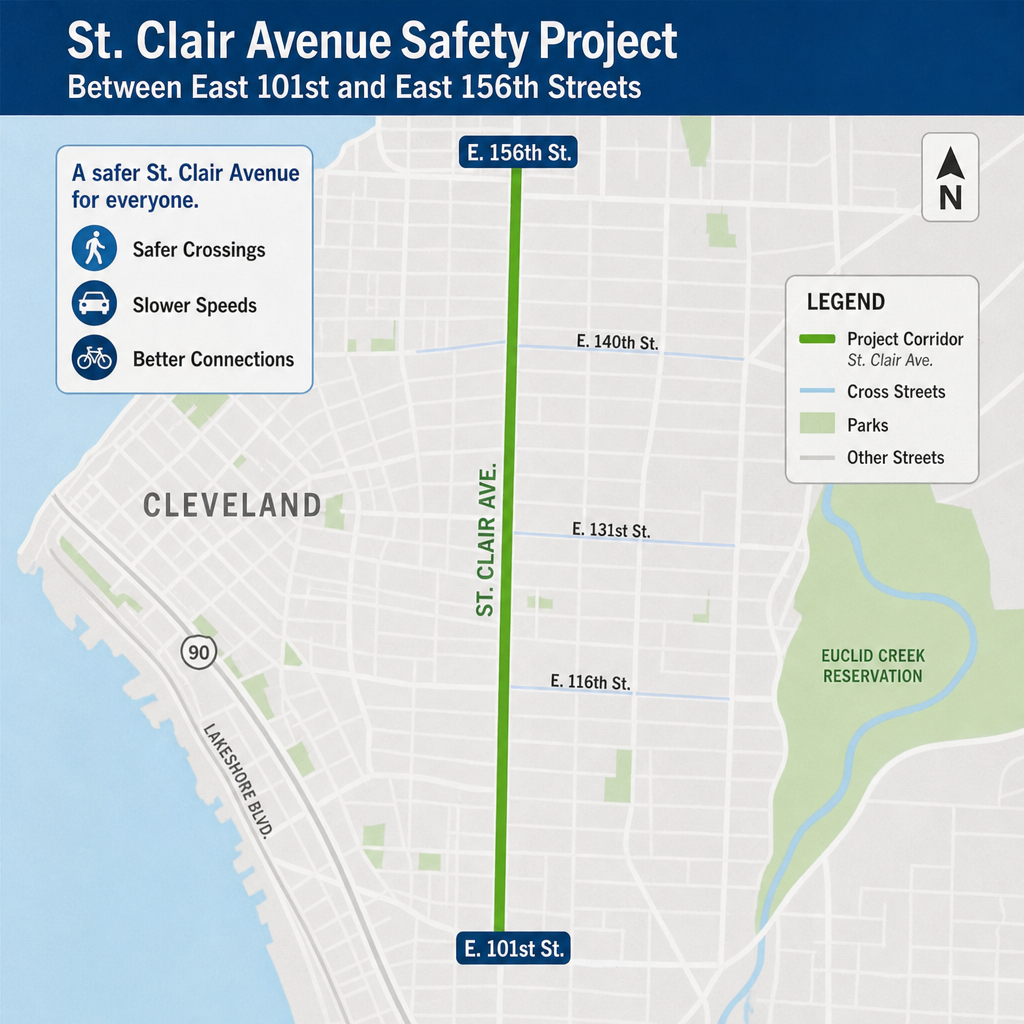
St. Clair Avenue’s danger comes into focus when you look beyond fender-benders to deaths and life-changing injuries. Cleveland reports at least 14 people killed and 79 seriously injured between East 101st and East 156th Streets from 2020 through 2024. The city’s response centers on redesigning the street—not simply asking everyone to drive more carefully. Here is what the numbers, proposed changes, and Ohio injury-claim rules mean for people using the corridor.
Call (216) 677-5490 or request a free consultation today to speak with an experienced Cleveland car accident attorney at Buckeye Law Group.
Why is St. Clair Avenue so dangerous?
St. Clair combines a documented concentration of severe crashes with conditions the city intends to address through speed management, intersection changes, and safer crossings. Cleveland identifies the East 101st–East 156th project area as containing its two deadliest intersections for traffic crashes. That makes St. Clair safety a concern for everyone traveling through the corridor, whether driving, walking, cycling, or reaching a bus stop.
Road layout matters because it influences everyday decisions. On a four-lane, undivided roadway, a driver waiting to turn left can interrupt through traffic, prompting abrupt braking or lane changes. Federal Highway Administration guidance explains that these arrangements create opportunities for rear-end, left-turn, and sideswipe crashes. A road diet addresses those conflicts by separating turning vehicles from through traffic.
For someone crossing the street, multiple travel lanes create another problem: one driver may stop while a driver in the adjacent lane continues. FHWA identifies this as a multiple-threat crossing risk and explains how reducing lanes can improve pedestrian safety. The practical lesson is that a clear-looking lane does not necessarily mean the whole crossing is clear.
What safety improvements are planned for St. Clair Avenue?
Cleveland’s published scope includes fewer vehicle lanes with a center turn lane, changes at high-crash intersections, raised crosswalks, pedestrian refuge islands, separated bike lanes, and bus boarding islands. Detailed design began in fall 2025. The project page describes design work and conceptual plans, not a completed corridor-wide installation or a confirmed opening date.
A road diet targets turning and lane-changing conflicts
A typical four-to-three-lane road diet creates one through lane in each direction and a center two-way left-turn lane. This gives turning drivers somewhere to wait without blocking a through lane and reduces the incentive to weave around stopped vehicles. FHWA research reports overall crash reductions of 19%–47% for studied conversions of previously four-lane, undivided roads. That range is evidence supporting the approach, not a guaranteed reduction for St. Clair.
Measuring success requires more than new pavement markings
Residents should look for evidence that the redesign changes actual outcomes, not just the street’s appearance. FHWA recommends evaluating crash frequency and severity alongside operational measures after a road diet. Useful questions include whether serious injuries decline, vehicle speeds become more consistent, and people can navigate crossings more safely.
A short period without a serious crash is encouraging, but it is not enough to establish long-term effectiveness. FHWA’s evaluation guidance calls for multiple years of before-and-after crash and traffic-volume data. That distinction matters when judging whether St. Clair traffic changes are delivering durable benefits rather than a temporary fluctuation.
Practical habits for traveling the corridor
Infrastructure improvements and personal precautions serve different purposes. A redesign can reduce recurring conflicts, while an individual traveler still needs to respond to the conditions immediately ahead. Ohio’s driver guidance emphasizes maintaining space, observing traffic, and responding safely to hazards; use those principles rather than assuming familiarity makes a route predictable. Build a simple routine around the corridor’s turning and crossing conflicts:
- Leave A Braking Cushion: Give yourself room to respond when a vehicle slows or stops to turn.
- Avoid Sudden Moves Around Stopped Traffic: A stopped vehicle may conceal someone crossing or another developing hazard.
- Check The Whole Crossing: Do not interpret one driver yielding as confirmation that every lane is safe.
- Expect Changing Layouts: Where work or new markings are present, follow posted directions rather than habit. These precautions address the lane-changing and crossing conflicts described in FHWA guidance.
How do Ohio injury claims apply after a St. Clair crash?
A crash on a dangerous road does not automatically establish who owes compensation. The claim still depends on the conduct of those involved, how that conduct contributed to the collision, and the resulting losses. Ohio’s Department of Insurance explains that even a traffic ticket does not necessarily establish complete responsibility; investigators may consider whether multiple people shared fault.
Shared fault does not always prevent recovery
Under Ohio Revised Code Section 2315.33, an injured person can recover when their fault is not greater than the combined fault of the other responsible parties. Recovery is reduced proportionately. In ordinary percentage terms, 50% fault can still permit recovery; more than 50% bars recovery under this rule. This distinction matters when an insurer argues that an injured driver, cyclist, or pedestrian contributed to the collision.
The filing deadline is not an insurance-reporting deadline
Ohio generally requires a bodily-injury lawsuit within two years after the claim accrues, usually when the injury occurs. Exceptions can affect the calculation, so obtain advice about your specific circumstances. Reporting a collision to an insurer is different from filing a lawsuit; ask a Cleveland personal injury attorney to identify the applicable deadline rather than assuming ongoing discussions protect it.
Protect your health and preserve useful evidence
After a collision, prioritize emergency assistance and avoid exposing yourself to moving traffic to collect evidence. Ohio State Bar Association guidance recommends recording information about the people involved, obtaining witness contacts, and photographing the scene when safe. A useful record captures more than vehicle damage: markings, signals, sightlines, and vehicle positions can help explain how events unfolded. When circumstances allow:
- Request emergency help for injuries and follow responders’ directions.
- Exchange identifying and insurance information and obtain witness contact details.
- Photograph the wider scene safely, including vehicle positions, road markings, signals, and visible damage.
- Keep loss documentation together, including medical bills, treatment records, repair information, and employer documentation of missed earnings.
If you consult a Cleveland car accident attorney, bring those materials and a factual timeline. Ask how disputed fault will be evaluated, what additional evidence may be needed, and how fees work. A Cleveland auto accident lawyer can help assess a serious-injury claim, but the corridor’s reputation alone cannot substitute for evidence or guarantee an outcome. Ohio’s insurance regulator specifically identifies serious injuries as a reason legal assistance may be needed.
Cleveland and St. Clair Avenue Accident Resources: Police, Crash Reports, and Local Courts
People involved in traffic collisions along St. Clair Avenue between East 101st and East 156th Streets may need assistance obtaining police reports, locating court records, or understanding how civil injury claims are handled in Cuyahoga County. The following Cleveland-area resources provide official information to help residents take informed steps after an accident.
Cleveland Division of Police: Fifth District
Address: 881 East 152nd Street, Cleveland, OH 44110
Phone: (216) 623-5500
Non-emergency police assistance: (216) 621-1234
The Cleveland Division of Police’s Fifth District station is located near the eastern end of the St. Clair Avenue improvement corridor. Residents can contact Cleveland police for non-emergency assistance and questions concerning local incidents.
For an existing crash report, identify the investigating agency and obtain the incident or report number when available. The Fifth District station should not automatically be assumed to have investigated every collision along St. Clair Avenue. Official Cleveland Police District Directory City of Cleveland, Ohio.
Cleveland Police Public Records and Accident Reports
Address: Justice Center, 1300 Ontario Street, Cleveland, OH 44113
Accident Records Unit: (216) 623-5269
Individuals seeking documentation of a Cleveland traffic collision can request records through the Cleveland Division of Police. Depending on availability and applicable public-records rules, relevant materials may include the crash report and other records maintained by the department.
The department provides public-records services and accepts requests for accident reports. Before submitting a request, gather the collision date, approximate time, location, and any available report number to help identify the correct incident. Official Cleveland Police Public Records Requests.
Ohio Department of Public Safety: Online Crash Report Search
Ohio residents can also search for collision documentation through the state’s online crash-report system. The database allows searches using a crash number or additional information such as the crash date, county, and investigating agency.
An important distinction is that reports obtained through this state database are provided for statistical purposes and are not official copies for court proceedings. Reports may take up to six weeks to appear. For an official report and available supplements, contact the investigating law enforcement agency. Ohio Department of Public Safety Crash Report Search
Cleveland Municipal Court: Civil Division
Address: 1200 Ontario Street, Level 2, Cleveland, OH 44113
Phone: (216) 664-4870
Cleveland Municipal Court handles qualifying civil matters within its territorial and monetary jurisdiction. Its Civil Division generally accepts cases seeking $15,000 or less in damages, while its Small Claims Division has a $6,000 limit.
Understanding these limits can help accident victims distinguish municipal court matters from larger personal injury lawsuits. However, the appropriate court depends on the nature of the dispute, the parties, jurisdictional requirements, and the relief sought.
Cuyahoga County Court of Common Pleas: Civil Division
Clerk of Courts Address: Justice Center, 1200 Ontario Street, First Floor, Cleveland, OH 44113
Civil Division Phone: (216) 443-7974
The Cuyahoga County Court of Common Pleas has jurisdiction over civil cases involving amounts exceeding $15,000. Serious personal injury lawsuits arising from Cleveland traffic collisions may be filed in this court when applicable jurisdictional and venue requirements are satisfied.
The Clerk of Courts maintains case records, accepts filings, and provides information about court procedures. Injured individuals should understand that filing a police report or communicating with an insurance company does not replace the legal requirements for timely filing a civil lawsuit.
City of Cleveland: St. Clair Avenue Safety Improvement Project
Residents interested in the corridor’s proposed safety improvements can review the City of Cleveland’s official St. Clair Avenue project page. The resource includes information about proposed roadway reconfiguration, intersection modifications, pedestrian improvements, and bicycle infrastructure. Reviewing the city’s plans can help residents distinguish proposed safety measures from completed construction and understand how roadway design may change along the corridor.
St. Clair Avenue Traffic Safety Improvements and Your Legal Rights After a Cleveland Car Accident
St. Clair Avenue’s history of fatal and serious-injury crashes highlights the importance of Cleveland’s proposed roadway safety improvements. Changes to traffic lanes, turning movements, pedestrian crossings, and bicycle infrastructure aim to reduce documented hazards between East 101st and East 156th Streets. Evaluating these improvements through long-term crash data will be essential to determining their effectiveness. For Cleveland motorists, pedestrians, and cyclists, understanding local traffic risks and exercising caution remain important. Following a collision, individuals should prioritize medical attention, obtain available police reports, preserve relevant evidence, and document injury-related expenses.
Under Ohio law, injured individuals generally have two years to file a personal injury lawsuit, although exceptions may apply. Consulting a Cleveland personal injury attorney can help clarify liability, insurance coverage, and applicable legal deadlines. Buckeye Law Group encourages Cleveland residents to stay informed about roadway improvements and understand their legal options following a serious traffic accident.
Call (216) 677-5490 or request a free consultation today to speak with an experienced Cleveland car accident attorney at Buckeye Law Group.
Legal Disclaimer: This article is provided by Buckeye Law Group for general educational and informational purposes and does not constitute individualized legal or medical advice. The content discusses Cleveland, Ohio, roadway safety initiatives, local traffic conditions, car accidents, and legal considerations involving motor vehicle accident claims. References to Ohio traffic laws, accident reporting procedures, insurance coverage, negligence, potential compensation, and filing deadlines are intended to help Cleveland and Cuyahoga County residents better understand their legal rights and available resources following a car accident. Every car accident case involves unique circumstances, and determining liability or eligibility for compensation requires a careful evaluation of the available evidence, applicable Ohio laws, and individual facts. Reading this article or contacting Buckeye Law Group’s Cleveland car accident attorneys does not, by itself, establish an attorney-client relationship. Individuals seeking guidance regarding injuries, insurance disputes, or potential compensation following a collision should consult a qualified Ohio car accident attorney. Past case results do not guarantee or predict future outcomes.
What Greater Akron’s latest crash data reveals about roadway safety and serious injuries
Greater Akron’s latest regional crash report shows fewer crashes overall, but serious injuries remain a concern. The Akron Metropolitan Area Transportation Study’s 2022–2024 analysis separates encouraging declines in fatalities from
Why Is St. Clair Avenue One of Cleveland’s Most Dangerous Roads? Crash Data and Safety Improvements Explained
St. Clair Avenue’s danger comes into focus when you look beyond fender-benders to deaths and life-changing injuries. Cleveland reports at least 14 people killed and 79 seriously injured between East
Dayton’s 2026 Road Safety Action Plan: What Local Crash Data Reveals About Dangerous Driving Conditions
The City of Dayton, Ohio, has adopted a comprehensive Safe Streets and Roads for All (SS4A) Safety Action Plan to address traffic fatalities, serious injuries, and hazardous roadway conditions throughout
Cleveland’s 2026 Daylight Saving Time Change: Earlier Darkness, Pedestrian Safety, and Ohio Traffic Laws
Cleveland’s daylight saving time ends on Sunday, November 1, 2026, at 2:00 a.m., when clocks move backward one hour and Northeast Ohio returns to Eastern Standard Time (EST). While the
Halloween Weekend 2026 in Dayton: Impaired Driving Risks, Free Rideshare Resources, and Ohio Accident Laws
Halloween weekend brings celebrations throughout Dayton, Ohio, but increased nighttime traffic, pedestrians, and alcohol-related activities also create important safety concerns. Whether you are attending an event in downtown Dayton, visiting
Halloween Pedestrian Safety Near Ohio State University: Columbus Crosswalk Laws, Accident Risks, and What to Do If You’re Injured
Halloween weekend brings students, residents, and visitors throughout Columbus, particularly around The Ohio State University and the surrounding University District. As people travel between campus, restaurants, residential neighborhoods, and entertainment
Can You Pursue Compensation for a Traumatic Brain Injury After an Ohio Car Accident?
A traumatic brain injury sustained in an Ohio car accident can have significant and lasting consequences for an individual’s health, financial stability, and quality of life. When another party’s negligence
How Long After a Car Accident Can Concussion Symptoms Appear?
A concussion can cause symptoms immediately after a crash or several hours or days later. Sometimes a person first recognizes changes in sleep, mood, concentration, or memory a week or
Not at Fault in a Columbus Car Accident? What Ohio Drivers Should Do Next
Following a car accident in Columbus, Ohio, that may have been caused by another driver’s negligence, taking appropriate steps can help protect your health, preserve important evidence, and safeguard your
Is Personal Injury Mediation Legally Binding in Ohio?
Personal injury mediation in Ohio does not automatically create a binding outcome, but a settlement reached through mediation can be legally enforceable. The distinction is between negotiating a resolution and

Buckeye Law Group represents people injured in auto accidents, slip and falls, workplace accidents and more in Ohio. Contact us today to learn more.
© 2026 All Rights Reserved | The Buckeye Law Group Inc. Privacy Policy Sitemap
Office Locations
- Akron Office 388 S Main St #400 Akron, OH 44311 (330) 426-0288
- Cincinnati Office 201 E 5th St Ste 1910 Cincinnati, OH 45202 (513) 547-2445
- Cleveland Office 127 Public Square Ste 1540 Cleveland, OH 44114 (216) 677-5490
- Columbus Office 20 E Broad St Suite 300 Columbus, OH 43215 (614) 482-3793
- Dayton Office 70 Birch Alley Ste 240 Dayton, OH 45440 (937) 884-4474
- Euclid Office 25701 N Lakeland Blvd Suite 113-C, Cleveland, OH 44132 (216) 405-2626
- Mansfield Office 305 E Main St Ste 6A, Mansfield, OH 44904 (567) 210-2606
- Findlay Office 7430 Timberstone Dr unit 101a, Findlay, OH 45840 419-873-5119
- Mentor Office 7537 Mentor Ave Ste 101, Mentor, OH 44060 (440) 306-3536
- Middletown Office 300 N Main St #400, Middletown, OH 45042 (326) 800-9150
- Parma Office 1257 Rockside Rd #A, Parma, OH 44131 (216) 279-1664
- Springfield Office 2100 E High St Ste TL3, Springfield, OH 45505 (937) 806-5791
- Toledo Office 3950 Sunforest Ct Ste 200, Toledo, OH 43623 (567) 483-3883
- Westlake Office 26404 Center Ridge Rd Ste B2, Westlake, OH 44145 216-247-0565
- Whitehall Office 5340 E Main St Ste 203, Whitehall, OH 43213 (380) 257-5206
- Youngstown Office 306 Churchill Hubbard Rd, Youngstown, OH 44505 (234) 225-0683
Contact Us
© 2026 All Rights Reserved | The Buckeye Law Group Inc. Privacy Policy Sitemap