Greater Akron’s latest regional crash report shows fewer crashes overall, but serious injuries remain a concern. The Akron Metropolitan Area Transportation Study’s 2022–2024 analysis separates encouraging declines in fatalities from increases in serious injury crashes. For Akron residents, understanding roadway safety requires looking beyond overall crash statistics. Where accidents occur, the severity of resulting injuries, and whether roadway improvements address documented crash patterns are all important considerations. (amatsplanning.org)
Call (330) 426-0288 or request a free consultation today to speak with an experienced Akron auto accident lawyer at Buckeye Law Group.
What does Greater Akron’s latest crash data show?
As of November 2, 2026, AMATS lists its 2022–2024 Annual Crash Report as its latest regional crash report. It covers Summit and Portage counties and northeastern Wayne County, not just Akron city limits. That distinction matters when comparing regional findings with city-only statistics or reports covering different years. (amatsplanning.org)
The central trends point in different directions:
| Measure | Earlier Figure | 2024 Figure | Meaning |
|---|---|---|---|
| Total Regional Crashes | 16,563 in 2022 | 14,968 | Fewer reported crashes overall |
| Traffic Fatalities | 69 in 2023 | 51 | Fewer people killed year over year |
| Serious Injury Crashes | 324 in 2023 | 345 | More crashes causing incapacitating injuries |
| People Seriously Injured | 396 in 2023 | 405 | More people experiencing serious harm |
AMATS reports these crash and injury counts separately because one collision can injure multiple people. Crashes and injured people are not interchangeable measures. The figures 333 in 2022 and 405 in 2024 describe people seriously injured, rather than serious injury crashes. Keeping those categories straight prevents misleading comparisons.
AMATS suggests targeted safety projects and newer vehicle safety features may be helping reduce overall crashes. That is a possible explanation, not proof that any single intervention caused the regional decline. The increase in serious injuries is a reason to keep examining outcomes rather than declaring the roads safe based on total crashes alone. (hudson.oh.us)
Akron locations that deserve closer attention
Four roadway segments in Akron rank among the ten highest-ranked high-crash segments identified in the regional report. Understanding the precise boundaries of these segments is important, as crash data associated with one section of a roadway should not automatically be considered representative of the entire road. (amatsplanning.org)
- North Main Street: Olive Street west to East Tallmadge Avenue, ranked third regionally.
- Copley Road: East Avenue to Diagonal Road/South Portage Path, ranked eighth.
- North Portage Path: Garman Road to Merriman Road, ranked ninth.
- Copley Road: Storer Avenue to East Avenue, ranked tenth.
At the intersection level, Rhodes Avenue and West Thornton Street ranked first regionally. Signal Akron’s account of the analysis identified 26 crashes there, with nearly 60% involving injury. Riverview and Ira roads in Cuyahoga Falls ranked second. (signalakron.org)
These rankings are planning tools, not predictions that a particular trip will end in a crash. AMATS uses high-crash findings to help communities identify safety needs and pursue improvement funding. For residents seeking action, naming the specific intersection or segment makes a concern easier to connect with that process.
Are Akron’s road diets reducing crashes and serious injuries?
Akron-area road diets have reduced injury crashes at many studied locations, but the results are not uniform, and fewer injury crashes do not automatically mean fewer serious injury crashes. Signal Akron’s October 2026 coverage of AMATS’ road diet analysis reported reductions in injury crashes at 13 of 16 studied locations, while total crashes declined at nine. (signalakron.org)
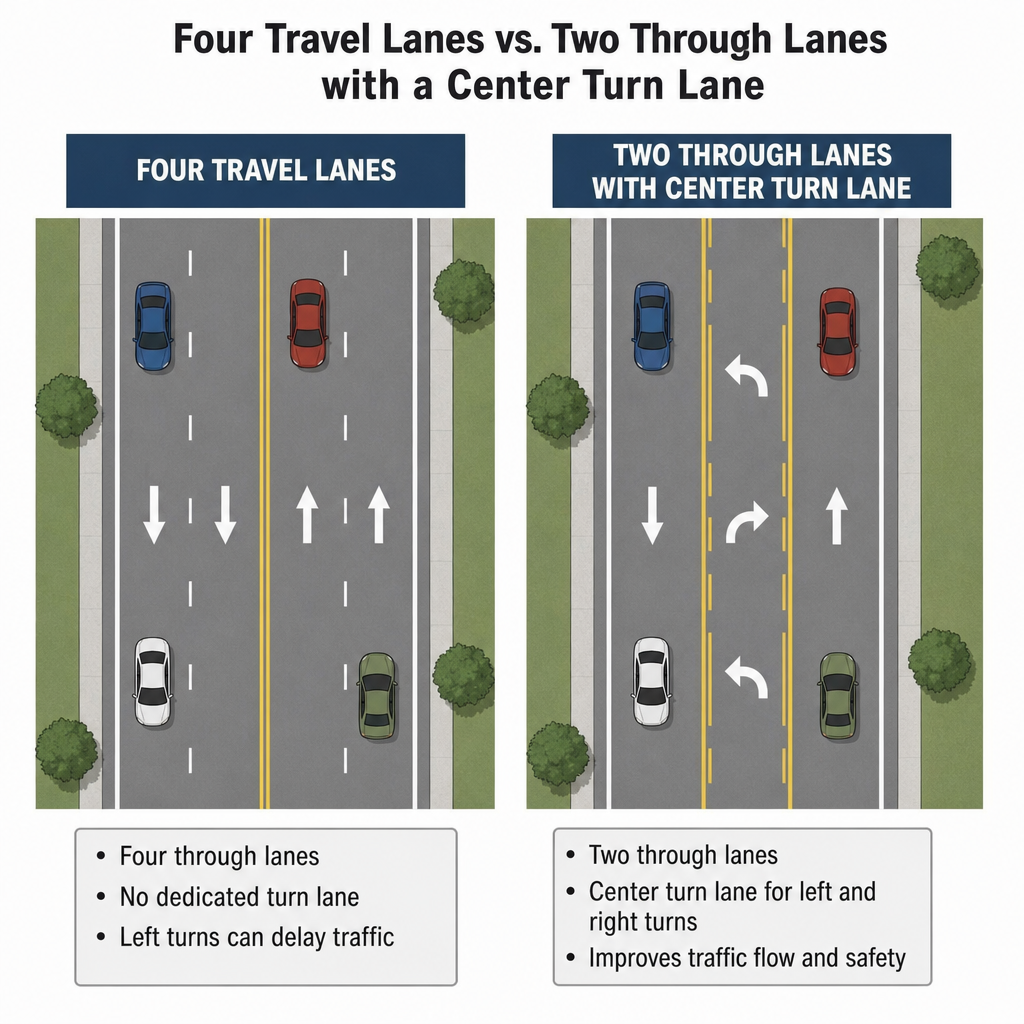
A typical road diet converts four undivided travel lanes into one through lane in each direction plus a center two-way left-turn lane. Available space may support bicycle lanes, pedestrian refuge islands, or other uses. The purpose is to reorganize traffic movements, not simply remove pavement from drivers. (highways.dot.gov)
The center turn lane separates vehicles waiting to turn left from through traffic. Fewer through lanes can also limit weaving and reduce speed differences between vehicles. Those changes address conflicts associated with rear-end, sideswipe, and turning crashes.
Local outcomes illustrate why follow-up matters. West Exchange Street between Rhodes Avenue and South Broadway Street experienced a total crash reduction exceeding 50%. By contrast, Signal Akron reported an increase exceeding 147% on the studied East Market Street segment between Case Avenue and Cook Street.
Neither example establishes what every redesign will accomplish. Small underlying crash counts can produce large percentage changes, and the local analysis did not demonstrate broad reductions in serious injury crashes. The useful question is whether a specific project reduces the conflicts and injury outcomes occurring at that location, not whether road diets should receive blanket praise or blame.
Persistent safety concerns need location-specific responses
Memorial Parkway illustrates the gap between a regional trend and everyday experience. In October 2026, News 5 reported that Akron police counted 97 crashes on the parkway since 2024, including 15 involving injuries. Residents described concerns about speeding, crossings, and children traveling near school. (news5cleveland.com)
The same reporting described federally supported plans to study the corridor and gather public input. A study is an opportunity to investigate conditions and recommend changes; it is not evidence that a particular redesign has already been selected or completed. When reviewing traffic incident data or submitting comments, residents can make the discussion more useful by asking for:
- Precise Locations: Identify the crossing, driveway, curve, or intersection rather than describing the whole corridor as dangerous.
- Separate Severity Totals: Request property-damage, injury, serious injury, and fatal crash figures instead of one combined number.
- Clear Evaluation Periods: Ask which years establish the baseline and when officials will review conditions after improvements.
A speeding complaint should also prompt investigation rather than an assumption that every nearby collision involved speed. Ohio crash reports distinguish contributing circumstances such as unsafe speed, failure to yield, improper turns, and vision obstruction. Identifying the actual pattern helps keep proposed responses tied to evidence. (ohioattorneygeneral.gov)
How does crash data affect an injury claim?
Regional statistics provide context, but an individual injury claim depends on the evidence surrounding that collision. A high-crash ranking does not automatically establish who was negligent, and even a traffic citation does not necessarily settle every question of fault. Ohio’s Department of Insurance explains that responsibility may be shared based on the circumstances. (insurance.ohio.gov)
That distinction matters when speaking with an Akron auto accident attorney. The discussion should focus on what happened in your crash and how responsibility will be evaluated, not on treating a dangerous-road designation as proof that someone owes compensation.
Ohio generally allows an injured person to recover damages when their fault is not greater than the combined fault of the other responsible people. Recoverable compensatory damages are reduced proportionately by the injured person’s share of fault. Disputed responsibility can therefore have practical consequences for a claim. (codes.ohio.gov)
Serious injuries are also a reason to consider individualized legal guidance. The Ohio Department of Insurance notes that people with serious injuries may need a lawyer when dealing with an insurer. An Akron car accident lawyer or Akron personal injury attorney can discuss the circumstances of your claim; a regional trend cannot predict its outcome.
Practical steps after an Akron collision
Prioritize safety and assistance before collecting evidence. Ohio’s Department of Public Safety advises checking for injuries, requesting help, gathering information, and notifying your insurer. Its guidance also emphasizes recording the circumstances rather than debating fault at the scene. (publicsafety.ohio.gov)
- Check for injuries and request assistance. Keep immediate safety ahead of insurance paperwork.
- Exchange identifying information. Collect driver, vehicle, owner, and insurance details, along with witness contact information.
- Record the circumstances. Note the sequence of events, weather, road conditions, and traffic controls.
- Cooperate with investigating officers. Answer their questions without speculating about facts you do not know.
- Notify your insurer promptly. Keep the information you collected available for the claims process.
The takeaway: measure safety by harm prevented
Greater Akron’s falling crash totals are encouraging, but rising serious injury counts show why the work is unfinished. Road diets offer promising local results without guaranteeing the same outcome everywhere. A more effective approach involves evaluating location-specific crash data, monitoring the effectiveness of roadway safety improvements, and examining the unique circumstances of each serious collision rather than relying solely on regional crash statistics.
Call (330) 426-0288 or request a free consultation today to speak with an experienced Akron auto accident lawyer at Buckeye Law Group.
Legal Disclaimer: This article is provided by Buckeye Law Group for general educational and informational purposes and does not constitute individualized legal or medical advice. The content discusses Akron, Ohio, roadway safety initiatives, local traffic conditions, motor vehicle accidents, and legal considerations involving car accident injury claims. References to Ohio traffic laws, accident reporting procedures, insurance coverage, negligence, potential compensation, and filing deadlines are intended to help Akron and Summit County residents better understand their legal rights and available resources following a motor vehicle accident. Every car accident claim involves unique circumstances, and determining liability or eligibility for compensation requires a careful evaluation of the available evidence, applicable Ohio laws, and specific facts of the case. Reading this article or contacting Buckeye Law Group’s Akron auto accident lawyers does not, by itself, establish an attorney-client relationship. Individuals seeking guidance about their circumstances should consult a qualified Ohio personal injury attorney. Past case results do not guarantee or predict future outcomes.
What Greater Akron’s latest crash data reveals about roadway safety and serious injuries
Greater Akron’s latest regional crash report shows fewer crashes overall, but serious injuries remain a concern. The Akron Metropolitan Area Transportation Study’s 2022–2024 analysis separates encouraging declines in fatalities from
Why Is St. Clair Avenue One of Cleveland’s Most Dangerous Roads? Crash Data and Safety Improvements Explained
St. Clair Avenue’s danger comes into focus when you look beyond fender-benders to deaths and life-changing injuries. Cleveland reports at least 14 people killed and 79 seriously injured between East
Dayton’s 2026 Road Safety Action Plan: What Local Crash Data Reveals About Dangerous Driving Conditions
The City of Dayton, Ohio, has adopted a comprehensive Safe Streets and Roads for All (SS4A) Safety Action Plan to address traffic fatalities, serious injuries, and hazardous roadway conditions throughout
Cleveland’s 2026 Daylight Saving Time Change: Earlier Darkness, Pedestrian Safety, and Ohio Traffic Laws
Cleveland’s daylight saving time ends on Sunday, November 1, 2026, at 2:00 a.m., when clocks move backward one hour and Northeast Ohio returns to Eastern Standard Time (EST). While the
Halloween Weekend 2026 in Dayton: Impaired Driving Risks, Free Rideshare Resources, and Ohio Accident Laws
Halloween weekend brings celebrations throughout Dayton, Ohio, but increased nighttime traffic, pedestrians, and alcohol-related activities also create important safety concerns. Whether you are attending an event in downtown Dayton, visiting
Halloween Pedestrian Safety Near Ohio State University: Columbus Crosswalk Laws, Accident Risks, and What to Do If You’re Injured
Halloween weekend brings students, residents, and visitors throughout Columbus, particularly around The Ohio State University and the surrounding University District. As people travel between campus, restaurants, residential neighborhoods, and entertainment
Can You Pursue Compensation for a Traumatic Brain Injury After an Ohio Car Accident?
A traumatic brain injury sustained in an Ohio car accident can have significant and lasting consequences for an individual’s health, financial stability, and quality of life. When another party’s negligence
How Long After a Car Accident Can Concussion Symptoms Appear?
A concussion can cause symptoms immediately after a crash or several hours or days later. Sometimes a person first recognizes changes in sleep, mood, concentration, or memory a week or
Not at Fault in a Columbus Car Accident? What Ohio Drivers Should Do Next
Following a car accident in Columbus, Ohio, that may have been caused by another driver’s negligence, taking appropriate steps can help protect your health, preserve important evidence, and safeguard your
Is Personal Injury Mediation Legally Binding in Ohio?
Personal injury mediation in Ohio does not automatically create a binding outcome, but a settlement reached through mediation can be legally enforceable. The distinction is between negotiating a resolution and

Buckeye Law Group represents people injured in auto accidents, slip and falls, workplace accidents and more in Ohio. Contact us today to learn more.
© 2026 All Rights Reserved | The Buckeye Law Group Inc. Privacy Policy Sitemap
Office Locations
- Akron Office 388 S Main St #400 Akron, OH 44311 (330) 426-0288
- Cincinnati Office 201 E 5th St Ste 1910 Cincinnati, OH 45202 (513) 547-2445
- Cleveland Office 127 Public Square Ste 1540 Cleveland, OH 44114 (216) 677-5490
- Columbus Office 20 E Broad St Suite 300 Columbus, OH 43215 (614) 482-3793
- Dayton Office 70 Birch Alley Ste 240 Dayton, OH 45440 (937) 884-4474
- Euclid Office 25701 N Lakeland Blvd Suite 113-C, Cleveland, OH 44132 (216) 405-2626
- Mansfield Office 305 E Main St Ste 6A, Mansfield, OH 44904 (567) 210-2606
- Findlay Office 7430 Timberstone Dr unit 101a, Findlay, OH 45840 419-873-5119
- Mentor Office 7537 Mentor Ave Ste 101, Mentor, OH 44060 (440) 306-3536
- Middletown Office 300 N Main St #400, Middletown, OH 45042 (326) 800-9150
- Parma Office 1257 Rockside Rd #A, Parma, OH 44131 (216) 279-1664
- Springfield Office 2100 E High St Ste TL3, Springfield, OH 45505 (937) 806-5791
- Toledo Office 3950 Sunforest Ct Ste 200, Toledo, OH 43623 (567) 483-3883
- Westlake Office 26404 Center Ridge Rd Ste B2, Westlake, OH 44145 216-247-0565
- Whitehall Office 5340 E Main St Ste 203, Whitehall, OH 43213 (380) 257-5206
- Youngstown Office 306 Churchill Hubbard Rd, Youngstown, OH 44505 (234) 225-0683
Contact Us
© 2026 All Rights Reserved | The Buckeye Law Group Inc. Privacy Policy Sitemap