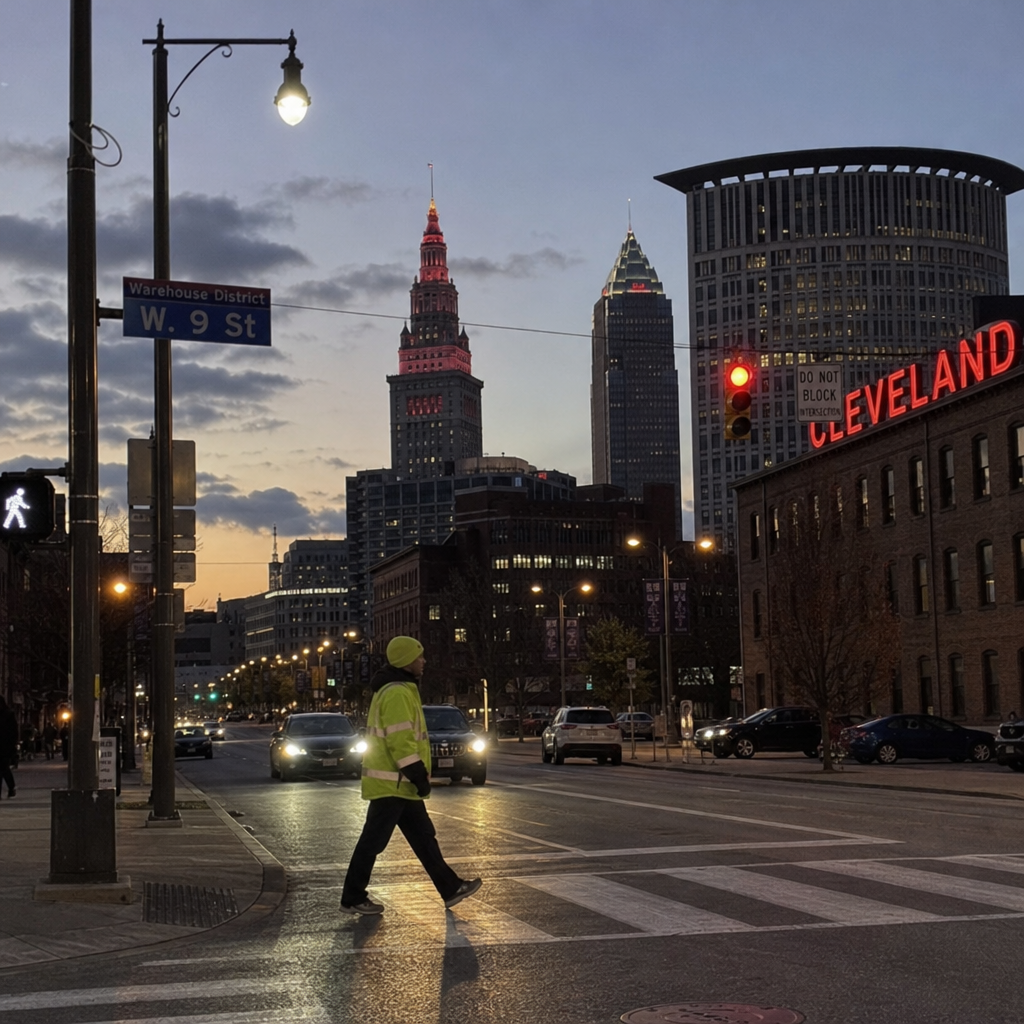
Cleveland’s daylight saving time ends on Sunday, November 1, 2026, at 2:00 a.m., when clocks move backward one hour and Northeast Ohio returns to Eastern Standard Time (EST). While the adjustment provides an additional hour on the clock, it also brings earlier evening darkness, changing visibility conditions for drivers, pedestrians, and bicyclists.
For Cleveland residents commuting through Downtown, University Circle, and neighborhood commercial corridors, this transition deserves careful attention. Familiar routes that previously had daylight during the evening commute may become more challenging as darkness arrives earlier. Understanding Ohio traffic laws, recognizing visibility hazards, and using Cleveland’s public safety resources can help residents prepare. This guide explains the 2026 time change, pedestrian safety concerns, legal responsibilities, and practical precautions for traveling after dark.
Call (216) 677-5490 or request a free consultation today to speak with an experienced Cleveland pedestrian accident attorney at Buckeye Law Group.
When Does Daylight Saving Time End in Cleveland in 2026?
According to the National Institute of Standards and Technology (NIST), daylight saving time ends November 1, 2026, at 2:00 a.m. Cleveland returns to Eastern Standard Time (UTC−5) as clocks move backward to 1:00 a.m. The transition changes how daylight aligns with daily schedules rather than eliminating an hour of sunlight.
| 2026 Change | Local Date | Clock Adjustment | Time Afterward |
|---|---|---|---|
| Spring Forward | March 8 | 2:00 a.m. becomes 3:00 a.m. | Eastern Daylight Time |
| Fall Back | November 1 | 2:00 a.m. becomes 1:00 a.m. | Eastern Standard Time |
For individuals leaving work around 5:00 p.m., the shift may be especially noticeable. Previously daylight commutes may now overlap with sunset, increasing the importance of appropriate vehicle lighting and pedestrian awareness.
Why Does the Fall Time Change Affect Pedestrian Safety?
Reduced visibility can make pedestrians and bicyclists more difficult to detect, particularly at intersections, near parked vehicles, and along poorly illuminated streets. The Federal Highway Administration (FHWA) recognizes roadway lighting as an important safety countermeasure, particularly where vehicles interact with pedestrians. Research also indicates a relationship between changing daylight conditions and fatal traffic collisions.
A 2025 study published in the Journal of Safety Research examined fatal crashes throughout the contiguous United States between 2010 and 2019. Researchers found a 13% increase in fatal pedestrian and bicyclist crashes during the five weeks following the fall time change in the studied comparison periods. However, this historical national finding does not predict a corresponding increase in Cleveland collisions in November 2026. The research nevertheless reinforces why motorists should adjust their driving habits when daylight conditions change.
Cleveland Streets and Neighborhoods Where Pedestrian Awareness Matters
Cleveland’s transportation network connects downtown businesses, healthcare facilities, residential neighborhoods, and public transit routes. Several areas illustrate where additional awareness may be beneficial.
Downtown Cleveland and Public Square
Public Square, Euclid Avenue, and surrounding downtown intersections accommodate pedestrians, buses, turning vehicles, and other transportation users. Drivers should examine crosswalks carefully before turning, particularly when stopped vehicles or surrounding traffic obstruct visibility.
University Circle and Healthcare Districts
University Circle serves medical facilities, educational institutions, and public transportation connections. Healthcare employees leaving evening shifts, patients attending appointments, and transit passengers may encounter reduced visibility while walking between buildings, parking facilities, and transit stops.
West 25th Street and Commercial Corridors
West 25th Street and similar Cleveland commercial corridors include businesses, parked vehicles, and pedestrian crossings. Motorists should exercise caution when approaching intersections or passing parked vehicles that may obstruct their view. These locations are examples of environments where drivers and pedestrians interact, not a ranking of Cleveland’s most dangerous streets.
Cleveland’s Vision Zero Initiative
The City of Cleveland’s Vision Zero program focuses on preventing traffic-related deaths and serious injuries. Its official crash dashboard provides information about fatal and serious-injury crashes from 2016 through 2025, including high-crash roadway segments identified using 2021–2025 data. Residents can review these resources to better understand documented traffic safety concerns.
Ohio Pedestrian Right-of-Way Laws After Dark
Ohio law establishes responsibilities for motorists and pedestrians regardless of lighting conditions.
Ohio Revised Code §4511.46: Crosswalk Right-of-Way
Under Ohio Revised Code §4511.46, when traffic signals are absent, inoperative, or not clearly assigning right-of-way, drivers must yield to pedestrians within crosswalks when they are:
- On the same half of the roadway as the approaching vehicle.
- Approaching closely enough from the opposite half to be endangered.
Drivers must slow or stop when necessary. The law also prohibits passing another vehicle stopped at a marked crosswalk or unmarked intersection crosswalk to allow a pedestrian to cross. However, pedestrians cannot suddenly enter the path of a vehicle that is too close to avoid an immediate hazard.
Ohio Revised Code §4511.48: Crossing Outside Crosswalks
Under Ohio Revised Code §4511.48, pedestrians crossing outside marked crosswalks or unmarked intersection crosswalks generally must yield to roadway traffic. Between adjacent intersections with operating traffic signals, pedestrians must use marked crosswalks. Importantly, the statute preserves a motorist’s legal duty to exercise due care to avoid collisions with pedestrians. Therefore, crossing outside a designated crosswalk does not automatically eliminate every potential responsibility of a driver.
Ohio Revised Code §4511.14: Pedestrian Signals
Ohio Revised Code §4511.14 establishes three important pedestrian signal instructions:
- Steady Walking Person: Pedestrians may begin crossing, subject to applicable yielding requirements.
- Flashing Raised Hand: Pedestrians must not start crossing. Those already crossing after a walking-person indication should continue to the far side or designated refuge area.
- Steady Raised Hand: Pedestrians must not enter the roadway in that direction.
Drivers and pedestrians should follow these requirements even when visibility is reduced.
Ohio Headlight and Speed Requirements After Sunset
Under Ohio Revised Code §4513.03, vehicles generally must display required lights between sunset and sunrise, when insufficient lighting or atmospheric conditions prevent objects from being discerned 1,000 feet ahead, and when windshield wipers operate because of precipitation. Parking lights alone do not satisfy these requirements.
Additionally, Ohio Revised Code §4511.21 requires drivers to maintain reasonable and proper speeds based on conditions. A posted speed limit does not eliminate the obligation to reduce speed when darkness, rain, or obstructed visibility demands additional caution.
Practical Pedestrian Safety Tips for Cleveland Residents
The November time change provides an opportunity to review everyday transportation habits.
For Motorists:
- Inspect headlights, taillights, and brake lights before evening travel.
- Reduce speed when approaching intersections and pedestrian crossings.
- Check carefully for pedestrians before turning or reversing.
- Avoid distractions that divert attention from surrounding traffic.
- Allow additional stopping distance when weather or visibility deteriorates.
For Pedestrians:
- Wear reflective clothing or accessories and consider carrying a flashlight.
- Use sidewalks and designated crossings whenever practicable.
- Follow pedestrian signals and remain alert to turning vehicles.
- Avoid assuming a driver has noticed you.
- Plan evening routes with adequate lighting and appropriate crossings.
The National Highway Traffic Safety Administration provides additional pedestrian safety recommendations for motorists and people walking.
What Should You Do After a Pedestrian Accident in Cleveland?
A pedestrian accident can result in significant injuries, medical expenses, and uncertainty regarding legal responsibility. The following steps may help protect your health and preserve important information.
1. Seek Appropriate Medical Attention: Call 911 for emergencies and follow medical recommendations. Some injuries may require additional evaluation even when symptoms initially appear manageable.
2. Report The Collision: Contact the appropriate police department and provide accurate information about the circumstances.
3. Preserve Evidence: When safe, photograph roadway conditions, crosswalk markings, traffic signals, and available vehicle information. Identify witnesses and potential surveillance footage.
4. Maintain Documentation: Preserve medical records, treatment instructions, insurance communications, employment records, and related expenses.
5. Understand Ohio’s Comparative Negligence Law: Under Ohio Revised Code §2315.33, a plaintiff’s legally established share of fault may reduce compensation. Fault exceeding 50% generally prevents recovery of compensatory damages under this provision.
6. Be Aware Of Filing Deadlines: Ohio Revised Code §2305.10 generally establishes a two-year filing period for many personal injury claims. Exceptions and different deadlines may apply. Determining liability requires reviewing the specific evidence, applicable traffic laws, and circumstances of the collision.
Cleveland and Cuyahoga County Pedestrian Safety Resources
Cleveland residents can access official information through the following public agencies.
Cleveland Division of Police
Emergency: 911
Non-emergency: (216) 621-1234
Accident Records Unit: (216) 623-5269
Records address: 1300 Ontario Street, Cleveland, OH 44113
The department provides information about reporting collisions and obtaining accident records.
Official Cleveland Police Contact Information
Cleveland 311
Phone: 311 or (216) 664-2000
Website: Cleveland 311
Residents can report non-emergency municipal infrastructure concerns, including street maintenance and other roadway conditions.
Greater Cleveland Regional Transit Authority
Website: RTA Bus Safety
RTA provides guidance about traveling safely around buses, boarding, exiting, and crossing streets near transit stops.
Ohio Department of Transportation
Website: OHGO Traffic Information
ODOT provides information about traffic incidents, construction, travel conditions, and monitored highway cameras.
Cuyahoga County Clerk of Courts
Civil Division: (216) 443-7951
Address: 1200 Ontario Street, Cleveland, OH 44113
Website: Cuyahoga County Clerk of Courts
The Clerk maintains applicable civil court records and provides information about court procedures.
Frequently Asked Questions
- When does Cleveland fall back in 2026? Cleveland clocks move backward one hour on November 1, 2026, at 2:00 a.m., returning to Eastern Standard Time.
- What time will sunset occur after the time change? Sunset is expected at approximately 5:21 p.m. on November 1, 2026, compared with 6:22 p.m. the previous evening.
- Are Cleveland drivers required to yield to pedestrians after dark? Yes. Ohio pedestrian right-of-way laws apply regardless of the time of day. Specific responsibilities depend on traffic signals, crosswalk locations, and surrounding circumstances.
- Can pedestrians seek compensation after an accident outside a crosswalk? Potentially. Ohio’s comparative negligence law permits recovery in some cases involving shared fault. Determining eligibility requires reviewing the specific circumstances and available evidence.
Preparing Cleveland for Safer Evening Travel
The November 1, 2026, daylight saving time transition is an important reminder that reduced visibility can change the conditions motorists and pedestrians encounter on familiar routes. Understanding Ohio traffic laws, adjusting travel habits, and using Cleveland’s public safety resources can help residents prepare for earlier darkness.
At Buckeye Law Group, we understand the medical, financial, and legal challenges that can follow a pedestrian accident. Individuals injured in Cleveland or surrounding Ohio communities may contact our local personal injury attorneys for a free consultation to discuss their circumstances and available legal options.
Call (216) 677-5490 or request a free consultation today to speak with an experienced Cleveland pedestrian accident attorney at Buckeye Law Group.
Legal Disclaimer: This article provides general educational and community safety information and does not constitute legal or medical advice. Ohio pedestrian laws, liability considerations, and filing deadlines depend on the specific facts of each case. Reading this content or contacting Buckeye Law Group does not, by itself, establish an attorney-client relationship. Past case results do not guarantee future outcomes.
Cleveland’s 2026 Daylight Saving Time Change: Earlier Darkness, Pedestrian Safety, and Ohio Traffic Laws
Cleveland’s daylight saving time ends on Sunday, November 1, 2026, at 2:00 a.m., when clocks move backward one hour and Northeast Ohio returns to Eastern Standard Time (EST). While the
Halloween Weekend 2026 in Dayton: Impaired Driving Risks, Free Rideshare Resources, and Ohio Accident Laws
Halloween weekend brings celebrations throughout Dayton, Ohio, but increased nighttime traffic, pedestrians, and alcohol-related activities also create important safety concerns. Whether you are attending an event in downtown Dayton, visiting
Halloween Pedestrian Safety Near Ohio State University: Columbus Crosswalk Laws, Accident Risks, and What to Do If You’re Injured
Halloween weekend brings students, residents, and visitors throughout Columbus, particularly around The Ohio State University and the surrounding University District. As people travel between campus, restaurants, residential neighborhoods, and entertainment
Can You Pursue Compensation for a Traumatic Brain Injury After an Ohio Car Accident?
A traumatic brain injury sustained in an Ohio car accident can have significant and lasting consequences for an individual’s health, financial stability, and quality of life. When another party’s negligence
How Long After a Car Accident Can Concussion Symptoms Appear?
A concussion can cause symptoms immediately after a crash or several hours or days later. Sometimes a person first recognizes changes in sleep, mood, concentration, or memory a week or
Not at Fault in a Columbus Car Accident? What Ohio Drivers Should Do Next
Following a car accident in Columbus, Ohio, that may have been caused by another driver’s negligence, taking appropriate steps can help protect your health, preserve important evidence, and safeguard your
Is Personal Injury Mediation Legally Binding in Ohio?
Personal injury mediation in Ohio does not automatically create a binding outcome, but a settlement reached through mediation can be legally enforceable. The distinction is between negotiating a resolution and
How to Obtain an Ohio Crash Report After an Accident in Dayton
After an accident in Dayton, start with Ohio’s Crash Retrieval system to locate a report, then contact the investigating agency if you need an official copy. The Ohio Department of
T-Bone Accidents in Columbus Ohio: Who Is at Fault and What Evidence Matters?
T-bone collisions are often among the most disputed Columbus car accidents because both drivers may tell very different stories about the same intersection. Fault usually depends on who had the
Medical Negligence in Dayton: When a Medical Error May Support an Ohio Malpractice Claim
A bad medical outcome does not always mean a provider committed malpractice, but some errors may support an Ohio medical malpractice claim. For patients and families in Dayton, the key

Buckeye Law Group represents people injured in auto accidents, slip and falls, workplace accidents and more in Ohio. Contact us today to learn more.
© 2026 All Rights Reserved | The Buckeye Law Group Inc. Privacy Policy Sitemap
Office Locations
- Akron Office 388 S Main St #400 Akron, OH 44311 (330) 426-0288
- Cincinnati Office 201 E 5th St Ste 1910 Cincinnati, OH 45202 (513) 547-2445
- Cleveland Office 127 Public Square Ste 1540 Cleveland, OH 44114 (216) 677-5490
- Columbus Office 20 E Broad St Suite 300 Columbus, OH 43215 (614) 482-3793
- Dayton Office 70 Birch Alley Ste 240 Dayton, OH 45440 (937) 884-4474
- Euclid Office 25701 N Lakeland Blvd Suite 113-C, Cleveland, OH 44132 (216) 405-2626
- Mansfield Office 305 E Main St Ste 6A, Mansfield, OH 44904 (567) 210-2606
- Findlay Office 7430 Timberstone Dr unit 101a, Findlay, OH 45840 419-873-5119
- Mentor Office 7537 Mentor Ave Ste 101, Mentor, OH 44060 (440) 306-3536
- Middletown Office 300 N Main St #400, Middletown, OH 45042 (326) 800-9150
- Parma Office 1257 Rockside Rd #A, Parma, OH 44131 (216) 279-1664
- Springfield Office 2100 E High St Ste TL3, Springfield, OH 45505 (937) 806-5791
- Toledo Office 3950 Sunforest Ct Ste 200, Toledo, OH 43623 (567) 483-3883
- Westlake Office 26404 Center Ridge Rd Ste B2, Westlake, OH 44145 216-247-0565
- Whitehall Office 5340 E Main St Ste 203, Whitehall, OH 43213 (380) 257-5206
- Youngstown Office 306 Churchill Hubbard Rd, Youngstown, OH 44505 (234) 225-0683
Contact Us
© 2026 All Rights Reserved | The Buckeye Law Group Inc. Privacy Policy Sitemap