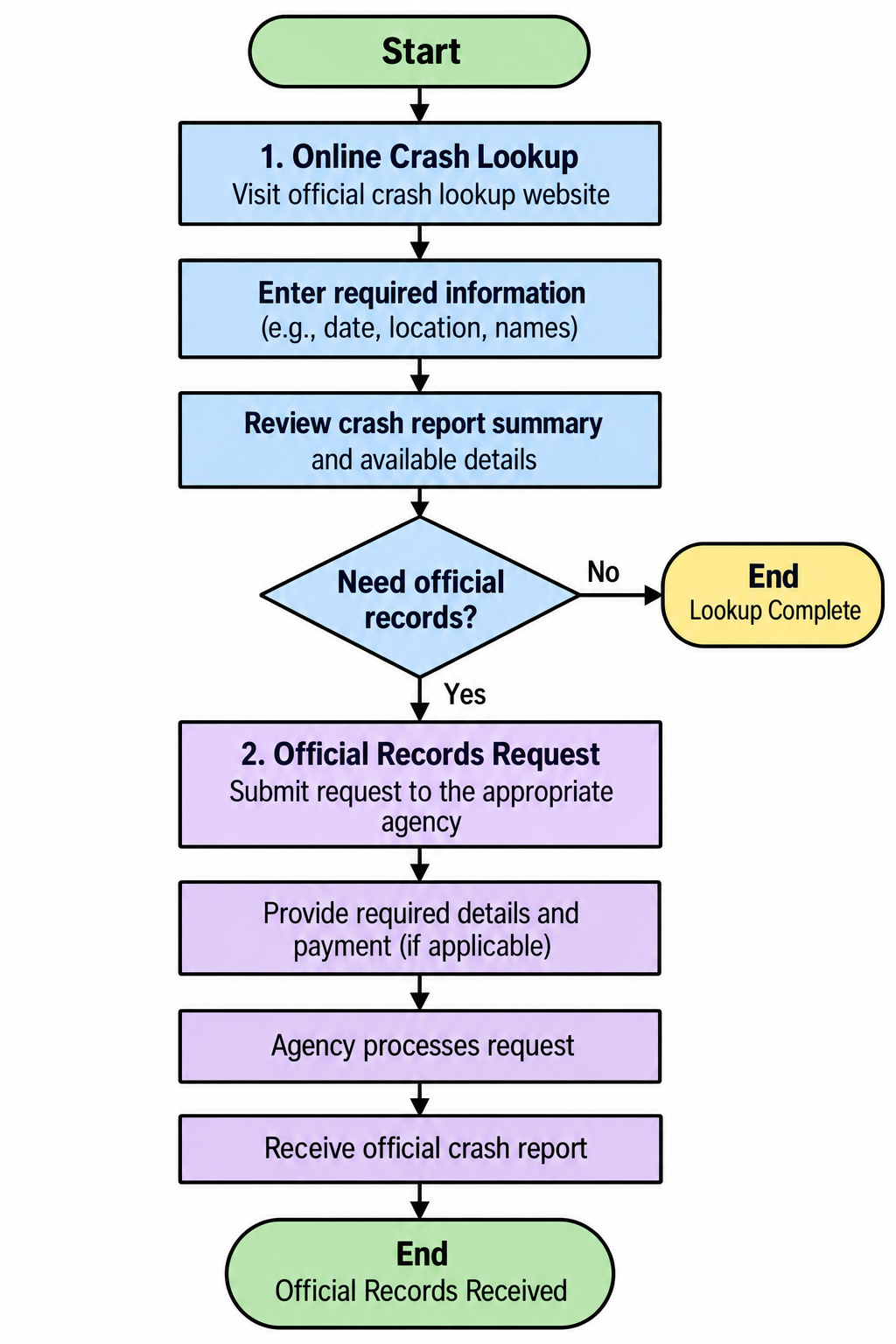
After an accident in Dayton, start with Ohio’s Crash Retrieval system to locate a report, then contact the investigating agency if you need an official copy. The Ohio Department of Public Safety warns that online copies are not official documents and may take up to six weeks to appear. The following guidance explains how to locate an Ohio crash report, request additional records from the appropriate agency, and take the necessary steps if your report is unavailable or cannot be located.
Call (937) 884-4474 or request a free consultation today to speak with an experienced Dayton car accident attorney at Buckeye Law Group.
Where can you find an Ohio crash report online?
Use the Ohio Department of Public Safety’s Crash Report Search for an Ohio crash report lookup. To locate an official Ohio crash report, search using the crash number or document number. If those identifiers are unavailable, use the advanced search options to narrow your results by the collision date range, county, investigating law enforcement agency, and last name. Dayton’s police website directs readers to the state database for traffic accident reports within its jurisdiction. Follow these steps:
- Gather Your Details: Have the officer’s information card, crash date, location, and any report number ready.
- Open Crash Report Search: Reach it through the Ohio Department of Public Safety’s Crash Reports page.
- Enter The Number If Available: Otherwise, select Advanced Options and enter the date range and county. For a crash within Dayton, start with Montgomery County.
- Choose The Investigating Agency Carefully: Use the agency shown on your paperwork rather than assuming Dayton Police handled it.
- Check The Matching Record: Confirm that the date, location, and vehicles correspond to your accident before saving a copy.
The state’s online crash report lookup is available at no charge. However, a crash report downloaded through the Ohio Department of Public Safety’s online system is a statistical copy and should not be considered a substitute for the official report maintained by the investigating law enforcement agency.
Getting an official Dayton crash accident report
To obtain an official crash report in Dayton, Ohio, contact the agency that investigated the collision. Check the paperwork supplied at the scene before requesting records. The state specifically directs people to the investigating agency for official reports and supplemental information.
For a Dayton Police investigation, the city lists the Records Bureau at 335 W. Third Street, Dayton, Ohio 45402 as a place to obtain a complete traffic crash report with witness statements. You can also request witness statements by emailing witness@daytonohio.gov; Dayton requires the report number to process that request.
If Ohio State Highway Patrol investigated your Ohio car crash, use its Public Records & Reports Request service instead. That agency maintains complete reports and photographs only for crashes its troopers investigated. Its online ordering process requires a valid credit card, so check the applicable charge before ordering. When contacting an agency, ask which request methods it accepts, whether copying or delivery charges apply, and whether your request includes diagrams, witness statements, photographs, and supplements. Do not assume every supporting record comes with the initial report.
What if your Ohio accident report is missing or delayed?
A missing online result does not necessarily mean no report exists. ODPS says reports can take up to six weeks to appear; an absent record may mean the agency has not submitted it or the collision occurred on private property. Contact the investigating agency rather than repeatedly searching without changing your approach.
Ohio State Highway Patrol asks people to wait at least seven business days before ordering its crash reports or photographs. Additional investigative material may remain unavailable until that work is complete. This is separate from the state retrieval system’s availability window, not a guarantee that every report will appear within seven days. For your next Ohio crash report search:
- Verify the crash date and report number against your paperwork.
- Broaden the date range or remove an uncertain agency filter.
- Ask the investigating agency whether the report is complete and how to request it directly.
- Notify your insurer promptly instead of waiting for the online record. Ohio’s driver guidance recommends reporting the crash to your insurance company as soon as possible.
What should you do if no officer responded?
Contact the police agency responsible for the crash location and ask how to document the collision. Dayton’s online citizen reporting system expressly excludes motor vehicle accidents. For a nonemergency within Dayton, call 937-333-2677 for guidance; call 911 for an emergency. An ordinary Ohio incident report submission is not the same as an Ohio traffic crash report.
Do not treat BMV Form 3303 as a universal self-report form. It is an Uninsured Accident Report for qualifying crashes involving an insured vehicle and an uninsured vehicle. The current form requires receipt within six months, specified identifying information, and documented damage exceeding $400 or personal injury exceeding $500.
The form also says not to complete it yourself if your insurer is handling the claim. Eligible submissions may be emailed to BMV3303@dps.ohio.gov or mailed to the Compliance Unit address printed on the form. Follow its documentation requirements rather than sending only a written account.
How Ohio Accident Reports Affect Fault Determinations and Insurance Claims
After an Ohio traffic accident, fault can affect recovery, but a citation does not automatically establish complete responsibility. Ohio’s Department of Insurance explains that responsibility may be shared and insurers investigate the circumstances. Compare the report with your photographs and other records; ask the investigating agency how to flag factual errors.
Keep your individual record separate from broader research. Ohio crash data and Ohio accident statistics describe patterns, not what happened in your collision. Likewise, a general Ohio traffic report is not your crash-specific record. If fault or injuries are disputed, consider asking a local Ohio attorney to review the official report and supporting evidence.
Call (937) 884-4474 or request a free consultation today to speak with an experienced Dayton car accident attorney at Buckeye Law Group.
Legal Disclaimer: This article provides general educational information about how Dayton car accident attorneys at Buckeye Law Group may assist individuals injured in motor vehicle collisions throughout Dayton and Montgomery County, Ohio. It does not constitute legal advice, and reading this article or contacting our firm does not establish an attorney-client relationship. Car accident claims may involve rear-end collisions, T-bone accidents, head-on crashes, distracted driving, speeding, or other forms of negligence. Under Ohio Revised Code § 2305.10, personal injury claims are generally subject to a two-year statute of limitations, although exceptions may apply. Ohio Revised Code § 2315.33 establishes comparative negligence rules that may affect compensation. Our Dayton car accident attorneys may investigate collisions, preserve evidence, evaluate insurance coverage, identify liable parties, and pursue compensation under Ohio law. Each case depends on its specific circumstances, and prior results do not guarantee a similar outcome.
How Much Should an Insurance Company Pay for Injuries After a Car Accident?
After an Ohio car accident, an insurance company may offer a settlement before the full extent of your injuries, anticipated medical treatment, or long-term financial losses becomes clear. Ohio law
What Happens If an Insurance Company Won’t Offer a Fair Settlement After a Car Accident?
After an Ohio car accident, an insurance settlement offer may arrive while medical treatment continues and fault remains disputed. If the insurance company won’t offer a fair settlement, you do
Toledo’s Summit Street Cycle Track: What the 2026–2027 Redesign Means for Cyclist and Pedestrian Safety
Toledo’s Summit Street Cycle Track project is a two-phase reconstruction intended to make a section of North Summit Street safer and more connected for people walking and bicycling. In 2026,
Greater Dayton’s 2026 E-Bike and E-Moto Safety Proposal: What Ohio Riders and Parents Should Know
Electric bicycles and other small electric-powered vehicles are becoming increasingly common on roads, neighborhood streets, and recreational trails throughout Greater Dayton. Their growing use also raises important questions about rider
Dayton’s Keowee Street Safety Project: How Lane Reductions and New Walking Paths Could Improve Roadway Safety
Dayton’s Keowee Street safety project would reduce the roadway from seven lanes to five between East Fifth Street and East Monument Avenue, adding multi-use paths, landscaping, and signal upgrades. The
Dayton I-75 Construction in November 2026: Lane Closures, Traffic Shifts, and Work-Zone Safety
Motorists traveling along I-75 through Dayton, Ohio, in November 2026 should be aware of multiple construction projects that may affect travel times, lane configurations, and access to nearby interchanges. According
Columbus I-70/I-71 Construction in November 2026: Ramp Closures, Detours, and Driver Safety
Motorists traveling through downtown Columbus, Ohio, in November 2026 should prepare for temporary traffic disruptions as construction continues along the I-70/I-71 corridor. Overnight interstate restrictions, ramp closures, and designated detours
Mansfield’s Main Street Transformation: What Drivers and Pedestrians Should Know About Downtown Traffic Changes in 2026
As Mansfield completes its 2026 Main Street Transformation, residents and visitors should understand how the redesigned streets affect access to downtown businesses, public buildings, pedestrian crossings, and nearby parking areas.
Toledo’s Douglas Road and Monroe Street Intersection Improvements: What Drivers and Pedestrians Should Know in 2026
The City of Toledo identifies the Douglas Road and Monroe Street intersection as a 2026 improvement project intended to support pedestrian safety, driver safety, and better pavement conditions. For people
Springfield’s South Limestone Street Safety Improvements: What Drivers Should Know
South Limestone Street in Springfield, Ohio, is the focus of safety improvements intended to reduce conflicts between vehicles entering, leaving, and traveling along the corridor. The Ohio Department of Transportation’s

Buckeye Law Group represents people injured in auto accidents, slip and falls, workplace accidents and more in Ohio. Contact us today to learn more.
© 2026 All Rights Reserved | The Buckeye Law Group Inc. Privacy Policy Sitemap
Office Locations
- Akron Office 388 S Main St #400 Akron, OH 44311 (330) 426-0288
- Cincinnati Office 201 E 5th St Ste 1910 Cincinnati, OH 45202 (513) 547-2445
- Cleveland Office 127 Public Square Ste 1540 Cleveland, OH 44114 (216) 677-5490
- Columbus Office 20 E Broad St Suite 300 Columbus, OH 43215 (614) 482-3793
- Dayton Office 70 Birch Alley Ste 240 Dayton, OH 45440 (937) 884-4474
- Euclid Office 25701 N Lakeland Blvd Suite 113-C, Cleveland, OH 44132 (216) 405-2626
- Mansfield Office 305 E Main St Ste 6A, Mansfield, OH 44904 (567) 210-2606
- Findlay Office 7430 Timberstone Dr unit 101a, Findlay, OH 45840 419-873-5119
- Mentor Office 7537 Mentor Ave Ste 101, Mentor, OH 44060 (440) 306-3536
- Middletown Office 300 N Main St #400, Middletown, OH 45042 (326) 800-9150
- Parma Office 1257 Rockside Rd #A, Parma, OH 44131 (216) 279-1664
- Springfield Office 2100 E High St Ste TL3, Springfield, OH 45505 (937) 806-5791
- Toledo Office 3950 Sunforest Ct Ste 200, Toledo, OH 43623 (567) 483-3883
- Westlake Office 26404 Center Ridge Rd Ste B2, Westlake, OH 44145 216-247-0565
- Whitehall Office 5340 E Main St Ste 203, Whitehall, OH 43213 (380) 257-5206
- Youngstown Office 306 Churchill Hubbard Rd, Youngstown, OH 44505 (234) 225-0683
Contact Us
© 2026 All Rights Reserved | The Buckeye Law Group Inc. Privacy Policy Sitemap