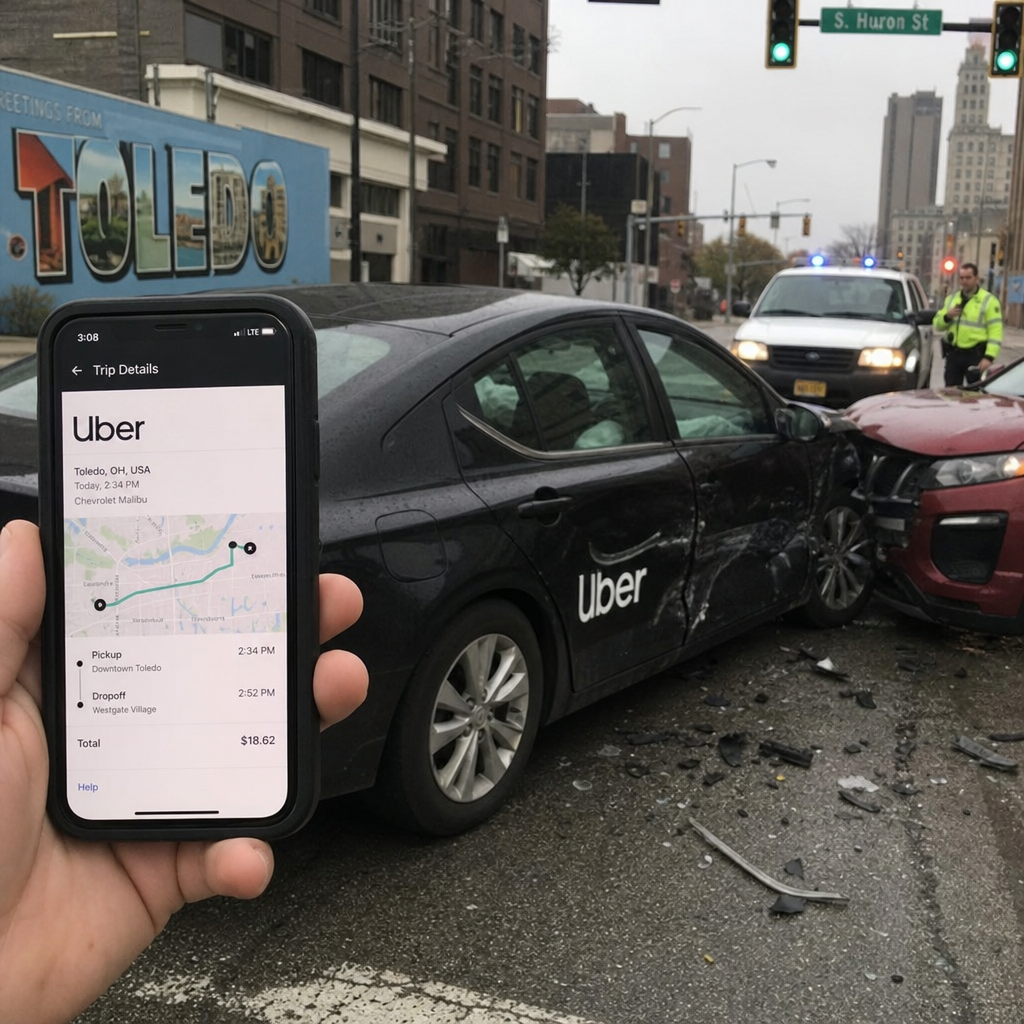
A Toledo Uber accident can feel more confusing than a typical car crash because several insurance policies may be involved. The most important issue is usually the driver’s app status at the moment of impact, because that determines whether a personal policy, Uber liability coverage, or Ohio transportation network company coverage may apply. This guide explains how rideshare accident claims work, what compensation may be available, and what steps can help protect your rights after a crash.
Call (567) 483-3883 or request a free consultation today to speak with an experienced Toledo rideshare accident lawyer at Buckeye Law Group.
Who may be liable after a Toledo Uber accident?
Liability may fall on the Uber driver, another motorist, a vehicle owner, a defective vehicle or parts manufacturer, or another third party whose conduct helped cause the crash. In many Toledo rideshare accident cases, the injured person must first determine who acted negligently and then identify which insurance policy applies to that person or company.
The key complication is that Uber drivers use personal vehicles while switching between personal driving and commercial rideshare activity. A driver who causes a crash while running a personal errand is usually treated differently from a driver who is logged in, matched with a passenger, or actively transporting someone. That is why app data, trip receipts, screenshots, police reports, and witness statements can become central evidence.

Uber insurance depends on the driver’s app status
Uber accident policy questions usually start with one timeline: was the driver offline, waiting for a request, heading to pick up a rider, or carrying a passenger? Ohio law requires specific insurance for transportation network company drivers while they are logged in and available, and higher coverage when they are engaged in transportation network company services. Ohio Revised Code § 3942.02 requires at least $50,000 per person, $100,000 per accident, and $25,000 for property damage while a driver is logged on but not yet engaged in services, and at least $1 million when engaged in services.
Uber’s own insurance information follows the same basic staged structure for U.S. rideshare driving. Uber states that third-party liability coverage may apply while a driver is online and waiting for a request, and that higher third-party liability coverage applies once a driver accepts a trip and during the ride.
| Driver Status | Likely Coverage Issue | Practical Claim Impact |
|---|---|---|
| App off | Driver’s personal auto insurance usually comes first. | Uber may deny involvement because the driver was not working through the app. |
| App on, waiting for request | Limited rideshare coverage may apply. | Disputes may focus on whether the driver was truly online and available. |
| Ride accepted, passenger not yet picked up | Higher commercial coverage may apply. | App logs and trip records become especially important. |
| Passenger in vehicle | Higher commercial coverage may apply. | Injured passengers may have clearer evidence that the trip was active. |
This staged approach is the reason “just file with Uber” is often too simple. A Toledo Uber accident claim may involve Uber’s insurer, the driver’s personal insurer, another driver’s insurer, and possibly your own uninsured or underinsured motorist coverage.
What compensation can an injured rideshare passenger pursue?
An injured passenger, pedestrian, cyclist, or driver may pursue compensation for losses caused by the crash. The value and available categories depend on the facts, the insurance coverage, the severity of the injuries, and how Ohio fault rules apply. Common damages in rideshare accident claims include:
- Emergency and follow-up medical care, including ambulance transport, hospital care, imaging, physical therapy, medication, and specialist visits.
- Future medical needs, especially when injuries require surgery, long-term rehabilitation, injections, mobility support, or ongoing pain management.
- Lost income, including missed work, reduced hours, lost bonuses, or reduced earning capacity if the injuries limit future employment.
- Pain and suffering, which may reflect physical pain, loss of normal activities, sleep disruption, and reduced quality of life.
- Emotional distress, including anxiety about riding in vehicles, trauma symptoms, or stress tied to recovery.
- Property damage, such as vehicle repairs, phone damage, child seats, glasses, or other personal items damaged in the crash.
- Wrongful death damages, when a fatal Uber-related collision leaves surviving family members with legally recognized losses.
Common injuries include whiplash, fractures, concussions, traumatic brain injuries, spinal injuries, internal injuries, and soft tissue damage. Some symptoms appear immediately, while others worsen over hours or days. Getting medical care quickly helps protect your health and creates documentation insurers often request when evaluating causation and damages.
Ohio fault rules can reduce or block recovery
Ohio uses a comparative fault rule that can affect any rideshare claim. Under Ohio Revised Code § 2315.33, a claimant’s compensatory damages are reduced by that person’s share of fault, and recovery is barred if the person’s fault is greater than the combined fault of the other parties.
In practical terms, fault percentages matter. If an insurer argues that you contributed to the crash or worsened your injuries, that argument may reduce the settlement offer. In passenger cases, comparative fault is often less central than in driver or pedestrian cases, but it can still arise if an insurer claims a passenger interfered with the driver, failed to wear a seat belt, or delayed medical care.
A Toledo rideshare accident lawyer may push back by gathering medical records, vehicle data, witness accounts, traffic camera footage, photos, app records, and expert analysis. The goal is not only to prove that someone else was negligent, but also to prevent an insurer from assigning unfair blame to the injured person.
Why are Uber accident claims more complicated than regular car accident claims?
Uber claims are more complicated because the insurance coverage changes based on digital activity, not just vehicle ownership. Ohio law also says personal auto policies are not required to cover a driver while the driver is logged on to a transportation network company’s digital network or using the vehicle to transport passengers for compensation.
That creates a coverage gap dispute in some cases. A personal insurer may say the driver was using the car for rideshare work. Uber’s insurer may say the driver was offline or outside the covered period. Meanwhile, the injured person may be stuck between insurers that are each trying to move responsibility elsewhere. There may also be more evidence to obtain than in a standard crash. Useful information may include the Uber trip record, driver status logs, GPS data, acceptance time, pickup route, passenger receipt, driver communications, dashcam footage, and insurance certificates. Some of this evidence is not available from the police report alone, so prompt preservation requests can matter.
Steps to take right after an Uber crash in Toledo
The minutes and days after a crash can shape the claim. Even if you are unsure whether your injuries are serious, take steps that protect both your health and your legal position.
- Call 911 And Request Medical Help If Needed: A police report can document the location, drivers, vehicles, witnesses, and initial observations.
- Get Medical Care Promptly: Do not assume soreness is minor, especially after a rear-end collision, side-impact crash, or head impact.
- Document The Scene: Photograph vehicle positions, damage, license plates, skid marks, traffic lights, weather, visible injuries, and the Uber app screen if you can do so safely.
- Save Trip Details: Keep receipts, driver name, vehicle information, route screenshots, pickup and drop-off details, and messages from the app.
- Collect Witness Information: Names, phone numbers, and short statements can be valuable if the insurers later dispute what happened.
- Report The Crash To Uber: Use the app or appropriate reporting channel, but keep your description factual and avoid guessing about fault or injury severity.
- Avoid Quick Recorded Statements: Insurers may ask questions before you understand your diagnosis, prognosis, or full losses.
- Speak With A Lawyer Familiar With Uber Driver Protection And Insurance Disputes: Legal guidance can help identify all policies and preserve digital evidence.
Helpful Toledo and Lucas County Resources After an Uber Accident
Following an Uber or rideshare accident in Toledo, obtaining accurate documentation can help establish how the collision occurred, identify potentially responsible parties, and preserve evidence needed for an insurance claim. Injured passengers, motorists, pedestrians, and cyclists may find the following local resources helpful when documenting an accident and understanding their legal options.
Toledo Police Department: Obtaining Accident Reports
If the Toledo Police Department investigated your accident, you can request a copy of the crash report through the Ohio Department of Public Safety’s Crash Retrieval System. The Toledo Police Department also maintains a Records Section at 525 N. Erie Street, Toledo, OH 43604.
When requesting a report, retain the accident date, location, responding agency, and report number, if available. These records may help establish the circumstances of the collision and identify witnesses or other involved motorists.
Toledo Public Records and Emergency Medical Services
Additional documentation, including available 911 recordings, police photographs, and video footage, may be requested through the Toledo Police Department’s Public Records Office.
Individuals who received emergency medical assistance from Toledo Fire & Rescue can also contact the city’s EMS Bureau at 419-245-1275 for information about requesting emergency medical services records. Because evidence may be subject to retention policies and disclosure restrictions, injured individuals should consider requesting relevant records promptly.
Lucas County Court of Common Pleas: Civil Case Information
When an Uber accident results in a personal injury lawsuit, the appropriate court depends on the circumstances of the claim. Cases filed in the Lucas County Court of Common Pleas are handled through its civil court system.
The Lucas County Clerk of Courts Civil Division is located at 700 Adams Street, First Floor, Toledo, OH 43604. The Civil Division Filing and Intake can be reached at 419-213-4490 for filing and court record information. In addition to these local records, injured individuals should preserve their Uber trip receipts, driver information, communications, and route screenshots. These materials may be particularly important when determining the driver’s activity on the Uber platform and identifying potentially applicable insurance coverage.
Evidence that strengthens a Toledo rideshare accident claim
Strong claims are built on clear documentation. The more complete the evidence, the harder it is for an insurer to deny coverage, undervalue injuries, or shift blame unfairly. A useful evidence file may include:
- Police crash report and report number.
- Names and insurance information for all drivers.
- Uber trip receipt, driver profile, and vehicle details.
- Screenshots showing ride status or route.
- Photos and videos from the scene.
- Medical records, bills, prescriptions, and work restrictions.
- Employer records showing missed time or reduced earnings.
- Witness contact information.
- Repair estimates and property damage photos.
- Notes about pain levels, appointments, and daily limitations.
For serious crashes, lawyers may also work with accident reconstruction professionals, medical experts, or economic experts. These professionals can help explain how the collision happened, why the injuries are related, and how the losses may affect the injured person in the future.
Deadlines matter in Ohio injury cases
Ohio generally gives injured people two years to bring an action for bodily injury or injury to personal property under Ohio Revised Code § 2305.10. Waiting too long can create serious problems, even if the insurance company has been communicating with you. The deadline is not the only timing issue. Digital rideshare records may become harder to obtain with time, witnesses may become difficult to find, and vehicles may be repaired or sold before damage patterns are preserved. Acting early can make the difference between a claim supported by objective evidence and a claim that depends mostly on memory.
When legal help becomes especially important
Not every minor crash requires a lawsuit, but Uber-related claims often benefit from careful legal review. You should consider contacting a Toledo rideshare accident lawyer if you suffered significant injuries, missed work, required ongoing care, received conflicting insurance responses, or were told that Uber’s coverage does not apply. Legal help may also be important when multiple vehicles were involved, when the Uber driver’s status is disputed, when a personal insurer denies coverage, or when the insurer suggests you were partly at fault. A local Ohio attorney can review the facts, identify available insurance, calculate damages, negotiate with insurers, and prepare for litigation if settlement discussions fail.
Protecting Your Legal Rights After an Uber Accident in Toledo, Ohio
A Toledo Uber crash is not just a car accident with an app attached. The driver’s status, Ohio’s rideshare insurance requirements, comparative fault rules, medical documentation, and insurance timing all affect the outcome. If you were injured, focus on medical care, preserve every piece of trip and crash evidence, and get guidance before accepting a settlement or giving detailed statements to insurers.
Call (567) 483-3883 or request a free consultation today to speak with an experienced Toledo rideshare accident lawyer at Buckeye Law Group.
*This article provides general information about how a Toledo rideshare accident lawyer at Buckeye Law Group may assist individuals injured in Uber accidents throughout Toledo and Lucas County, Ohio. It is intended for educational purposes only and does not constitute legal advice. Reading this article or contacting Buckeye Law Group does not establish an attorney-client relationship. Rideshare accident claims may involve disputed liability, multiple insurance policies, medical expenses, lost income, and applicable Ohio legal deadlines. Under Ohio Revised Code § 3942.02, insurance requirements depend on the rideshare driver’s status at the time of the collision. Evaluating these claims may require reviewing police reports, rideshare trip records, insurance policies, witness statements, and medical documentation. A Toledo rideshare accident lawyer at Buckeye Law Group may investigate negligence, identify potentially liable parties, determine applicable insurance coverage, preserve critical evidence, evaluate potential compensation, and explain an injured individual’s legal rights under Ohio law. Every case is different, and prior results do not guarantee a similar outcome.*
How Much Should an Insurance Company Pay for Injuries After a Car Accident?
After an Ohio car accident, an insurance company may offer a settlement before the full extent of your injuries, anticipated medical treatment, or long-term financial losses becomes clear. Ohio law
What Happens If an Insurance Company Won’t Offer a Fair Settlement After a Car Accident?
After an Ohio car accident, an insurance settlement offer may arrive while medical treatment continues and fault remains disputed. If the insurance company won’t offer a fair settlement, you do
Toledo’s Summit Street Cycle Track: What the 2026–2027 Redesign Means for Cyclist and Pedestrian Safety
Toledo’s Summit Street Cycle Track project is a two-phase reconstruction intended to make a section of North Summit Street safer and more connected for people walking and bicycling. In 2026,
Greater Dayton’s 2026 E-Bike and E-Moto Safety Proposal: What Ohio Riders and Parents Should Know
Electric bicycles and other small electric-powered vehicles are becoming increasingly common on roads, neighborhood streets, and recreational trails throughout Greater Dayton. Their growing use also raises important questions about rider
Dayton’s Keowee Street Safety Project: How Lane Reductions and New Walking Paths Could Improve Roadway Safety
Dayton’s Keowee Street safety project would reduce the roadway from seven lanes to five between East Fifth Street and East Monument Avenue, adding multi-use paths, landscaping, and signal upgrades. The
Dayton I-75 Construction in November 2026: Lane Closures, Traffic Shifts, and Work-Zone Safety
Motorists traveling along I-75 through Dayton, Ohio, in November 2026 should be aware of multiple construction projects that may affect travel times, lane configurations, and access to nearby interchanges. According
Columbus I-70/I-71 Construction in November 2026: Ramp Closures, Detours, and Driver Safety
Motorists traveling through downtown Columbus, Ohio, in November 2026 should prepare for temporary traffic disruptions as construction continues along the I-70/I-71 corridor. Overnight interstate restrictions, ramp closures, and designated detours
Mansfield’s Main Street Transformation: What Drivers and Pedestrians Should Know About Downtown Traffic Changes in 2026
As Mansfield completes its 2026 Main Street Transformation, residents and visitors should understand how the redesigned streets affect access to downtown businesses, public buildings, pedestrian crossings, and nearby parking areas.
Toledo’s Douglas Road and Monroe Street Intersection Improvements: What Drivers and Pedestrians Should Know in 2026
The City of Toledo identifies the Douglas Road and Monroe Street intersection as a 2026 improvement project intended to support pedestrian safety, driver safety, and better pavement conditions. For people
Springfield’s South Limestone Street Safety Improvements: What Drivers Should Know
South Limestone Street in Springfield, Ohio, is the focus of safety improvements intended to reduce conflicts between vehicles entering, leaving, and traveling along the corridor. The Ohio Department of Transportation’s

Buckeye Law Group represents people injured in auto accidents, slip and falls, workplace accidents and more in Ohio. Contact us today to learn more.
© 2026 All Rights Reserved | The Buckeye Law Group Inc. Privacy Policy Sitemap
Office Locations
- Akron Office 388 S Main St #400 Akron, OH 44311 (330) 426-0288
- Cincinnati Office 201 E 5th St Ste 1910 Cincinnati, OH 45202 (513) 547-2445
- Cleveland Office 127 Public Square Ste 1540 Cleveland, OH 44114 (216) 677-5490
- Columbus Office 20 E Broad St Suite 300 Columbus, OH 43215 (614) 482-3793
- Dayton Office 70 Birch Alley Ste 240 Dayton, OH 45440 (937) 884-4474
- Euclid Office 25701 N Lakeland Blvd Suite 113-C, Cleveland, OH 44132 (216) 405-2626
- Mansfield Office 305 E Main St Ste 6A, Mansfield, OH 44904 (567) 210-2606
- Findlay Office 7430 Timberstone Dr unit 101a, Findlay, OH 45840 419-873-5119
- Mentor Office 7537 Mentor Ave Ste 101, Mentor, OH 44060 (440) 306-3536
- Middletown Office 300 N Main St #400, Middletown, OH 45042 (326) 800-9150
- Parma Office 1257 Rockside Rd #A, Parma, OH 44131 (216) 279-1664
- Springfield Office 2100 E High St Ste TL3, Springfield, OH 45505 (937) 806-5791
- Toledo Office 3950 Sunforest Ct Ste 200, Toledo, OH 43623 (567) 483-3883
- Westlake Office 26404 Center Ridge Rd Ste B2, Westlake, OH 44145 216-247-0565
- Whitehall Office 5340 E Main St Ste 203, Whitehall, OH 43213 (380) 257-5206
- Youngstown Office 306 Churchill Hubbard Rd, Youngstown, OH 44505 (234) 225-0683
Contact Us
© 2026 All Rights Reserved | The Buckeye Law Group Inc. Privacy Policy Sitemap