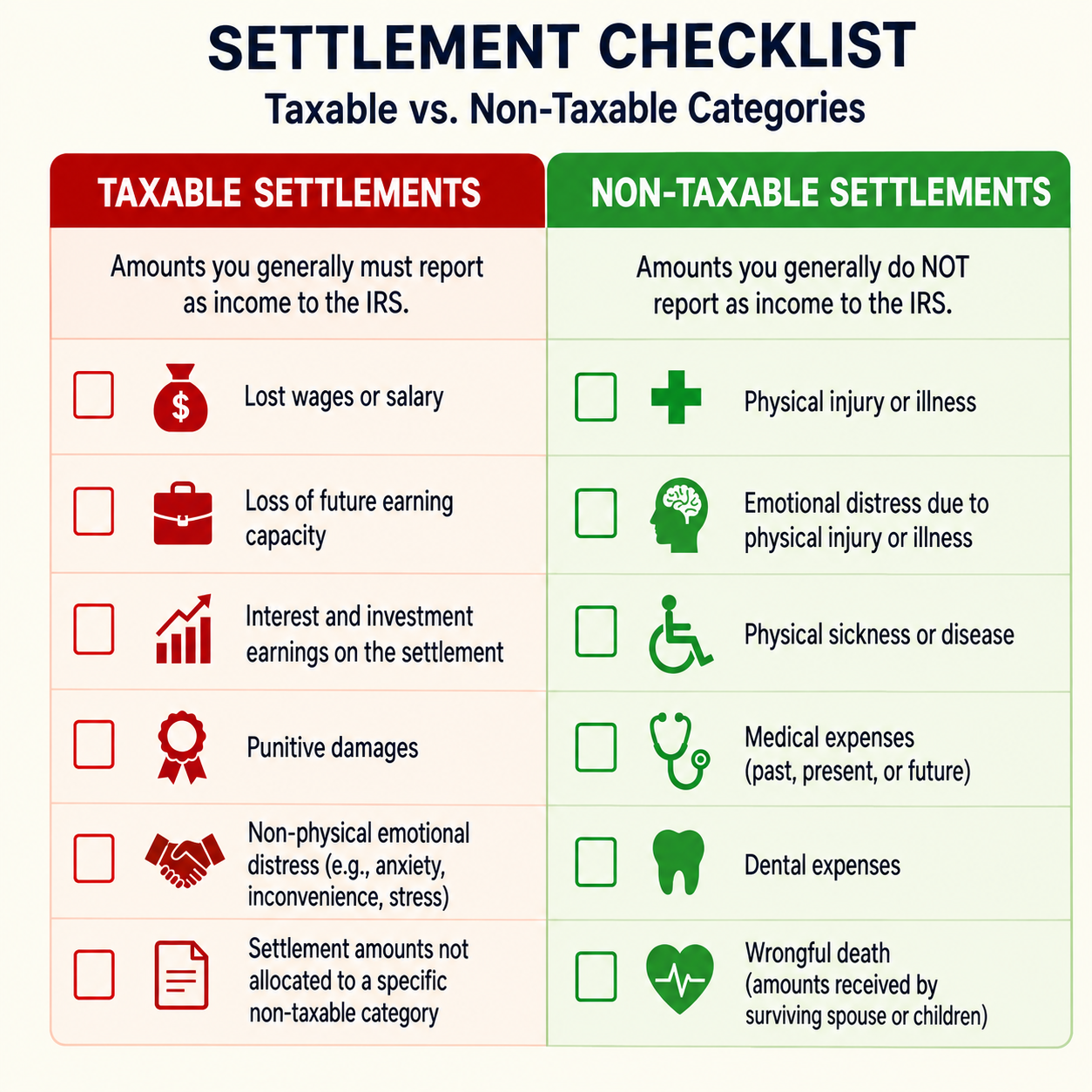
A personal injury settlement in Ohio is often not taxable when the money compensates you for physical injuries or physical sickness. But some parts of a settlement can be taxable, especially punitive damages, interest, and certain payments for emotional distress or previously deducted medical expenses. The safest approach is to understand what each dollar in the settlement represents before you sign, deposit, or report anything.
Call 1-800-411-7246 or request a free consultation to speak with a local Ohio personal injury attorney at Buckeye Law Group today.
Understanding When Ohio Personal Injury Settlements Are Taxable or Tax-Exempt
In many personal injury cases, the main settlement amount is not taxable if it is paid because of a physical injury or physical sickness. That means compensation for medical treatment, pain and suffering tied to bodily injury, and lost wages resulting from the physical injury may be excluded from federal income in many cases. The IRS states that compensatory damages received on account of personal physical injury or physical sickness are generally excludable, with important exceptions such as punitive damages.
Ohio personal injury settlements usually start with the federal tax treatment because Ohio income tax is generally based on federal adjusted gross income. If a settlement is not included in federal income, it commonly does not flow into Ohio taxable income. However, taxable portions may still matter for federal, Ohio, and sometimes municipal tax purposes, so it is smart to review the settlement language carefully. This is why the question “Are Personal Injury Settlements Taxable in Ohio?” rarely has a one-word answer. It depends on the type of damages, how the settlement agreement is written, whether the claim involved physical injury, and whether any part of the payment represents taxable items.
The Basic Rule for Injury-Related Compensation
The central tax rule is tied to the reason for the payment. If you receive money because another person caused a physical injury, that compensation is generally treated differently from money received for a non-physical claim such as reputational harm, employment discrimination without physical injury, or purely emotional distress.
For example, a person injured in a car crash may receive compensation for emergency care, follow-up treatment, pain, physical limitations, and time missed from work because of those injuries. If those payments are genuinely connected to the physical injury, they are usually handled more favorably for tax purposes. By contrast, money paid for punitive damages is taxable even when the underlying case involved physical injury.
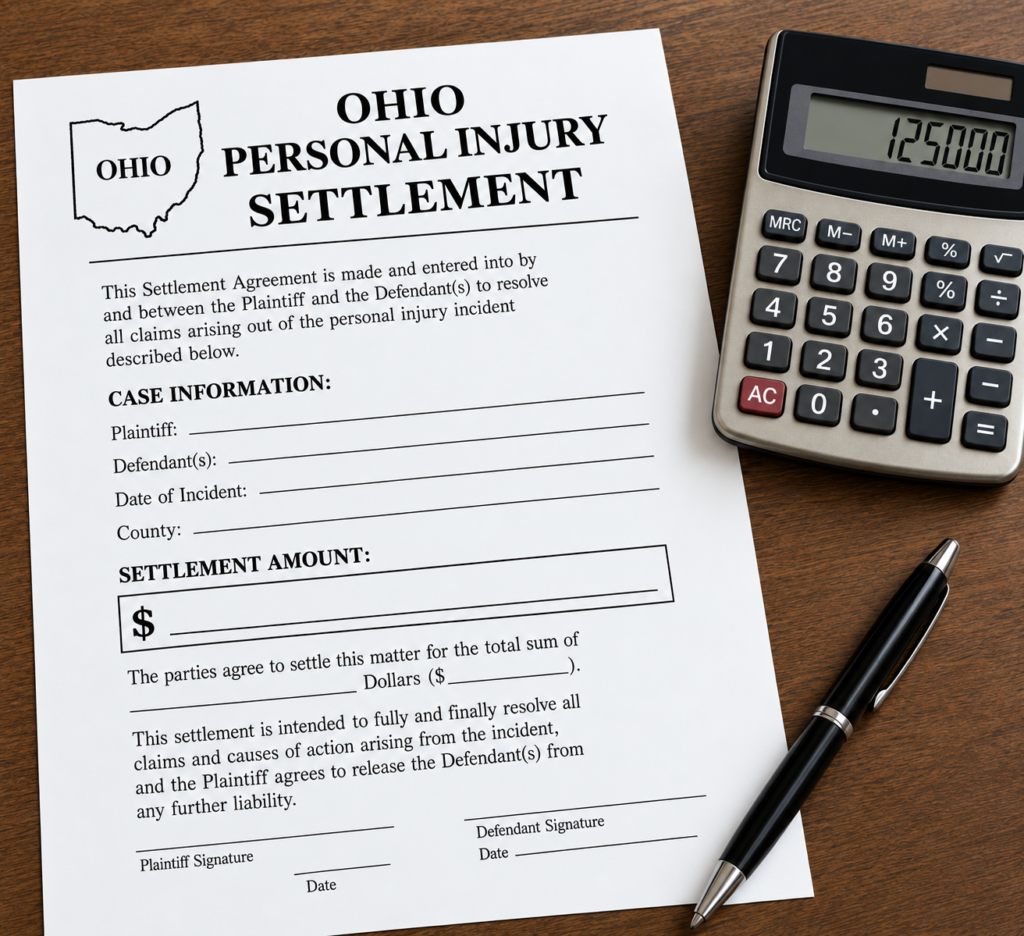
A settlement agreement should ideally describe what the payment is for. The IRS may look at the settlement wording, the claims made, and the intent of the payer when deciding how to characterize a payment. If the agreement is vague, it may create confusion later, especially if a Form 1099 is issued.
What Parts of an Ohio Personal Injury Settlement are Usually Not Taxable?
Most people asking about Ohio personal injury settlements want to know whether they will lose a large share of their recovery to taxes. In a typical bodily injury case, several categories may be non-taxable when they are paid because of personal physical injuries or sickness. Commonly non-taxable categories may include:
- Medical expenses related to the injury, unless you previously deducted those expenses and received a tax benefit.
- Pain and suffering connected to physical injuries, such as pain after a collision, fall, or other accident.
- Lost wages caused by the physical injury, when the wage loss flows from the bodily injury claim.
- Loss of enjoyment of life tied to the injury, when included as part of compensatory damages for physical harm.
- Future medical care or future physical limitations, when the payment is meant to compensate for ongoing injury-related needs.
The medical expense rule deserves special attention. If you deducted medical expenses on a prior tax return and the deduction reduced your taxes, a later settlement reimbursing those expenses may be taxable to that extent. The IRS specifically notes this tax-benefit issue for settlements involving physical injury or sickness. This is one reason personal injury lawyers often recommend keeping medical bills, insurance statements, tax returns, and settlement documents organized. Good records make it easier to show what the settlement covered.
Which Settlement Payments can Create Taxes?
Some settlement dollars can be taxable even when the case began as a personal injury Ohio claim. The key is whether a portion of the recovery falls outside compensation for physical injury or physical sickness. Potentially taxable portions may include:
- Punitive Damages: Punitive damages are designed to punish wrongful conduct, not simply compensate the injured person. The IRS treats punitive damages as taxable income in most cases, even if the case involved physical injuries.
- Interest on a Judgment or Settlement: If interest is added because payment was delayed or because a judgment accrued interest, that interest is generally taxable. It is separate from the injury compensation itself.
- Emotional Distress Not Caused by Physical Injury: Emotional distress damages can be taxable when they are not directly tied to a physical injury or physical sickness. However, medical costs for treating that emotional distress may receive different treatment in limited circumstances.
- Reimbursement of Previously Deducted Medical Expenses: If you claimed a deduction for medical expenses in an earlier year and received a tax benefit, reimbursement through a settlement can become taxable.
- Non-Injury Claims Bundled into One Settlement: Some cases include several claims at once. If an agreement combines physical injury damages with wage disputes, discrimination claims, contract claims, or property damage, the tax result may vary by category.
A careful settlement allocation can help reduce confusion. It should be realistic and consistent with the actual claims, not an after-the-fact attempt to label everything as non-taxable.
How Ohio Tax Treatment Fits With Federal Rules
Ohio’s personal income tax system generally uses federal adjusted gross income as the starting point, then applies Ohio-specific adjustments. The Ohio Department of Taxation explains filing obligations and Ohio income tax calculations around that federal starting point. That means the federal classification of your settlement is extremely important. If the payment is excluded from federal gross income because it compensates you for physical injuries, it generally should not increase your federal adjusted gross income. If part of the settlement is taxable federally, it may also affect your Ohio tax picture.
Municipal taxes can add another layer. Ohio municipal income tax law excludes certain compensation for personal injuries or property damages, but it also identifies exceptions such as lost salaries or wages and punitive damages. Because city tax rules can be technical, a tax professional familiar with Ohio municipalities can be helpful if your settlement includes wage-related or punitive components.
Why Settlement Wording Matters Before You Sign
The words in your settlement agreement can matter almost as much as the dollar amount. A well-drafted agreement identifies the nature of the claims and may allocate funds among physical injury damages, medical bills, lost income, property damage, punitive damages, or interest when appropriate. That allocation can affect tax reporting.
This does not mean parties can simply choose whatever tax label they prefer. The allocation should reflect the reality of the case. If the facts show the payment was for a taxable claim, a document calling it something else may not solve the problem. Before signing, consider asking these questions:
- Does the agreement clearly state that the payment is for physical injuries or physical sickness, if that is accurate?
- Does it separate punitive damages, interest, property damage, or non-injury claims?
- Will the defendant or insurer issue a Form 1099?
- Were any medical expenses previously deducted on a tax return?
- Does the settlement include attorney fees, liens, or reimbursements that may need separate review?
A local Ohio personal injury lawyer can help negotiate settlement wording, but tax advice should also come from a qualified tax professional. The two roles are different, and both can matter when a recovery is substantial.
What Should You do After Receiving A Settlement?
Once a case resolves, do not assume the tax issue is finished. Settlement funds often arrive after months or years of medical treatment, insurance discussions, lien negotiations, and legal work. A little organization can prevent problems later. Use this practical checklist:
- Save the Final Settlement Agreement: Keep the signed version, not just emails or drafts.
- Keep the Closing Statement: This may show attorney fees, costs, medical liens, and net proceeds.
- Watch for Tax Forms: If you receive a Form 1099, do not ignore it, even if you believe the money is non-taxable.
- Gather Prior Tax Returns: Look for any medical deductions related to the injury.
- Separate Settlement Funds from Regular Income at First: This can make tracking easier.
- Speak with a Tax Professional Before Filing: Bring the settlement agreement, 1099s, medical records, and closing statement.
If you are still negotiating, talk through tax issues before the agreement is finalized. It is usually easier to address allocation and wording during settlement discussions than after the check has been issued.
Ohio Resources for Personal Injury Settlement and Tax Assistance
Understanding how a personal injury settlement affects your taxes can be challenging, particularly when compensation includes several categories of damages. Fortunately, Ohio residents have access to government agencies and community programs that provide information about tax reporting, filing requirements, and financial assistance.
Statewide Settlement and Tax Resources
Ohio Department of Taxation: Ohio residents can obtain information about state income tax obligations and reporting requirements.
- Address: 4485 Northland Ridge Boulevard, Columbus, OH 43229
- Individual Income Tax Assistance: (800) 282-1780
Internal Revenue Service — Settlement Tax Guidance: The IRS provides guidance on the federal tax treatment of personal injury settlements, including physical injury compensation, punitive damages, interest, and other settlement payments.
IRS Volunteer Income Tax Assistance (VITA): Eligible Ohio residents can locate free basic tax preparation assistance by entering their ZIP code. Complex settlement-related tax questions may require a qualified tax professional.
Local Tax Assistance in Ohio Communities
Depending on where you live or work, municipal income tax rules may also affect how certain settlement payments are treated. These local offices provide municipal tax information and taxpayer assistance.
When to Contact an Ohio Personal Injury Attorney
A local Ohio personal injury attorney can help you understand the legal value of your claim, document injury-related losses, and negotiate settlement terms that accurately reflect what happened. This is especially important when a case includes serious injuries, disputed liability, long-term medical care, lost earning capacity, or multiple categories of damages. Personal injury lawyers are not substitutes for tax preparers or CPAs, but they can help structure the legal settlement record in a clear way. If a tax question could affect your net recovery, your attorney may recommend that you also consult a tax professional before signing the release. You may want legal guidance if:
- The insurer is pressuring you to settle quickly.
- Your injuries required significant medical care.
- You missed work or may lose future income.
- The settlement includes emotional distress, punitive damages, or interest.
- You received a 1099 and are unsure why.
- You are comparing offers and need to understand the real net value.
Searching for “are personal injury settlements taxable in Ohio” is often the first step. The next step is getting advice based on the facts of your case.
Understanding the Tax Implications of an Ohio Personal Injury Settlement
Most Ohio personal injury settlements for physical injuries are not taxable in the same way ordinary income is. However, taxes may apply to punitive damages, interest, certain emotional distress payments, prior medical deductions, and mixed settlements that include non-injury claims. The best protection is clarity. Know what the settlement compensates, make sure the agreement reflects the real claims, keep detailed records, and ask both legal and tax professionals when the numbers or categories are complicated. If you are working through a personal injury claim in Ohio, a local attorney can help you pursue a fair recovery while keeping important settlement details from becoming an afterthought.
Call 1-800-411-7246 or request a free consultation to speak with a local Ohio personal injury attorney at Buckeye Law Group today.
*This article provides general information about how an Ohio personal injury attorney may assist individuals injured by another party’s negligence. It is intended for educational purposes only and does not constitute legal advice. Reading this article or contacting Buckeye Law Group does not establish an attorney-client relationship. Personal injury claims throughout Ohio may involve car accidents, truck collisions, slip-and-fall incidents, medical malpractice, and workplace injuries. These cases may involve disputed liability, insurance coverage, medical expenses, lost income, pain and suffering, and Ohio legal deadlines. Evaluating a claim may require reviewing accident reports, medical records, insurance policies, and evidence of damages. An Ohio personal injury attorney at Buckeye Law Group may help injured individuals understand their rights, assess potential compensation, negotiate with insurers, and explore legal options. Every case is different, and prior results do not guarantee a similar outcome.*
Are Personal Injury Settlements Taxable in Ohio?
A personal injury settlement in Ohio is often not taxable when the money compensates you for physical injuries or physical sickness. But some parts of a settlement can be taxable,
Is It Worth Hiring a Cincinnati Car Accident Attorney After a Minor Crash?
A minor crash can feel like something you should be able to handle with a few phone calls and a repair estimate. Sometimes that is true. But if pain appears
Does Homeowners Insurance Cover Dog Bite Injuries in Cincinnati?
Homeowners insurance often provides coverage for dog bite injuries in Cincinnati, Ohio. However, coverage is not guaranteed. Whether an insurance policy covers a particular incident depends on its liability provisions,
Who Is Responsible for a Multi-Vehicle Car Accident on I-480 Near Cleveland?
A multi-vehicle crash on I-480 can feel chaotic from the first second: traffic stops, drivers swerve, several insurers get involved, and everyone has a different version of what happened. Responsibility
How to prove liability in a Toledo slip and fall accident
How to prove liability in a Toledo slip and fall accident comes down to evidence: what caused the fall, who controlled the property, what they knew or should have known,
How Long Does a Car Accident Settlement Take in Toledo Ohio?
If you were hurt in a crash in Toledo, the settlement timeline depends on the injury, the insurance coverage, the evidence, and whether the insurer accepts responsibility. A straightforward claim
PTSD After a Columbus Car Accident: Can Psychological Injuries Support Compensation?
A Columbus car accident can cause more than physical injuries. The psychological effects of a serious collision may persist long after visible injuries have healed. Individuals may experience recurring nightmares,
Can You Recover Compensation After a Motorcycle Accident in Dayton if You Were Not Wearing a Helmet?
A missing helmet does not automatically prevent an injured rider from seeking compensation after a motorcycle crash in Dayton. Ohio law looks at who caused the collision, whether the rider
Who Can File a Wrongful Death Lawsuit in Toledo, Ohio?
When someone dies as a result of another person’s negligence, recklessness, or wrongful conduct, Ohio law may allow surviving family members to seek compensation through a civil claim known as
Who Is Liable After a Commercial Truck Accident on I-75 Near Dayton?
A commercial truck crash on I-75 near Dayton can involve more than one responsible party. The driver may be part of the story, but truck accident liability often turns on
Buckeye Law Group represents people injured in auto accidents, slip and falls, workplace accidents and more in Ohio. Contact us today to learn more.
© 2026 All Rights Reserved | The Buckeye Law Group Inc. Privacy Policy Sitemap
Office Locations
- Akron Office 388 S Main St #400 Akron, OH 44311 (330) 426-0288
- Cincinnati Office 201 E 5th St Ste 1910 Cincinnati, OH 45202 (513) 547-2445
- Cleveland Office 127 Public Square Ste 1540 Cleveland, OH 44114 (216) 677-5490
- Columbus Office 20 E Broad St Suite 300 Columbus, OH 43215 (614) 482-3793
- Dayton Office 70 Birch Alley Ste 240 Dayton, OH 45440 (937) 884-4474
- Euclid Office 25701 N Lakeland Blvd Suite 113-C, Cleveland, OH 44132 (216) 405-2626
- Mansfield Office 305 E Main St Ste 6A, Mansfield, OH 44904 (567) 210-2606
- Findlay Office 7430 Timberstone Dr unit 101a, Findlay, OH 45840 419-873-5119
- Mentor Office 7537 Mentor Ave Ste 101, Mentor, OH 44060 (440) 306-3536
- Middletown Office 300 N Main St #400, Middletown, OH 45042 (326) 800-9150
- Parma Office 1257 Rockside Rd #A, Parma, OH 44131 (216) 279-1664
- Springfield Office 2100 E High St Ste TL3, Springfield, OH 45505 (937) 806-5791
- Toledo Office 3950 Sunforest Ct Ste 200, Toledo, OH 43623 (567) 483-3883
- Westlake Office 26404 Center Ridge Rd Ste B2, Westlake, OH 44145 216-247-0565
- Whitehall Office 5340 E Main St Ste 203, Whitehall, OH 43213 (380) 257-5206
- Youngstown Office 306 Churchill Hubbard Rd, Youngstown, OH 44505 (234) 225-0683
Contact Us
© 2026 All Rights Reserved | The Buckeye Law Group Inc. Privacy Policy Sitemap