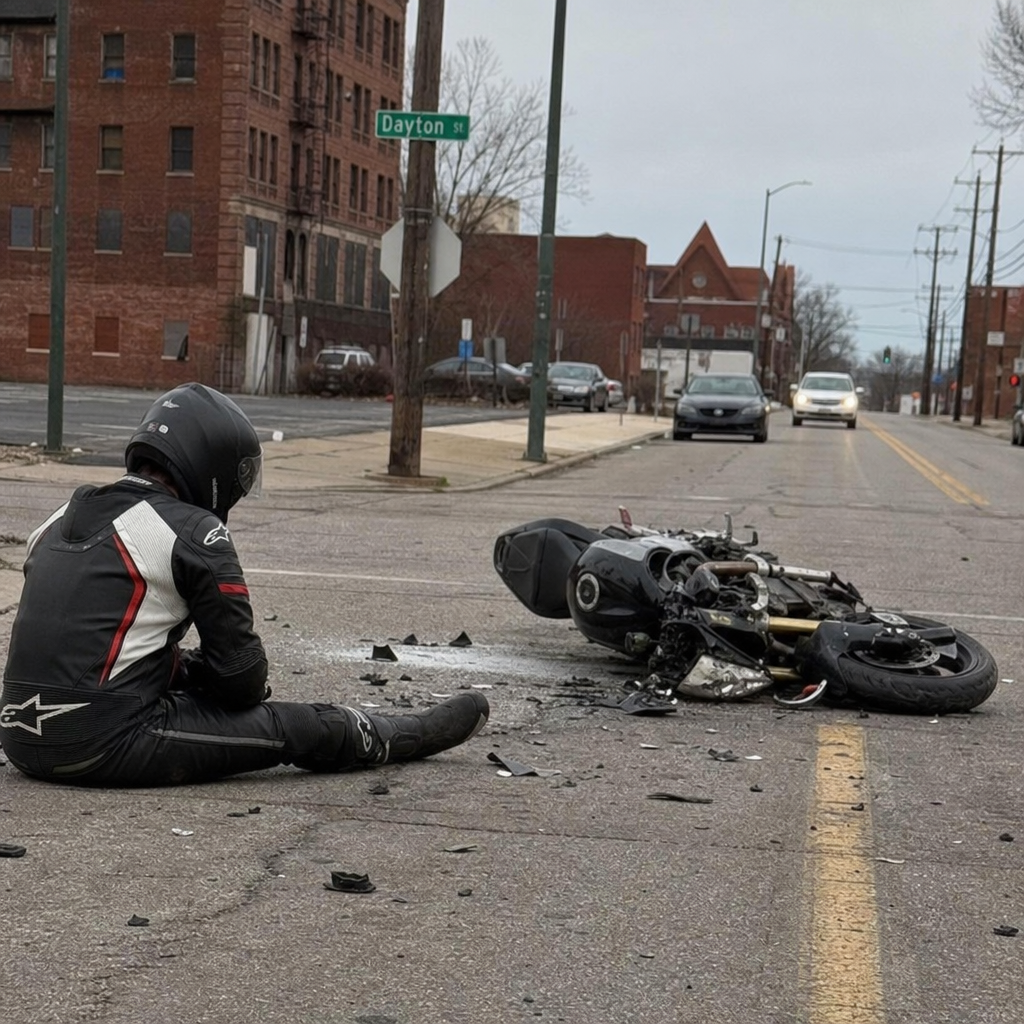
A missing helmet does not automatically prevent an injured rider from seeking compensation after a motorcycle crash in Dayton. Ohio law looks at who caused the collision, whether the rider was legally required to wear a helmet, and whether helmet use had anything to do with the injuries being claimed. For many riders, the stronger question is not “Was I wearing a helmet?” but “What evidence shows the other driver caused my losses?”
Call (937) 884-4474 or request a free consultation to speak with a Dayton motorcycle accident lawyer at Buckeye Law Group.
Can you still recover compensation if you were not wearing a helmet?
Yes, you may still be able to recover compensation after a Dayton motorcycle accident even if you were not wearing a helmet. Motorcycle accident claims usually turn on negligence: who failed to use reasonable care, how that failure caused the crash, and what losses followed. Ohio’s comparative fault rule allows an injured person to recover damages as long as the person’s share of fault is not greater than the combined fault of others, and any recovery is reduced by the person’s percentage of fault.
That means a helmet issue is not the same as causing a crash. If a driver turned left in front of you, drifted into your lane, ran a red light, or followed too closely, the main liability question is still the driver’s conduct. The insurance company may focus on helmet use because it can distract from the driver’s unsafe actions or reduce the value of the claim, especially when head, face, or brain injuries are involved. This is why many injured riders speak with motorcycle accident lawyers before accepting an insurance adjuster’s explanation of fault. A careful review can separate crash causation from injury causation, which is an important distinction in motorcycle crash compensation.
Ohio helmet law creates different rules for different riders
Ohio law does not require every motorcycle operator or passenger to wear a helmet. However, Ohio Revised Code § 4511.53 establishes specific helmet requirements based on a rider’s age, licensing status, and experience. Motorcycle operators under age 18 and those holding a license or endorsement with an active novice designation must wear a U.S. Department of Transportation (DOT) – approved helmet. These requirements also apply to passengers under 18 and passengers riding with operators subject to the helmet mandate. Additionally, motorcycle operators using a temporary instruction permit must wear an approved helmet and cannot carry passengers.
The Ohio Bureau of Motor Vehicles (BMV) explains that newly licensed motorcycle riders generally maintain novice status for one year. Ohio law also requires motorcycle operators and passengers to use appropriate protective eyewear, subject to limited exceptions for certain enclosed vehicles. Following a Dayton motorcycle accident, determining whether helmet requirements applied involves reviewing the circumstances of the collision and the rider’s legal obligations. A Dayton motorcycle accident lawyer may evaluate several important factors, including the rider’s age, motorcycle license or endorsement, novice designation, permit restrictions, and compliance with applicable Ohio safety laws. Importantly, Ohio law expressly restricts the use of violations of these helmet and protective-eyewear provisions in civil trials. Therefore, helmet use should not be treated as an automatic determination of negligence or liability
- Adult, Non-Novice Rider: You may not have been legally required to wear a helmet, though the insurer may still argue about injury severity.
- Rider Under 18: Helmet use is legally required.
- Novice Endorsement Holder: Helmet use is legally required during the novice period.
- Temporary Permit Rider: Additional permit restrictions may apply, including helmet requirements in specific circumstances.
- Passenger: The requirement can depend on the passenger’s age and whether the operator is in a category that requires helmet use.
Ohio’s helmet statute also says the helmet and eye-protection provisions, or a violation of them, shall not be used in the trial of a civil action. That language can matter when an insurer tries to turn a helmet dispute into a full defense, but the practical impact depends on the facts, pleadings, evidence, and court rulings in a specific case.
The difference between causing the crash and worsening an injury
A driver’s negligence may cause the collision even if the rider was not wearing a helmet. For example, if a car changes lanes without checking its blind spot and hits a motorcycle, the absence of a helmet did not cause the lane change. The rider’s claim may still include medical bills, lost income, motorcycle damage, pain and suffering, and other critical losses tied to the crash. The harder dispute often concerns injuries. If the rider suffered a broken leg, road rash, shoulder trauma, or spinal injury, helmet use may have little or no connection to those damages. If the rider suffered a concussion, skull fracture, facial injury, or traumatic brain injury, the insurance company may try to argue that a helmet would have reduced the harm. A Dayton motorcycle accident attorney may respond by focusing on medical evidence rather than assumptions. The key questions are whether the helmet issue is legally admissible, whether it is medically supported, and whether the defense can prove that nonuse actually caused a specific portion of the damages. Without that proof, a broad “no helmet, no compensation” argument is far too simplistic.
What compensation may be available after a Dayton motorcycle crash?
Motorcycle accident compensation in Dayton can include both financial losses and human losses. The value of a claim depends on the severity of the injuries, the available insurance, the evidence of fault, and the long-term effect on the rider’s life. Common categories may include:
- Emergency Medical Care and Hospitalization: Compensation may include ambulance transportation, emergency room evaluations, diagnostic imaging, surgical procedures, intensive care, and inpatient hospitalization. Serious motorcycle injuries, including traumatic brain injuries, spinal cord damage, and complex fractures, may require extensive medical intervention.
- Ongoing Medical Treatment and Rehabilitation: Injured motorcyclists may require physical therapy, occupational therapy, specialist appointments, prescription medications, or additional surgical procedures. When injuries cause lasting complications, a claim may also account for reasonably anticipated future medical expenses supported by medical evidence.
- Lost Wages and Reduced Earning Capacity: Motorcycle injuries may prevent individuals from returning to work during recovery. Compensation may address documented lost wages, missed employment opportunities, and lost employment benefits. If permanent limitations affect a person’s ability to perform their previous job or earn comparable income, diminished future earning capacity may also be considered.
- Motorcycle and Personal Property Damage: A motorcycle accident claim may involve the reasonable cost of repairing or replacing a damaged motorcycle, subject to applicable valuation and coverage rules. Additional losses may include damaged helmets, protective jackets, riding boots, gloves, and other safety equipment, along with reasonable towing and storage expenses.
- Physical Pain and Emotional Suffering: Beyond financial expenses, motorcycle injuries can substantially affect a person’s quality of life. Recoverable noneconomic damages may include physical pain, emotional distress, anxiety, sleep disturbances, and the inability to participate in recreational activities or ordinary daily routines.
- Permanent Disability, Scarring, and Disfigurement: Severe motorcycle accidents may result in permanent nerve damage, reduced mobility, amputations, visible scarring, or lasting neurological impairments. When supported by medical evidence, these injuries may affect the evaluation of future care needs, employment limitations, and noneconomic damages.
- Additional Out-of-Pocket Expenses: Depending on the severity of the injuries, recoverable expenses may include medically necessary transportation, mobility aids, home accessibility modifications, or assistance with essential daily activities. These expenses should be reasonable, related to the accident, and supported by appropriate documentation.
Motorcycle accident compensation in Dayton, Ohio, involves more than determining a potential settlement amount. A thorough evaluation requires examining liability, the severity of the injuries, available insurance coverage, and the financial and personal consequences of the collision. Supporting evidence may include police reports, medical records, treatment expenses, employment and wage documentation, photographs, motorcycle repair estimates, witness statements, and expert opinions when appropriate. An experienced Dayton motorcycle accident lawyer can evaluate this evidence to help establish the connection between the accident and the damages being sought, including ongoing medical needs, lost earning capacity, and pain and suffering.
How Insurers Use Helmet Arguments
Insurance companies often look for ways to reduce payouts in motorcycle accident claims. Helmet use can become one of those pressure points, especially because motorcyclists already face unfair stereotypes about risk-taking. An adjuster may imply that you were careless, that your injuries are your fault, or that a jury would blame you for the accident.
Those statements are not the same as legal proof. Ohio’s comparative fault system requires percentages of fault tied to the injury or loss, and damages are reduced only according to the plaintiff’s share of fault when recovery is still allowed. If the other driver’s negligence is well documented, the insurer should not be allowed to ignore that evidence simply because the rider was not wearing a helmet. A Dayton motorcycle crash lawyer may challenge helmet-based arguments by asking practical questions:
- Was the Motorcyclist Legally Required to Wear a Helmet? Under Ohio Revised Code § 4511.53, helmet requirements generally apply to riders under 18, novice motorcycle operators, temporary permit holders, and certain passengers. Determining whether the law required a helmet is an important part of evaluating the circumstances surrounding the accident.
- Did the Absence of a Helmet Contribute to the Collision? Helmet use and accident liability are separate legal considerations. Investigators must examine whether speeding, distracted driving, failure to yield, or another negligent act caused the collision. A motorcyclist’s decision not to wear a helmet does not, by itself, establish responsibility for the crash.
- Which Injuries Are Relevant to the Helmet Dispute? An evaluation should distinguish between injuries potentially affected by helmet use and those unrelated to head protection. For example, a helmet generally would not prevent a broken leg or other injuries caused by direct impact to the lower extremities. Any dispute over injury severity should be supported by reliable medical evidence.
- Is There Sufficient Medical or Accident Reconstruction Evidence? When an insurer questions whether a helmet could have prevented or reduced an injury, the analysis should consider medical records, diagnostic imaging, accident reconstruction findings, and qualified expert opinions when appropriate. Unsupported assumptions should not substitute for an evidence-based evaluation.
- Did Another Driver’s Negligence Cause the Motorcycle Accident? Establishing liability requires examining the actions of everyone involved. Traffic violations, unsafe lane changes, failure to maintain a proper lookout, and failure to yield may provide important evidence of driver negligence. A Dayton motorcycle accident lawyer will evaluate available evidence to determine how Ohio negligence laws apply to your claim.
This approach keeps the claim grounded in evidence instead of bias.
Steps to protect your claim after a no-helmet motorcycle accident
What you do after the crash can affect the strength of your case. Even if you are worried about helmet use, do not assume you have no claim. Focus on preserving evidence and getting medical clarity. Use this checklist as a starting point:
- Seek Prompt Medical Attention: Head, neck, and internal injuries may not produce immediate symptoms following a severe motorcycle accident.
- Follow Your Treatment Plan: Attend recommended appointments and document any delays or barriers to medical care.
- Preserve Crash Evidence: Keep damaged riding gear, photographs, motorcycle repair estimates, and other relevant evidence that can support your claim.
- Obtain the Police Report: Review documented road conditions, witness information, citations, and the responding officer’s observations.
- Exercise Caution With Insurers: Understand your policy obligations and consider obtaining legal advice before providing recorded statements.
- Limit Social Media Activity: Avoid posting crash-related information that insurers could misinterpret or use to dispute your claim.
- Document Financial and Personal Losses: Maintain medical bills, wage records, receipts, and a journal describing your injuries and recovery process.
- Consult a Dayton Motorcycle Accident Lawyer: Early legal guidance can help preserve time-sensitive evidence and evaluate your rights available under Ohio law.
These steps are useful in almost any motorcycle injury case, but they are especially important when the insurer is likely to raise a helmet defense.
A Local Legal Review Can Clarify the Real Value of Your Case
Every motorcycle crash has its own facts. A rider who was not wearing a helmet may still have a strong claim if another driver caused the collision and the evidence supports the damages. At the same time, helmet status, age, license designation, injury type, and medical proof can all affect strategy.
That is why the question “Can You Recover Compensation After a Motorcycle Accident in Dayton if You Were Not Wearing a Helmet?” should not be answered with a simple yes or no. Failing to wear a helmet does not automatically prevent an injured motorcyclist from pursuing compensation. However, helmet nonuse may raise legal and evidentiary questions that require careful evaluation. If you were injured in a Dayton motorcycle crash, consider speaking with local motorcycle accident lawyers who understand Ohio helmet rules, comparative fault, and insurance defense tactics. The sooner a Dayton motorcycle accident attorney reviews the evidence, the easier it may be to protect your right to pursue fair motorcycle crash compensation.
Call (937) 884-4474 or request a free consultation to speak with a Dayton motorcycle accident lawyer at Buckeye Law Group.
*This article provides general information about Ohio motorcycle helmet laws and how helmet use may relate to motorcycle accident injury claims in Dayton, Ohio. This article is intended for educational purposes only and does not constitute legal advice. Reading this article or contacting Buckeye Law Group does not, by itself, create an attorney-client relationship. Under Ohio law, motorcycle helmet requirements depend on factors such as the rider’s age and licensing status. Dayton motorcycle accident claims may involve driver negligence, disputed liability, helmet-related questions, insurance coverage, medical expenses, lost wages, and applicable filing deadlines. Evaluating a claim requires examining accident reports, medical records, evidence of negligence, injury causation, and applicable Ohio laws. Not wearing a helmet does not automatically prevent an injured motorcyclist from pursuing compensation. Consult a qualified Dayton motorcycle accident lawyer at Buckeye Law Group to better understand your legal rights, helmet requirements, and available options for pursuing an injury claim. Every case is different, and prior results do not guarantee a similar outcome.*
Can You Recover Compensation After a Motorcycle Accident in Dayton if You Were Not Wearing a Helmet?
A missing helmet does not automatically prevent an injured rider from seeking compensation after a motorcycle crash in Dayton. Ohio law looks at who caused the collision, whether the rider
Who Can File a Wrongful Death Lawsuit in Toledo, Ohio?
When someone dies as a result of another person’s negligence, recklessness, or wrongful conduct, Ohio law may allow surviving family members to seek compensation through a civil claim known as
Who Is Liable After a Commercial Truck Accident on I-75 Near Dayton?
A commercial truck crash on I-75 near Dayton can involve more than one responsible party. The driver may be part of the story, but truck accident liability often turns on
What Happens When a Pedestrian Is Hit by a Car in Downtown Dayton?
When a pedestrian is hit by a car in downtown Dayton, the first priorities are medical care, safety, and creating a clear record of what happened. After the scene is
How Do You Prove a Slip and Fall Injury Claim in Dayton, Ohio?
A slip and fall injury claim in Dayton, Ohio, usually comes down to evidence: what dangerous condition caused the fall, who was responsible for the property, whether they knew or
What Are Common Signs of Medical Malpractice in Toledo Hospitals?
Medical malpractice can be difficult to recognize because poor outcomes sometimes happen even when doctors, nurses, and hospitals do everything right. Still, certain warning signs may suggest that a preventable
How an Ohio car accident lawyer helps negotiate with insurance companies
After a crash, the insurance process can feel like a second accident: confusing, stressful, and full of pressure to make quick decisions. Understanding how an Ohio car accident lawyer helps
What Evidence is Needed After a Commercial Truck Accident in Akron, Ohio?
After a commercial truck crash in Akron, the strongest claim is usually built from evidence gathered quickly, preserved properly, and connected to the real cause of the collision. Useful evidence
Most dangerous roads and intersections in Akron, Ohio
Akron has plenty of everyday driving pinch points: quick merges, busy arterials, short downtown blocks, and neighborhood streets where drivers, walkers, and cyclists all share a common space. The latest
What Happens After a Dog Bite in Dayton, Ohio?
A dog bite can turn an ordinary walk, delivery stop, visit, or neighborhood errand into a confusing medical and legal situation. In Dayton and the surrounding Montgomery County area, the
Buckeye Law Group represents people injured in auto accidents, slip and falls, workplace accidents and more in Ohio. Contact us today to learn more.
© 2026 All Rights Reserved | The Buckeye Law Group Inc. Privacy Policy Sitemap
Office Locations
- Akron Office 388 S Main St #400 Akron, OH 44311 (330) 426-0288
- Cincinnati Office 201 E 5th St Ste 1910 Cincinnati, OH 45202 (513) 547-2445
- Cleveland Office 127 Public Square Ste 1540 Cleveland, OH 44114 (216) 677-5490
- Columbus Office 20 E Broad St Suite 300 Columbus, OH 43215 (614) 482-3793
- Dayton Office 70 Birch Alley Ste 240 Dayton, OH 45440 (937) 884-4474
- Euclid Office 25701 N Lakeland Blvd Suite 113-C, Cleveland, OH 44132 (216) 405-2626
- Mansfield Office 305 E Main St Ste 6A, Mansfield, OH 44904 (567) 210-2606
- Findlay Office 7430 Timberstone Dr unit 101a, Findlay, OH 45840 419-873-5119
- Mentor Office 7537 Mentor Ave Ste 101, Mentor, OH 44060 (440) 306-3536
- Middletown Office 300 N Main St #400, Middletown, OH 45042 (326) 800-9150
- Parma Office 1257 Rockside Rd #A, Parma, OH 44131 (216) 279-1664
- Springfield Office 2100 E High St Ste TL3, Springfield, OH 45505 (937) 806-5791
- Toledo Office 3950 Sunforest Ct Ste 200, Toledo, OH 43623 (567) 483-3883
- Westlake Office 26404 Center Ridge Rd Ste B2, Westlake, OH 44145 216-247-0565
- Whitehall Office 5340 E Main St Ste 203, Whitehall, OH 43213 (380) 257-5206
- Youngstown Office 306 Churchill Hubbard Rd, Youngstown, OH 44505 (234) 225-0683
Contact Us
© 2026 All Rights Reserved | The Buckeye Law Group Inc. Privacy Policy Sitemap