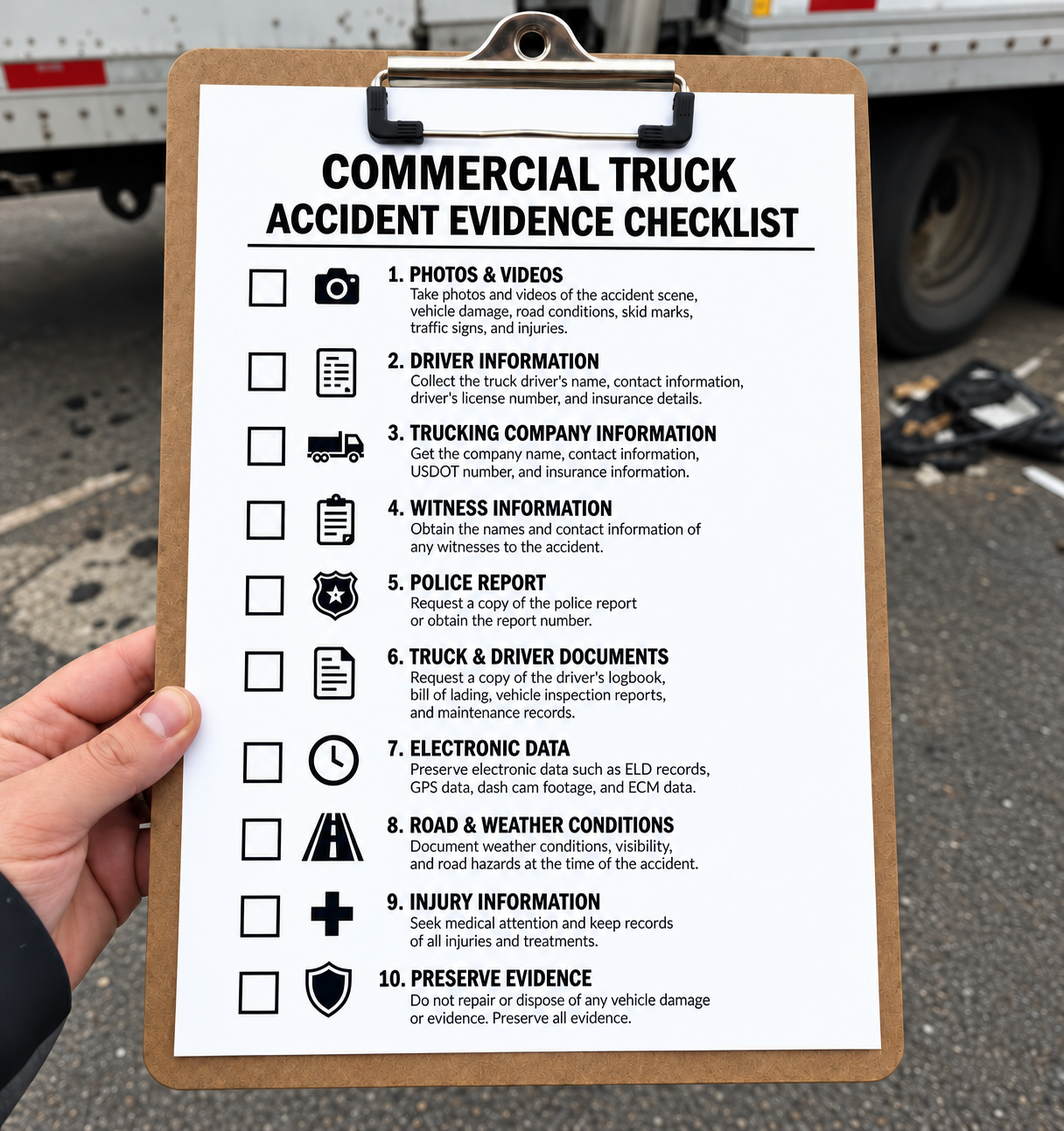
After a commercial truck crash in Akron, the strongest claim is usually built from evidence gathered quickly, preserved properly, and connected to the real cause of the collision. Useful evidence can include photos, medical records, witness information, police documentation, electronic truck data, maintenance records, driver logs, and company safety materials. Because some trucking records may be overwritten or kept for limited periods, early action can make a major difference in what is available later.
This article explains the main types of truck accident evidence, why they matter, and how an Akron truck accident lawyer or commercial truck accident attorney may help protect records before they disappear.
Call (330) 426-0288 or request a complimentary consultation to speak with a local Akron truck accident attorney at Buckeye Law Group.
What evidence is needed after a commercial truck accident in Akron, Ohio?
The key evidence after a commercial truck accident in Akron, Ohio, typically includes crash-scene proof, vehicle damage documentation, medical records, witness statements, law enforcement reports, trucking company records, driver qualification information, electronic logging data, cargo documents, and any available video. Each category helps answer a different question: what happened, who contributed to the crash, whether commercial truck safety rules were followed, and how the crash affected the injured person.
Truck accident evidence is different from evidence in an ordinary passenger-vehicle crash because commercial vehicles often generate records before, during, and after a trip. Federal Motor Carrier Safety Administration guidance says motor carriers must retain records of duty status and supporting documents for six months, and those supporting documents may include bills of lading, dispatch records, electronic mobile communication records, payroll records, and similar materials.
Scene Evidence Creates the First Picture of What Happened
The scene changes quickly after a crash. Vehicles are moved, skid marks fade, debris is cleared, and weather or traffic conditions shift. If it is safe to do so, scene documentation can help preserve details that may not appear fully in a later report. Useful crash-scene evidence may include:
- Photos and videos of all vehicles from multiple angles, including close-ups of impact points.
- Roadway conditions, such as construction zones, potholes, lane closures, standing water, snow, ice, or poor lighting.
- Traffic control devices, including stop signs, traffic lights, yield signs, lane markings, and warning signs.
- Skid marks, gouge marks, fluid trails, and debris fields that may help show movement before and after impact.
- The truck’s identifying information, including company name, USDOT number if visible, license plate, trailer number, and cab number.
- Cargo clues, such as spilled freight, shifted loads, broken straps, open trailer doors, or visible overloading concerns.
- Weather and visibility conditions, especially if fog, glare, rain, or nighttime lighting played a role.
Do not put yourself in danger to collect evidence. If you are injured, traffic is moving, or emergency personnel are controlling the scene, focus on getting medical help and letting trained responders do their work.
Medical Records Connect the Crash to the Injury
Medical evidence is not just about proving that someone was hurt. It also helps connect the injury to the crash, document the treatment timeline, and show how symptoms affected daily life. After a truck crash, it is common for adrenaline to mask pain, so getting evaluated promptly can matter even if symptoms seem manageable at first.
Important medical documentation may include emergency room records, imaging results, physician notes, specialist referrals, physical therapy records, prescriptions, work restrictions, and future treatment recommendations. Keep copies of discharge papers and follow-up instructions. If you miss work, need help with daily activities, or cannot drive, keep a simple journal that tracks those changes. A truck accident attorney may use medical records alongside other evidence, such as vehicle damage and witness statements, to show the force of the collision and the practical effect of the injuries.
Police Reports and Official Records Matter, But They Are Not the Whole Case
Law enforcement documentation can be a useful starting point. A report may identify drivers, vehicles, insurance information, witnesses, citations, diagrams, and the responding agency’s observations. In Ohio, a person claiming an interest arising out of a motor vehicle accident, or that person’s attorney, may obtain the submitted report and related documents from the law enforcement agency upon payment of the applicable fee.
The Ohio Department of Public Safety also provides an online crash report search, but it notes that reports shown there are not official court documents and that the investigating agency is the official record keeper. The site also notes that crash reports may take up to six weeks to appear online.
That means a police report is helpful, but it should not be treated as the only source of truth. Reports can omit details, rely on early information, or lack access to trucking company records. A commercial truck accident attorney may look beyond the report to determine whether fatigue, maintenance problems, distraction, cargo issues, route pressure, or training failures contributed to the crash.
Who Should You Contact After a Commercial Truck Accident in Akron, Ohio?
After a commercial truck accident in Akron, knowing which local agencies to contact can help protect your safety, document the collision, and preserve evidence. Whether the crash occurred along Interstate 77, Interstate 76, Route 8, or a busy roadway such as East Market Street or South Arlington Street, the appropriate resources depend on the collision’s location and circumstances. In addition to seeking medical attention, injured individuals should identify the investigating law enforcement agency, obtain the official crash report, and preserve records that may support an Ohio truck accident claim.
Akron Police Department
For commercial truck accidents investigated by the Akron Police Department, individuals can request accident documentation through the department’s online records portal.
- Records Division: (330) 375-2950
- Address: 217 S. High Street, Room 208, Akron, OH 44308
- Online resource: Akron Police Traffic Crash Reports
Crash reports may contain driver information, witness statements, vehicle descriptions, diagrams, and the investigating officer’s observations. These records provide an important starting point, although additional evidence may be necessary to establish liability.
Ohio State Highway Patrol
Commercial truck collisions on highways surrounding Akron, including I-77, I-76, and Route 8, may be investigated by the Ohio State Highway Patrol.
- Highway assistance: #677
- Crash reports: Ohio Department of Public Safety Crash Retrieval
- Additional records: Ohio State Highway Patrol Services
Highway patrol documentation may be particularly valuable in crashes involving tractor-trailers, multiple vehicles, interstate travel, or complex roadway conditions. The investigating agency can explain how to request available reports and supporting materials.
Summit County Sheriff’s Office
When a truck accident occurs within the jurisdiction of the Summit County Sheriff’s Office, the department may maintain the accident report and related investigative records.
- General contact: (330) 643-2154 , Address: 53 University Ave., Akron, Ohio, 44308
- Accident report requests: (330) 643-2176 or their request form
- Official resource: Summit County Sheriff’s Office Records and Reports
Requesting the correct report early can help identify involved drivers, insurance information, contributing circumstances, and potential witnesses.
Akron Emergency Medical Resources
Serious truck accidents can cause traumatic brain injuries, spinal injuries, fractures, and internal injuries. Prompt medical evaluation helps protect an injured person’s health and creates records documenting the injuries and treatment received. Two local hospitals offering emergency and trauma services include:
- Summa Health Akron Emergency Department: 151 N. Forge Street, Akron, OH 44304. Telephone: (330) 375-3361. The facility provides Level I trauma services.
- Cleveland Clinic Akron General: 1 Akron General Avenue, Akron, OH 44307. Telephone: (330) 344-6000. The hospital operates a Level 1 trauma center and emergency department.
For serious or potentially life-threatening injuries, call 911 and follow emergency responders’ instructions rather than attempting to drive yourself.
Why Local Documentation Matters in an Akron Truck Accident Claim
The location of a commercial truck collision can influence which agency investigates, where relevant evidence is maintained, and which witnesses or businesses may possess useful information. For example, a collision near the I-76 and I-77 interchange may involve highway traffic patterns, lane changes, or commercial vehicle movements. A crash on East Market Street or South Arlington Street may require additional examination of traffic signals, business surveillance footage, intersections, and nearby witnesses. Documenting the exact location, direction of travel, roadway conditions, and responding agency can help an Akron truck accident attorney identify evidence before it becomes unavailable.
Trucking Company Records Can Reveal Safety Issues
Commercial truck cases often turn on records controlled by the trucking company, broker, shipper, maintenance provider, or another business involved in the trip. These documents can show whether the truck and driver were properly prepared before the collision. Potential company records include:
- Driver qualification files showing licensing, employment history, training, medical certification, and safety background.
- Hours-of-service records showing driving time, on-duty time, rest breaks, and potential fatigue issues.
- Dispatch communications showing delivery instructions, timing pressure, route changes, or warnings.
- Bills of lading and cargo records showing what was being hauled, where it came from, and where it was going.
- Inspection, repair, and maintenance records showing whether brakes, tires, lights, steering, and other systems were maintained.
- Post-crash investigation materials created by the company or its insurer.
- Safety policies and training materials that may show what the company required and whether those rules were followed.
Because many of these materials are not in the injured person’s possession, preservation is important to your claim. An attorney can send a notice asking relevant parties to preserve records, electronic data, vehicle components, photographs, and internal communications.
Electronic Data May Show Speed, Braking, and Driver Behavior
Modern commercial vehicles often contain or connect to several electronic systems. Depending on the vehicle and carrier, available data may include electronic logging device records, GPS location history, engine control module data, dash camera footage, lane-departure alerts, hard-braking events, fleet-management messages, and telematics reports.
This data can be valuable because it may show what happened seconds, minutes, or hours before the crash. For example, it may help determine whether the truck slowed before impact, whether the driver had been on duty for a long period, or whether the route matched dispatch records.
Federal guidance on electronic logging devices states that a motor carrier must retain ELD records of duty status data and supporting documents for six months. That limited retention period is one key reason people often contact an akron truck accident lawyer soon after a serious crash.
Witnesses and Video Can Fill Important Gaps
Witnesses may notice facts that drivers miss in the shock of a collision. A witness might have seen the truck drifting between lanes, speeding, tailgating, running a red light, losing cargo, or braking too late. Even a short statement can help identify the sequence of events. If possible, collect witness names, phone numbers, email addresses, and a brief note about what they saw. Nearby businesses, homes, buses, parking lots, traffic cameras, or dash cameras may also have video. The challenge is that video may be automatically deleted, recorded over, or difficult to locate later. When video exists, timing matters. A prompt request to preserve footage may be the difference between having objective proof and relying only on memory.
Evidence Can Also Show Whether Commercial Truck Safety Rules Were Followed
Commercial truck safety involves more than how the driver behaved in the final seconds before impact. It can include driver hiring, training, supervision, vehicle maintenance, route planning, cargo loading, and compliance monitoring.
For example, if a crash involved a fatigued driver, the relevant evidence may include ELD records, supporting documents, dispatch messages, fuel receipts, toll records, and payroll records. If a crash involved brake failure, maintenance logs, inspection reports, repair invoices, and the physical condition of the truck may matter. If cargo shifted or spilled, loading diagrams, weight tickets, bills of lading, and shipper communications may become important.
FMCSA guidance also describes post-accident testing requirements for certain commercial motor vehicle crashes. In fatality crashes, testing is required; in bodily-injury or tow-away crashes, testing requirements can depend on whether a citation is issued within specified time periods.
What Should You Do in the Days After the Crash?
The first few days after a commercial truck accident can feel overwhelming. A simple plan helps you protect your health and preserve information without trying to investigate everything yourself. Use this checklist as a practical starting point:
- Get Medical Care and Follow the Treatment Plan: Gaps in care can make it harder to explain the injury timeline.
- Save Every Document: Keep medical bills, repair estimates, towing papers, rental car receipts, prescriptions, and insurance letters.
- Photograph Injuries and Property Damage: Take updated photos as bruising, swelling, or vehicle repairs change over time.
- Write Down What You Remember: Include time, location, direction of travel, weather, traffic, impact sequence, and conversations at the scene.
- Avoid Giving Recorded Statements Without Understanding Your Rights: Insurance adjusters may ask questions before you know the full extent of your injuries.
- Do Not Post Details Online: Social media posts can be taken out of context.
- Ask about Preservation of Trucking Evidence: Company records, vehicle data, and video may need to be requested quickly.
Ohio law generally requires actions for bodily injury or injury to personal property to be brought within two years after the cause of action accrues, with the statute stating that the cause usually accrues when the injury or loss occurs. Deadlines can depend on the facts, so anyone considering a claim should seek legal advice about their specific situation.
An Attorney Can Help Preserve and Organize the Evidence
A serious truck crash can involve multiple insurance companies, corporate defendants, investigators, and technical records. An injured person may not know which company owned the tractor, who leased the trailer, who loaded the cargo, or whether a broker or maintenance contractor played a role. That is one reason a truck accident attorney may begin by identifying every potentially responsible party.
An Akron truck accident lawyer may help by sending preservation letters, requesting official reports, locating video, interviewing witnesses, reviewing medical records, consulting accident reconstruction or trucking safety professionals when appropriate, and communicating with insurers. A commercial truck accident attorney can also help separate strong evidence from distractions, which is important when the file contains hundreds or thousands of pages. The goal is not to collect evidence for its own sake. The goal is to build a clear, supported account of how the collision happened, why it could have been prevented, and how it changed the injured person’s life.
Critical Evidence to Preserve After a Commercial Truck Accident in Akron, Ohio
The most critical evidence following a commercial truck accident in Akron, Ohio, is evidence that establishes liability, identifies potential violations of trucking safety regulations, demonstrates the connection between the collision and the injuries sustained, and documents the full extent of the injured party’s economic and non-economic damages. Photos, medical records, police documentation, witness information, electronic truck data, driver logs, maintenance records, and cargo documents can all play important roles. Because some records may be temporary or controlled by trucking companies, early preservation is often one of the most important steps after a serious crash.
Call (330) 426-0288 or request a complimentary consultation to speak with an Akron truck accident attorney at Buckeye Law Group.
*This article provides general information about commercial truck accidents in Akron, Ohio, and the legal considerations injured individuals may face when pursuing compensation. It is intended for educational purposes only and does not constitute legal advice. Reading this article or contacting Buckeye Law Group does not, by itself, create an attorney-client relationship. Akron truck accident claims may involve driver negligence, trucking company liability, federal safety regulations, insurance coverage, medical expenses, lost income, electronic truck data, and applicable filing deadlines. Evaluating a claim requires reviewing available evidence, identifying responsible parties, and assessing damages under Ohio law. Depending on the circumstances, investigations may involve local law enforcement, medical providers, or Summit County courts. Consult a qualified Akron truck accident attorney regarding your legal rights and available options. Every case is different, and prior results do not guarantee a similar outcome.*
What Evidence is Needed After a Commercial Truck Accident in Akron, Ohio?
After a commercial truck crash in Akron, the strongest claim is usually built from evidence gathered quickly, preserved properly, and connected to the real cause of the collision. Useful evidence
Most dangerous roads and intersections in Akron, Ohio
Akron has plenty of everyday driving pinch points: quick merges, busy arterials, short downtown blocks, and neighborhood streets where drivers, walkers, and cyclists all share a common space. The latest
What Happens After a Dog Bite in Dayton, Ohio?
A dog bite can turn an ordinary walk, delivery stop, visit, or neighborhood errand into a confusing medical and legal situation. In Dayton and the surrounding Montgomery County area, the
Wrongful Death Lawyers in Akron and How Local Ohio Attorneys Can Provide the Legal Resources Your Family Deserves
When a loved one dies because of another person’s carelessness, unsafe choices, or misconduct, the family is left with grief, unanswered questions, and often sudden financial pressure. Ohio law allows
How Can Cleveland Wrongful Death Lawyers Help Families Protect Their Rights and Pursue Compensation?
When a preventable death changes your family’s future, the legal process can feel impossible to face. Wrongful death lawyers in Cleveland can help families understand Ohio law, preserve evidence, deal
How to Document Lost Wages After a Columbus Car Accident
After a Columbus car accident, lost wage documentation is the paper trail that shows how your injuries reduced your income. The stronger that trail is, the easier it is to
How Can a Personal Injury Attorney Help After a Bicycle Accident in Middletown, Ohio?
A bicycle crash can turn an ordinary ride into a medical, financial, and legal problem in seconds. If you were hurt in a Middletown bicycle accident, a personal injury attorney
Columbus Bicycle Accidents and What to Do After A Crash
A bicycle crash can turn an ordinary ride through Columbus into a medical, financial, and legal problem in seconds. Whether the collision happens near Downtown, in the University District, along
Injured in a Columbus Rental Car Accident? Which Insurance Documents Matter
A rental car crash can turn into an insurance maze quickly, especially when someone is injured. After a Columbus rental car accident, the documents that matter most are the ones
Dog Bite at a Columbus Home or Apartment What Information Should You Preserve
A dog bite in a home, rental unit, hallway, courtyard, or apartment complex can become both a medical emergency and a legal problem within minutes. The information you preserve immediately

Buckeye Law Group represents people injured in auto accidents, slip and falls, workplace accidents and more in Ohio. Contact us today to learn more.
© 2026 All Rights Reserved | The Buckeye Law Group Inc. Privacy Policy Sitemap
Office Locations
- Akron Office 388 S Main St #400 Akron, OH 44311 (330) 426-0288
- Cincinnati Office 201 E 5th St Ste 1910 Cincinnati, OH 45202 (513) 547-2445
- Cleveland Office 127 Public Square Ste 1540 Cleveland, OH 44114 (216) 677-5490
- Columbus Office 20 E Broad St Suite 300 Columbus, OH 43215 (614) 482-3793
- Dayton Office 70 Birch Alley Ste 240 Dayton, OH 45440 (937) 884-4474
- Euclid Office 25701 N Lakeland Blvd Suite 113-C, Cleveland, OH 44132 (216) 405-2626
- Mansfield Office 305 E Main St Ste 6A, Mansfield, OH 44904 (567) 210-2606
- Findlay Office 7430 Timberstone Dr unit 101a, Findlay, OH 45840 419-873-5119
- Mentor Office 7537 Mentor Ave Ste 101, Mentor, OH 44060 (440) 306-3536
- Middletown Office 300 N Main St #400, Middletown, OH 45042 (326) 800-9150
- Parma Office 1257 Rockside Rd #A, Parma, OH 44131 (216) 279-1664
- Springfield Office 2100 E High St Ste TL3, Springfield, OH 45505 (937) 806-5791
- Toledo Office 3950 Sunforest Ct Ste 200, Toledo, OH 43623 (567) 483-3883
- Westlake Office 26404 Center Ridge Rd Ste B2, Westlake, OH 44145 216-247-0565
- Whitehall Office 5340 E Main St Ste 203, Whitehall, OH 43213 (380) 257-5206
- Youngstown Office 306 Churchill Hubbard Rd, Youngstown, OH 44505 (234) 225-0683
Contact Us
© 2026 All Rights Reserved | The Buckeye Law Group Inc. Privacy Policy Sitemap