A slip and fall injury claim in Dayton, Ohio, usually comes down to evidence: what dangerous condition caused the fall, who was responsible for the property, whether they knew or should have known about the hazard, and how the injury changed your life. Proving the claim is not just about showing that you fell; it is about connecting the fall to negligence and documenting your damages clearly. This guide explains the practical steps injured people can take after a slip & fall accident Dayton residents might experience at a store, apartment building, sidewalk, restaurant, office, or other property.
Call (937) 884-4474 or request a free consultation today to speak with a Dayton slip and fall lawyer at Buckeye Law Group.
What do you have to prove after a slip and fall in Dayton?
To prove a slip and fall claim, you generally need to show that a property owner, tenant, manager, or another responsible party failed to use reasonable care and that this failure caused your injuries. In many Ohio premises liability cases, the injured person must identify the specific hazard, explain why it was dangerous, show that the responsible party had actual or constructive notice of it, and prove damages such as medical bills, lost income, pain, and limitations in daily life. Ohio law also recognizes defenses, including arguments that the condition was open and obvious or that the injured person shares fault.
That may sound technical, but the idea is straightforward: evidence wins or loses these cases. A wet floor, broken step, icy entryway, uneven pavement, torn carpet, poor lighting, or spilled merchandise must be documented before it disappears. The more detail you can preserve early, the stronger the foundation for a Dayton premises liability claim.
The evidence that matters most
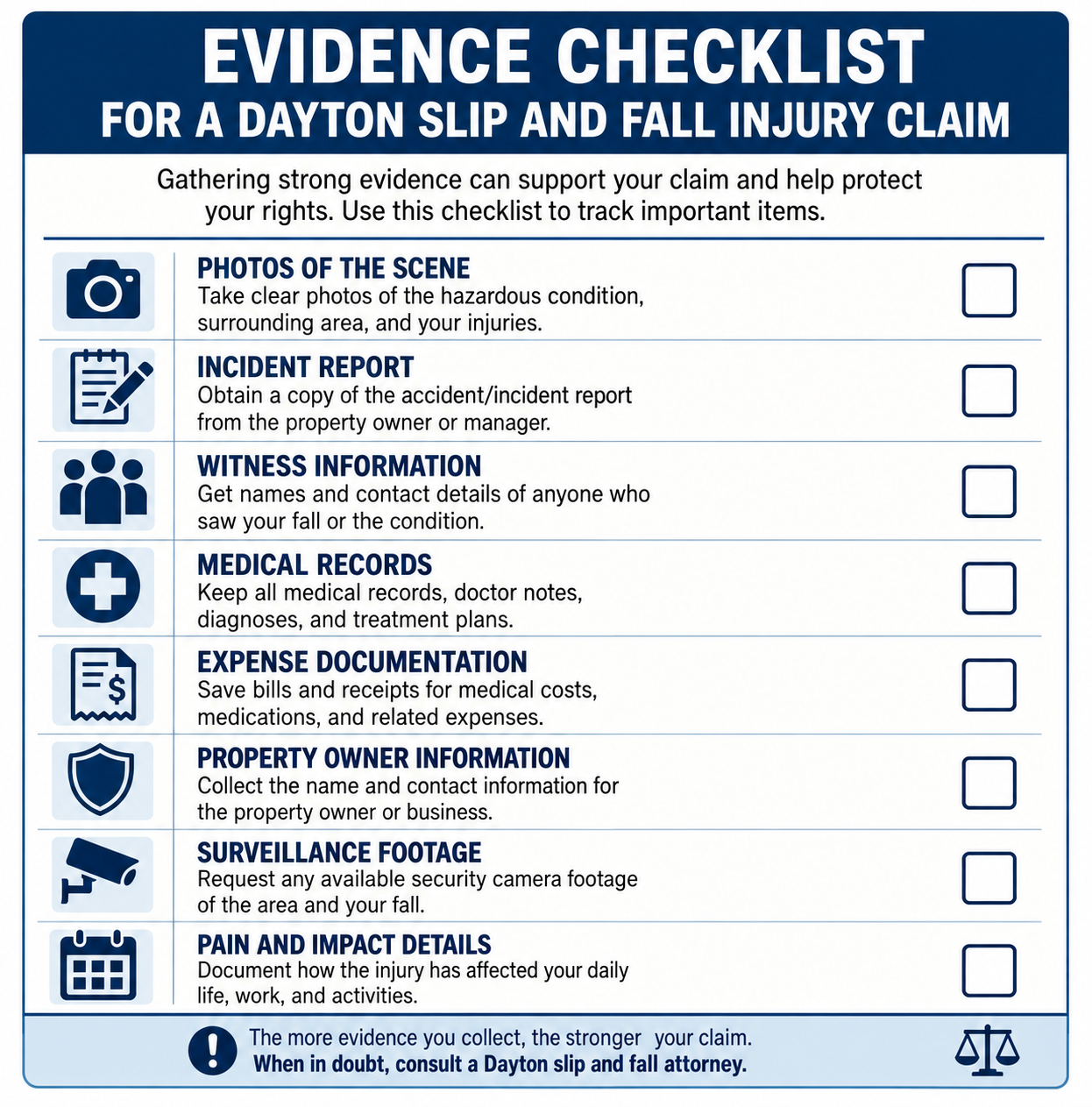
A fall can happen in seconds, but the proof is built from many small details. If you are physically able, begin gathering information as soon as possible. If you cannot, ask a friend, family member, or witness to help. Important evidence may include:
- Photos and Videos of the Hazard: Capture the spill, ice, broken flooring, missing warning sign, poor lighting, or obstruction from several angles.
- The Exact Location: Note the business name, address, aisle number, stairwell, parking lot area, apartment building entrance, or sidewalk section.
- Incident Reports: Ask the store, landlord, or manager to create a written report and request a copy if available.
- Witness Information: Get names and contact details for anyone who saw the fall, the hazard, or employees discussing it.
- Footwear and Clothing: Save the shoes you wore and avoid cleaning or altering them.
- Medical Records: Seek care promptly and tell medical providers exactly how the fall happened.
- Surveillance Video: Many businesses overwrite footage quickly, so an attorney may need to send a preservation letter.
A Dayton slip and fall attorney will often look for evidence showing how long the dangerous condition existed. For example, a fresh spill may be harder to prove than a leak with water stains, repeated complaints, or a history of prior falls. In a premises liability Dayton, Ohio, case, the timeline can be just as important as the hazard itself.
Notice is often the center of the case
Property owners are not automatically responsible for every injury on their property. In Ohio, the duty owed often depends on why the injured person was there, such as whether they were a business visitor, social guest, or trespasser. Business invitees are generally owed ordinary care, including reasonable steps to keep the premises safe and warnings about hidden dangers the owner knows or should know about.
“Notice” means the responsible party knew or reasonably should have known about the danger. Actual notice might involve an employee seeing a spill and ignoring it. Constructive notice can exist when a hazard was present long enough that reasonable inspection or maintenance should have discovered it. Evidence such as dirty liquid, footprints through a spill, prior complaints, maintenance logs, or security footage may help show constructive notice.
This is why quick action matters. Floors are cleaned, weather changes, repairs are made, and witnesses move on with their lives. A fall injury lawyer may investigate whether a store followed its inspection schedule, whether an apartment owner ignored maintenance requests, or whether a property manager failed to fix a recurring hazard.
How does the “open and obvious” defense affect a claim?
The open and obvious defense can affect a claim because Ohio courts may find that a property owner had no duty to warn about a hazard that was so apparent an ordinary person could be expected to notice and avoid it. This does not mean every visible hazard defeats a claim, but it does mean the facts matter: lighting, distractions, crowding, weather, signage, the layout of the property, and the injured person’s reason for being in that area may all become important. Ohio decisions repeatedly discuss this doctrine in premises liability cases, including slip and fall cases.
For example, a large pothole in broad daylight may be treated differently from a dark stair defect at an apartment complex or a transparent spill near a store display. The question is not simply whether the hazard could be seen in hindsight. The issue is whether, under the circumstances, a reasonable person would have discovered and protected themselves from the danger. Snow and ice cases can be especially challenging in Ohio. Courts often treat natural accumulations of snow and ice as obvious winter hazards, though exceptions may apply when conditions are substantially more dangerous than a visitor should expect or when the property owner’s actions create or worsen the danger.
Medical proof connects the fall to the injury
A strong slip fall lawsuit requires more than liability evidence. You also need medical proof linking the accident to the injuries claimed. Delays in treatment, inconsistent explanations, or gaps in care can give an insurance company room to argue that the injury was minor, preexisting, or unrelated. After a fall, consider these practical steps:
- Get Evaluated Quickly: Some injuries, including concussions, back injuries, soft tissue damage, and fractures, may not feel fully obvious right away.
- Describe the Mechanism of Injury: Tell providers whether you slipped forward, fell backward, twisted, hit your head, landed on your hip, or tried to catch yourself.
- Follow the Treatment Plan: Missed appointments can be used to question the seriousness of the injury.
- Track Symptoms and Limitations: Keep notes about pain levels, sleep problems, mobility issues, missed work, and activities you cannot perform.
- Save Bills and Receipts: Include prescriptions, medical devices, travel for appointments, and out-of-pocket expenses.
Medical documentation is often where the personal side of the case becomes visible. It shows not only what diagnosis you received, but how the injury affected your work, family responsibilities, independence, and daily routine.
Comparative fault can reduce or block recovery
Ohio follows a comparative fault system. Under Ohio Revised Code Section 2315.33, an injured person’s contributory fault does not automatically bar recovery if it is not greater than the combined fault of others, but damages are reduced in proportion to the injured person’s percentage of fault. In a slip and fall case, an insurer may argue that you were distracted, ignored warning signs, wore unsafe shoes, walked too fast, entered a restricted area, or failed to watch where you were going. These arguments do not always succeed, but they are common. Good evidence helps answer them.
Helpful counter-evidence might include photographs showing no warning signs, testimony that the hazard blended into the floor, video showing normal walking, records of prior complaints, or proof that employees created the condition. A Dayton accident attorney or Ohio injury attorney may also examine whether the property owner’s safety practices were reasonable for the type of property and hazard involved.
Deadlines and early investigation matter
Ohio Revised Code § 2305.10 generally gives two years for an action based on bodily injury, but deadlines can vary depending on the facts, the defendant, and the type of claim. Waiting can still harm the case long before the legal deadline arrives because surveillance footage may be erased, employees may change jobs, and the property may be repaired.
If the fall happened on government property, in a public building, on a sidewalk, or at a school or municipal facility, additional rules and immunities may apply. Those cases deserve prompt legal review because the process can be different from a claim against a private business or landlord.
A practical checklist for protecting your claim
If you are wondering how to prove a slip and fall injury claim in Dayton, Ohio, use this checklist as a starting point:
- Report the fall to the property owner, manager, landlord, or employee.
- Take photos and video before the hazard changes.
- Get witness names, phone numbers, and brief descriptions of what they saw.
- Ask whether surveillance video exists and where cameras are located.
- Seek medical care and explain that the injuries came from the fall.
- Avoid giving recorded statements to insurers before understanding your rights.
- Keep shoes, clothing, receipts, medical paperwork, and work absence records.
- Write down what happened while your memory is fresh.
- Speak with a qualified attorney if the injury is serious, liability is disputed, or an insurer contacts you quickly.
This checklist is not a substitute for legal advice, but it can help preserve the facts that matter. The goal is to make the claim understandable: what happened, why it happened, who was responsible, and what harm resulted.
How a Dayton Slip and Fall Attorney Can Help Preserve Evidence and Establish Liability Under Ohio Law
Slip and fall cases are evidence-driven. The strongest claims usually identify the exact hazard, show that the responsible party knew or should have known about it, address likely defenses, and document the injury with consistent medical proof. Because Ohio premises liability rules can be fact-specific, early investigation is often the difference between a claim that is supported and one that becomes difficult to prove.
If you were hurt in a fall, consider speaking with a Dayton slip and fall attorney who handles premises cases. A lawyer from Buckeye Law Group can evaluate the property condition, request video, preserve evidence, deal with insurers, and explain whether your facts support a claim under Ohio law.
Call (937) 884-4474 or request a free consultation to speak with a Dayton slip and fall lawyer at Buckeye Law Group.
*This article provides general information about slip and fall injury claims in Dayton, Ohio, and the legal considerations injured individuals may face following an accident on another party’s property. It is intended for educational purposes only and does not constitute legal advice. Reading this article or contacting Buckeye Law Group does not, by itself, create an attorney-client relationship. Dayton slip and fall accidents may involve wet floors, uneven surfaces, inadequate lighting, damaged sidewalks, unsafe stairways, or other hazardous property conditions. Establishing liability under Ohio law requires evaluating the property owner’s legal duties, knowledge of the hazard, available evidence, and applicable defenses. Important documentation may include photographs, incident reports, witness statements, surveillance footage, medical records, and financial losses. Ohio’s comparative negligence rules and filing deadlines may also affect a claim. Consult a qualified Dayton slip and fall injury attorney from Buckeye Law Group to understand your legal rights and available options. Every case is different, and prior results do not guarantee a similar outcome.*
Who Is Liable After a Commercial Truck Accident on I-75 Near Dayton?
A commercial truck crash on I-75 near Dayton can involve more than one responsible party. The driver may be part of the story, but truck accident liability often turns on
What Happens When a Pedestrian Is Hit by a Car in Downtown Dayton?
When a pedestrian is hit by a car in downtown Dayton, the first priorities are medical care, safety, and creating a clear record of what happened. After the scene is
How Do You Prove a Slip and Fall Injury Claim in Dayton, Ohio?
A slip and fall injury claim in Dayton, Ohio, usually comes down to evidence: what dangerous condition caused the fall, who was responsible for the property, whether they knew or
What Are Common Signs of Medical Malpractice in Toledo Hospitals?
Medical malpractice can be difficult to recognize because poor outcomes sometimes happen even when doctors, nurses, and hospitals do everything right. Still, certain warning signs may suggest that a preventable
How an Ohio car accident lawyer helps negotiate with insurance companies
After a crash, the insurance process can feel like a second accident: confusing, stressful, and full of pressure to make quick decisions. Understanding how an Ohio car accident lawyer helps
What Evidence is Needed After a Commercial Truck Accident in Akron, Ohio?
After a commercial truck crash in Akron, the strongest claim is usually built from evidence gathered quickly, preserved properly, and connected to the real cause of the collision. Useful evidence
Most dangerous roads and intersections in Akron, Ohio
Akron has plenty of everyday driving pinch points: quick merges, busy arterials, short downtown blocks, and neighborhood streets where drivers, walkers, and cyclists all share a common space. The latest
What Happens After a Dog Bite in Dayton, Ohio?
A dog bite can turn an ordinary walk, delivery stop, visit, or neighborhood errand into a confusing medical and legal situation. In Dayton and the surrounding Montgomery County area, the
Wrongful Death Lawyers in Akron and How Local Ohio Attorneys Can Provide the Legal Resources Your Family Deserves
When a loved one dies because of another person’s carelessness, unsafe choices, or misconduct, the family is left with grief, unanswered questions, and often sudden financial pressure. Ohio law allows
How Can Cleveland Wrongful Death Lawyers Help Families Protect Their Rights and Pursue Compensation?
When a preventable death changes your family’s future, the legal process can feel impossible to face. Wrongful death lawyers in Cleveland can help families understand Ohio law, preserve evidence, deal

Buckeye Law Group represents people injured in auto accidents, slip and falls, workplace accidents and more in Ohio. Contact us today to learn more.
© 2026 All Rights Reserved | The Buckeye Law Group Inc. Privacy Policy Sitemap
Office Locations
- Akron Office 388 S Main St #400 Akron, OH 44311 (330) 426-0288
- Cincinnati Office 201 E 5th St Ste 1910 Cincinnati, OH 45202 (513) 547-2445
- Cleveland Office 127 Public Square Ste 1540 Cleveland, OH 44114 (216) 677-5490
- Columbus Office 20 E Broad St Suite 300 Columbus, OH 43215 (614) 482-3793
- Dayton Office 70 Birch Alley Ste 240 Dayton, OH 45440 (937) 884-4474
- Euclid Office 25701 N Lakeland Blvd Suite 113-C, Cleveland, OH 44132 (216) 405-2626
- Mansfield Office 305 E Main St Ste 6A, Mansfield, OH 44904 (567) 210-2606
- Findlay Office 7430 Timberstone Dr unit 101a, Findlay, OH 45840 419-873-5119
- Mentor Office 7537 Mentor Ave Ste 101, Mentor, OH 44060 (440) 306-3536
- Middletown Office 300 N Main St #400, Middletown, OH 45042 (326) 800-9150
- Parma Office 1257 Rockside Rd #A, Parma, OH 44131 (216) 279-1664
- Springfield Office 2100 E High St Ste TL3, Springfield, OH 45505 (937) 806-5791
- Toledo Office 3950 Sunforest Ct Ste 200, Toledo, OH 43623 (567) 483-3883
- Westlake Office 26404 Center Ridge Rd Ste B2, Westlake, OH 44145 216-247-0565
- Whitehall Office 5340 E Main St Ste 203, Whitehall, OH 43213 (380) 257-5206
- Youngstown Office 306 Churchill Hubbard Rd, Youngstown, OH 44505 (234) 225-0683
Contact Us
© 2026 All Rights Reserved | The Buckeye Law Group Inc. Privacy Policy Sitemap