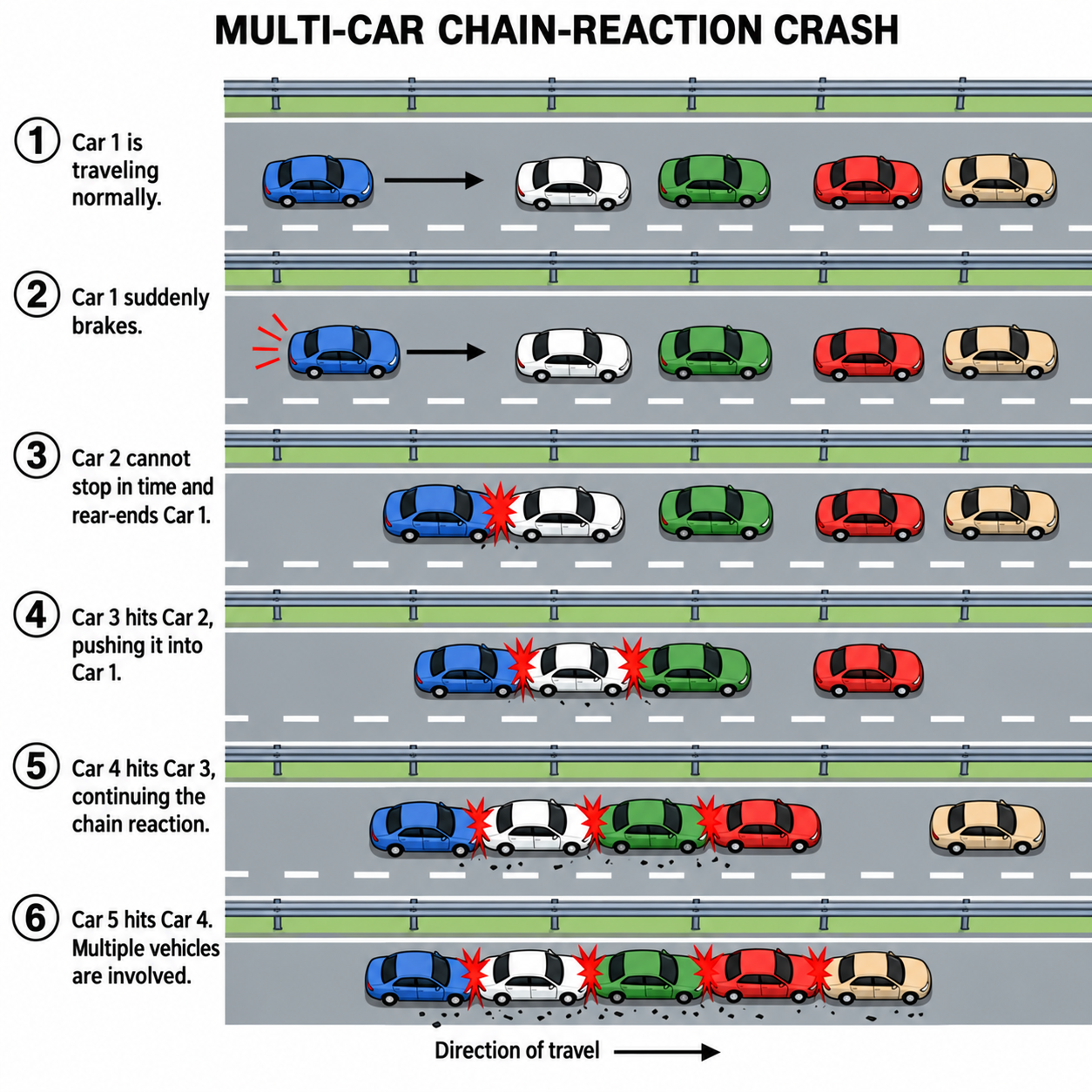
A multi-vehicle crash on I-480 can feel chaotic from the first second: traffic stops, drivers swerve, several insurers get involved, and everyone has a different version of what happened. Responsibility usually depends on who acted carelessly, whether more than one driver contributed, and how Ohio’s comparative fault rules apply. This overview explains how fault is commonly sorted out after a Cleveland-area chain-reaction crash and what information can help make the picture clearer.
Call (216) 677-5490 or request a free consultation to speak with a Cleveland car accident attorney at Buckeye Law Group today.
Who decides responsibility after a chain-reaction crash?
Responsibility is not automatically pinned on the first driver, the last driver, or the person who got the ticket. In a multi-vehicle collision, police, insurance adjusters, attorneys, and sometimes a court may all review the facts to decide how much fault belongs to each driver. Ohio law allows fault to be divided by percentage, which matters because a person’s recovery can be reduced by their share of fault, and recovery may be barred if their fault is greater than the combined fault of others.
That means a Cleveland car crash involving three, four, or more vehicles often turns into a detailed timeline problem. Who braked first? Who had enough room to stop? Did someone make an unsafe lane change? Was traffic already slowing near an interchange, construction zone, or bridge? The answer may not be obvious from vehicle damage alone.
Why I-480 crashes can become complicated quickly
I-480 carries commuter traffic across the Greater Cleveland area, with heavy merging, fast-changing speeds, and sections where congestion can appear suddenly. ODOT and the Ohio State Highway Patrol announced a nearly 14-mile I-480 safety corridor in Cuyahoga County, noting that speed and unbelted occupants are among top crash variables. That does not prove why any one crash happened, but it does show why investigators look closely at speed, spacing, lane movement, and driver attention.
A Cleveland traffic accident on I-480 may involve local drivers, commercial vehicles, rideshare drivers, out-of-state motorists, or people simply passing through. Add rain, snow, glare, road work, or stop-and-go rush-hour traffic, and the crash can become less like one “accident” and more like a sequence of separate impacts. Each impact may need its own fault analysis.
Recent Cuyahoga County car accident statistics also show why these cases are not rare background noise. The Ohio Traffic Safety Office’s county crash sheet reported 2025 Cuyahoga County totals including 75 fatal crashes, 645 serious-injury crashes, 2,673 minor-injury crashes, 3,333 possible-injury crashes, and 17,430 property-damage crashes. Those numbers cover the county, not just I-480, but they help explain why Cleveland accident news so often includes highway closures and multi-car wrecks.
Common fault patterns in a multi-vehicle collision
No two crashes are identical, but certain patterns come up again and again in chain-reaction cases. The key is whether a driver failed to use reasonable care under the conditions. Common scenarios include:
- Rear-end chain reaction: One vehicle stops or slows, another hits it, and the force pushes cars into each other. The rear drivers may face scrutiny, but the analysis can change if the lead vehicle stopped suddenly without warning or another vehicle cut in.
- Unsafe lane change: A driver moves across lanes without enough space, forcing surrounding traffic to brake or swerve. Ohio’s marked-lanes rule generally requires drivers to stay within a lane and move only when it can be done safely.
- Following too closely: A driver leaves too little room for traffic, speed, or road conditions. Ohio law says drivers must not follow more closely than is reasonable and prudent given speed, traffic, and highway conditions.
- Speed too fast for conditions: Even if a driver is near the posted limit, they may still be moving too fast for congestion, weather, visibility, or stopping distance. Ohio’s assured-clear-distance rule requires driving at a speed that allows stopping within the clear distance ahead.
- Failure to signal or sudden slowing: A driver who changes lanes, turns, stops, or suddenly decreases speed may be expected to use proper signals when there is an opportunity to do so.
- Secondary impacts after the first crash: Drivers approaching the scene may fail to slow down, move over safely, or react to disabled vehicles.
These patterns can overlap. For example, one driver may have made an unsafe merge, another may have been speeding, and a third may have been distracted. In that situation, responsibility may be split rather than assigned to only one person.
Can more than one driver be at fault?
Yes. In Ohio, more than one person can share legal responsibility for the same crash, and each person’s percentage of fault can affect the outcome. If an injured person is partly responsible, Ohio’s comparative fault rule reduces their compensatory damages by their percentage of fault, as long as their fault is not greater than the combined fault of the others. Here is a simple example:
Suppose Driver A makes an unsafe lane change, Driver B follows too closely, and Driver C is injured. An insurer or court might decide Driver A is 60% at fault and Driver B is 40% at fault. In another version, if Driver C was also speeding or distracted, Driver C could receive a percentage of fault too.
Ohio also has rules for how damages may be allocated among multiple defendants. For example, when one defendant is found more than 50% responsible for the same injury or loss, that defendant may be jointly and severally liable for economic damages, while other defendants may be responsible only for their proportionate shares. Noneconomic damages are generally tied to each defendant’s proportionate share. In a multi-car crash, fault percentages matter. They can influence settlement negotiations, insurance payments, and whether one party tries to shift blame to another driver.
Evidence that helps sort out what happened
The best evidence usually captures the crash as a sequence, not just a final scene. After a multi-vehicle collision, everyone may remember the moment of impact differently. Physical evidence and independent records can help separate memory from mechanics. Useful evidence may include:
- Police crash report: This may include driver statements, citations, diagrams, road conditions, and the officer’s observations.
- Photos and video: Vehicle positions, skid marks, debris fields, traffic signals, lane markings, weather, and dashcam footage can all matter.
- Witness statements: Neutral witnesses may describe speeding, weaving, sudden braking, or a vehicle that left before officers arrived.
- Vehicle damage patterns: Front, rear, and side damage can help reconstruct the order of impacts.
- Medical records: Prompt treatment can connect injuries to the crash and document symptoms that develop after the adrenaline wears off.
- Phone and vehicle data: In some cases, data may show distraction, speed, braking, or other pre-impact behavior.
- Traffic and construction information: Work zones, lane closures, and congestion can change what “reasonable driving” looked like at that moment.
If you are physically able, take photos before vehicles are moved, get names and insurance details, and avoid guessing about fault at the scene. It is fine to describe what you saw. It is not helpful to apologize automatically, speculate, or agree with another driver’s version before the facts are reviewed.
What should you do after a Cleveland-area highway crash?
After a crash on I-480, your first priority is safety, then documentation. Move out of live traffic if you can do so safely, call 911, accept medical evaluation if needed, and follow officer instructions. Once the immediate danger is handled, start preserving information because details can disappear quickly. A practical post-crash checklist:
- Call emergency services if anyone may be hurt or traffic is blocked.
- Do not stand between vehicles or near active highway lanes.
- Photograph the scene from safe angles, including all vehicles involved.
- Collect insurance and contact information from every driver, not just the one who hit you.
- Look for witnesses before they leave.
- Get medical care even if pain seems minor at first.
- Notify your insurer without giving a recorded statement you do not understand.
- Track expenses and symptoms in the days after the crash.
- Be cautious with quick settlement offers before the full impact is known.
Ohio’s general deadline for lawsuits involving bodily injury or injury to personal property is two years after the cause of action accrues, though individual situations can have exceptions or additional notice issues. That is one reason it is smart to get organized early instead of waiting until insurance disputes become harder to untangle.
Insurance companies do not always see the crash the same way
In a two-car crash, one insurer may accept liability quickly. In a multi-car crash, every insurer has an incentive to limit its driver’s share of fault. One company may blame the first impact, another may argue that a later impact caused the injury, and another may claim the damages were pre-existing or unrelated.
This is especially common when several people report neck, back, shoulder, or concussion symptoms after a chain reaction. The insurers may ask which impact caused which injury, whether the vehicles were already stopped, and whether seat belts, speed, or spacing contributed. These questions are frustrating, but they are also why records matter. If you are reading this after seeing a headline in Cleveland accident news or after being involved in a crash yourself, remember that early reports are often incomplete. Initial news coverage may identify a closure, location, or number of vehicles, but legal responsibility usually takes more investigation.
The bottom line on responsibility
Responsibility for a multi-vehicle crash on I-480 depends on evidence, Ohio traffic rules, and comparative fault. One driver may be fully responsible, but it is also common for fault to be divided among multiple drivers based on speeding, unsafe lane changes, following too closely, distraction, or failure to react reasonably to traffic conditions.
If you were involved in a Cleveland-area multi-car crash, focus on safety, medical care, documentation, and careful communication with insurers. For personal advice, speak with a qualified local Ohio attorney who can review the actual crash report, insurance coverage, injuries, and deadlines. This article is general information, not legal advice, but it should help you understand why fault is rarely as simple as “the last car pays.”
Call (216) 677-5490 or request a free consultation to speak with a Cleveland car accident attorney at Buckeye Law Group today.
*This article provides general information about how Cleveland car accident attorneys may assist injured individuals with insurance claims, settlement negotiations, and legal matters following a motor vehicle collision in Cleveland, Ohio. It is intended for educational purposes only and does not constitute legal advice. Reading this article or contacting Buckeye Law Group does not, by itself, establish an attorney-client relationship. Car accident claims in Cleveland and throughout Cuyahoga County may involve disputed liability, insurance coverage limitations, medical expenses, lost income, property damage, and applicable filing deadlines under Ohio law. Evaluating a claim requires reviewing available evidence, including police reports, medical records, witness statements, insurance policies, accident scene photographs, and documentation of economic and noneconomic losses. A Cleveland car accident attorney at Buckeye Law Group may help injured individuals understand their legal rights, assess potential compensation, evaluate settlement offers, communicate with insurance companies, and address disputes involving negligence, liability, or damages. Individuals injured in a Cleveland car accident should consider consulting a qualified Ohio personal injury attorney to better understand their rights, applicable legal deadlines, and available options for pursuing compensation. Every case is different, and prior results do not guarantee a similar outcome.*
Who Is Responsible for a Multi-Vehicle Car Accident on I-480 Near Cleveland?
A multi-vehicle crash on I-480 can feel chaotic from the first second: traffic stops, drivers swerve, several insurers get involved, and everyone has a different version of what happened. Responsibility
How to prove liability in a Toledo slip and fall accident
How to prove liability in a Toledo slip and fall accident comes down to evidence: what caused the fall, who controlled the property, what they knew or should have known,
How Long Does a Car Accident Settlement Take in Toledo Ohio?
If you were hurt in a crash in Toledo, the settlement timeline depends on the injury, the insurance coverage, the evidence, and whether the insurer accepts responsibility. A straightforward claim
PTSD After a Columbus Car Accident: Can Psychological Injuries Support Compensation?
A Columbus car accident can cause more than physical injuries. The psychological effects of a serious collision may persist long after visible injuries have healed. Individuals may experience recurring nightmares,
Can You Recover Compensation After a Motorcycle Accident in Dayton if You Were Not Wearing a Helmet?
A missing helmet does not automatically prevent an injured rider from seeking compensation after a motorcycle crash in Dayton. Ohio law looks at who caused the collision, whether the rider
Who Can File a Wrongful Death Lawsuit in Toledo, Ohio?
When someone dies as a result of another person’s negligence, recklessness, or wrongful conduct, Ohio law may allow surviving family members to seek compensation through a civil claim known as
Who Is Liable After a Commercial Truck Accident on I-75 Near Dayton?
A commercial truck crash on I-75 near Dayton can involve more than one responsible party. The driver may be part of the story, but truck accident liability often turns on
What Happens When a Pedestrian Is Hit by a Car in Downtown Dayton?
When a pedestrian is hit by a car in downtown Dayton, the first priorities are medical care, safety, and creating a clear record of what happened. After the scene is
How Do You Prove a Slip and Fall Injury Claim in Dayton, Ohio?
A slip and fall injury claim in Dayton, Ohio, usually comes down to evidence: what dangerous condition caused the fall, who was responsible for the property, whether they knew or
What Are Common Signs of Medical Malpractice in Toledo Hospitals?
Medical malpractice can be difficult to recognize because poor outcomes sometimes happen even when doctors, nurses, and hospitals do everything right. Still, certain warning signs may suggest that a preventable
Buckeye Law Group represents people injured in auto accidents, slip and falls, workplace accidents and more in Ohio. Contact us today to learn more.
© 2026 All Rights Reserved | The Buckeye Law Group Inc. Privacy Policy Sitemap
Office Locations
- Akron Office 388 S Main St #400 Akron, OH 44311 (330) 426-0288
- Cincinnati Office 201 E 5th St Ste 1910 Cincinnati, OH 45202 (513) 547-2445
- Cleveland Office 127 Public Square Ste 1540 Cleveland, OH 44114 (216) 677-5490
- Columbus Office 20 E Broad St Suite 300 Columbus, OH 43215 (614) 482-3793
- Dayton Office 70 Birch Alley Ste 240 Dayton, OH 45440 (937) 884-4474
- Euclid Office 25701 N Lakeland Blvd Suite 113-C, Cleveland, OH 44132 (216) 405-2626
- Mansfield Office 305 E Main St Ste 6A, Mansfield, OH 44904 (567) 210-2606
- Findlay Office 7430 Timberstone Dr unit 101a, Findlay, OH 45840 419-873-5119
- Mentor Office 7537 Mentor Ave Ste 101, Mentor, OH 44060 (440) 306-3536
- Middletown Office 300 N Main St #400, Middletown, OH 45042 (326) 800-9150
- Parma Office 1257 Rockside Rd #A, Parma, OH 44131 (216) 279-1664
- Springfield Office 2100 E High St Ste TL3, Springfield, OH 45505 (937) 806-5791
- Toledo Office 3950 Sunforest Ct Ste 200, Toledo, OH 43623 (567) 483-3883
- Westlake Office 26404 Center Ridge Rd Ste B2, Westlake, OH 44145 216-247-0565
- Whitehall Office 5340 E Main St Ste 203, Whitehall, OH 43213 (380) 257-5206
- Youngstown Office 306 Churchill Hubbard Rd, Youngstown, OH 44505 (234) 225-0683
Contact Us
© 2026 All Rights Reserved | The Buckeye Law Group Inc. Privacy Policy Sitemap