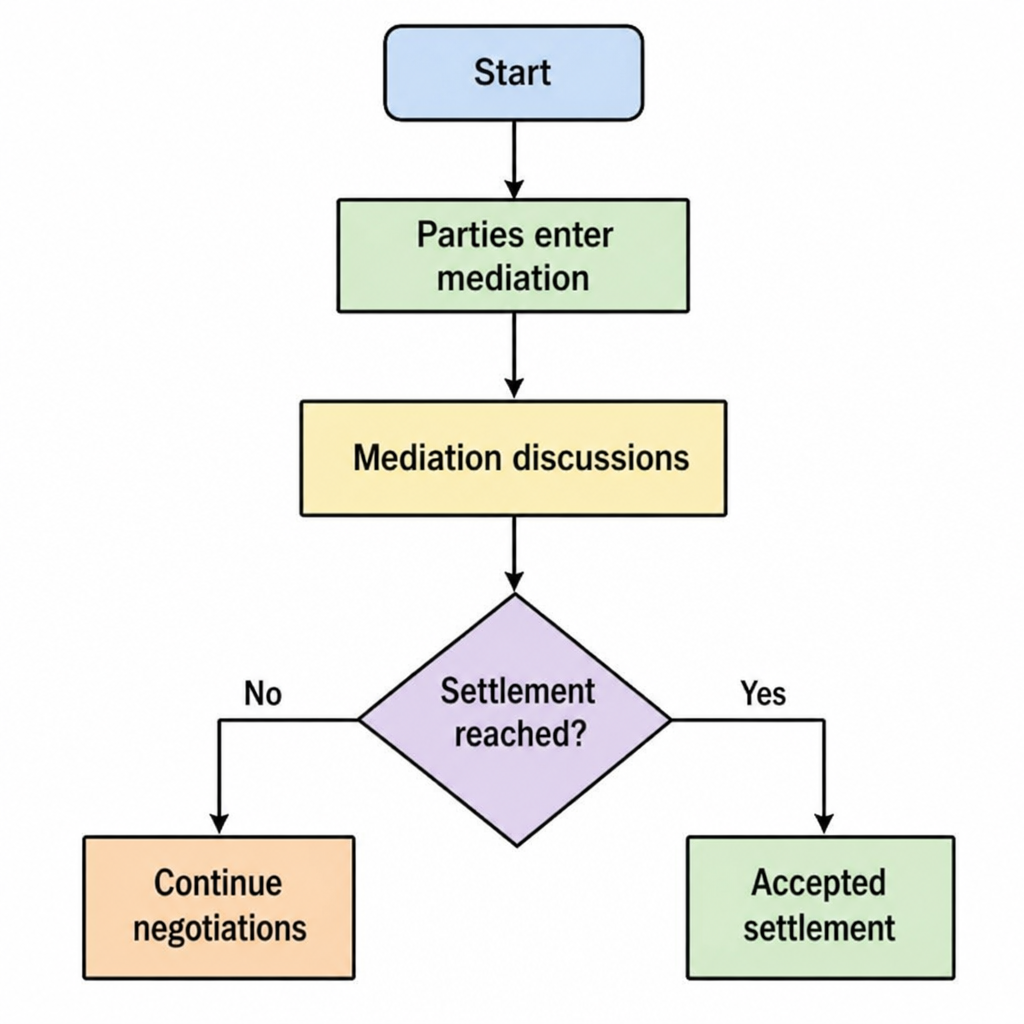
Personal injury mediation in Ohio does not automatically create a binding outcome, but a settlement reached through mediation can be legally enforceable. The distinction is between negotiating a resolution and agreeing to a contract that settles your claim. Understanding that difference helps you recognize when discussions may become commitments, and what to review before accepting an offer.
Call 1-800-411-7246 or request a free consultation today to speak with an experienced Ohio personal injury attorney at Buckeye Law Group.
When does personal injury mediation become legally binding?
Mediation becomes legally consequential when the parties form an enforceable settlement agreement, not simply when they attend a session or discuss compensation. Ohio courts apply contract principles: there must be an offer, acceptance, consideration, and mutual agreement on sufficiently clear essential terms. A signed settlement provides important documentation, although Ohio law recognizes that some oral settlements can also be enforceable.
For personal injury claims, the practical question is therefore not just, “Did mediation happen?” It is, “What did everyone actually agree to, and was that agreement final?” An unresolved proposal is different from an accepted settlement with definite terms. Consider three situations:
- An Offer Remains Under Discussion: One side proposes compensation, but the other has not accepted. The proposal alone is not a settlement.
- Important Terms Remain Unresolved: The parties discuss a payment but disagree about what claims will be released. Contract formation requires closer examination.
- The Parties Reach A Definite Agreement: An accepted settlement with clear essential terms may bind the parties, even if additional paperwork is expected.

The mediator guides negotiations rather than deciding your claim
A mediator is a neutral person who helps participants communicate and explore settlement. Unlike an arbitrator, the mediator does not decide who wins or impose a compensation award. The parties retain control over whether to accept an agreement.
That distinction also applies to court-referred mediation. An Ohio court may order parties to participate, but it cannot dictate settlement terms merely because mediation was ordered. Follow the participation requirements in your case without confusing required attendance with required acceptance.
For an injured person, this creates space to discuss disputed issues without handing the outcome to the mediator. You can evaluate a proposal against the risks and costs of continued litigation. A mediator’s suggestion remains part of negotiation unless the parties turn it into an agreement.
How Does Personal Injury Mediation Work in Columbus and Franklin County, Ohio?
For individuals pursuing personal injury claims in Columbus, Dublin, Westerville, Grove City, and surrounding Franklin County communities, understanding local mediation procedures can help them prepare for settlement negotiations and make informed legal decisions.
The Franklin County Court of Common Pleas, General Division, located at 345 South High Street in downtown Columbus, handles civil lawsuits, including personal injury litigation. Under the court’s Local Rule 105, certain civil cases may be referred to mediation. However, injured individuals and insurers may also arrange private mediation before a lawsuit is filed.
What Should Injured Individuals Expect During Mediation?
Requirements may vary depending on the assigned judge or magistrate. For example, the court’s published Civil Practice Guidelines include courtroom-specific requirements concerning insurance representatives and settlement authority. Before mediation, individuals pursuing compensation for a Columbus car accident, commercial truck collision, or another negligence-related injury should work with their attorney to review:
- Medical expenses, lost wages, future treatment needs, and documented damages.
- Disputed liability, available insurance coverage, and outstanding medical liens.
- Settlement authority, proposed release terms, and expected net compensation.
Importantly, participating in court-referred mediation does not require an injured individual to accept a settlement. However, agreements reached during mediation may become legally enforceable under Ohio law.
Ohio’s Uniform Mediation Act also establishes protections and exceptions concerning mediation communications. Before accepting an offer, injured individuals should understand when an agreement becomes binding and how its terms may affect their legal rights.
Does a settlement have to be signed to count?
Not always. Ohio courts recognize that an oral settlement may be enforceable when its terms are sufficiently definite to establish a contract. However, an agreement reached during mediation raises an additional issue: whether mediation privilege prevents the communications needed to prove it from being admitted in court.
This is why “nothing is binding until I sign” can be an unsafe assumption. In Zele v. Ohio Bell Telephone Co., the court explained that a settlement can bind parties before a final written document is signed. It also recognized that parties may intend not to become bound until the agreement is reduced to writing and executed. Which situation applies depends on their actual agreement and the evidence.
Put the intended point of commitment in writing
Before negotiations advance, ask your attorney to clarify whether acceptance is immediately binding or depends on execution of a final agreement. If a signed document is intended to be a condition of settlement, have that condition clearly communicated rather than privately assumed. Also clarify what authority your attorney has to accept an offer on your behalf; an authorized attorney’s settlement can bind the client. A short written settlement deserves careful review too. Do not dismiss it as “just a mediation summary” without checking whether it records final acceptance and essential obligations. The document’s substance and the parties’ intent matter more than your informal description of it.
Confidentiality does not make a settlement unenforceable
Ohio’s Uniform Mediation Act generally protects mediation communications from discovery and admission as evidence, subject to exceptions and waiver rules. That protection is different from whether the parties formed a contract. A settlement dispute can therefore involve both contract law and evidence restrictions.
One important exception appears in Ohio Revised Code Section 2710.05(A)(1): the mediation privilege does not cover a communication contained in a written agreement recorded and signed by all parties to that agreement. This helps explain why documenting a mediated settlement is particularly useful. It does not mean every signed document is automatically a valid contract.
Confidentiality outside court also requires attention. Section 2710.07 ties confidentiality to the parties’ agreement and applicable law or rules, with statutory qualifications. Before sharing negotiation details publicly, review the mediation agreement and ask counsel what restrictions apply. Do not assume either that everything is freely shareable or that every settlement term must remain secret.
Review more than the settlement amount
For a personal injury case in Ohio, use the proposed paperwork as a review checklist, not merely a confirmation of the dollar figure. Ask your attorney to explain what each obligation means for your situation. The goal is to identify uncertainty before acceptance, rather than argue about it afterward. Work through these points:
- Payment Obligations: Identify who pays, the agreed amount, the deadline, and any conditions that must be satisfied first.
- Claims Being Released: Ask which incident, claims, individuals, and organizations the release covers, including whether it addresses future consequences of the injury.
- Expected Net Recovery: Request an explanation of how attorney fees, case expenses, medical bills, liens, or reimbursement demands may affect the amount you receive.
- Unresolved Responsibilities: Clarify who will address outstanding reimbursement issues and whether any amounts remain estimates.
- Additional Restrictions: Review confidentiality, indemnity, or other obligations rather than treating them as unimportant boilerplate.
- Case Closure: Clarify how settlement payments, execution of release documents, and dismissal of the lawsuit will be coordinated. Ask your attorney to explain the applicable deadlines, each party’s obligations, and the legal remedies available if the settlement terms are not fulfilled.
These are suggested review topics, not mandatory terms in every settlement. Ohio’s enforceability analysis centers on whether the parties actually agreed to sufficiently clear essential terms. Your attorney can identify which matters must be resolved for your particular agreement.
What happens if someone changes their mind afterward?
A simple change of mind generally does not undo an otherwise binding Ohio settlement. Once an offer has been accepted and an enforceable agreement exists, later dissatisfaction is not itself a right to cancel. That makes review before acceptance more valuable than relying on an opportunity to reconsider afterward.
A genuine disagreement over whether a contract exists is different from regret. In Rulli v. Fan Co., the Supreme Court of Ohio held that a trial court must conduct an evidentiary hearing before entering judgment when the existence or meaning of a settlement agreement is disputed. That process resolves the dispute; it does not guarantee that either side can escape the settlement. If a disagreement develops, preserve the signed documents and correspondence you lawfully possess. Ask counsel to assess formation, settlement authority, privilege, and the available enforcement procedure. Avoid assuming the mediator can simply testify about every negotiation: Ohio law restricts mediator reporting and permits only specified disclosures.
Prepare for a decision, not just a discussion
When comparing mediation services in Ohio, ask about the process as well as scheduling. Find out how participants will exchange relevant information, who should attend, and how any agreement will be documented. Preparation should include realistic consideration of litigation risks, supporting documents, and a range of acceptable outcomes, not only an opening demand. Before the session, create a short decision checklist:
- List unresolved questions about your injuries, losses, and proposed settlement terms.
- Ask for an explanation of estimated deductions and remaining financial uncertainties.
- Confirm who has authority to approve a settlement and any limits on that authority.
- Arrange time to review proposed documents and consult privately with counsel.
- Ask how applicable court deadlines and required filings will be handled.
What to Know Before Accepting a Personal Injury Mediation Settlement in Ohio
Personal injury mediation in Ohio provides an opportunity for injured individuals and other involved parties to negotiate a potential settlement with the assistance of a neutral mediator. Although the mediator cannot impose a settlement, an agreement reached during mediation may become legally binding once the requirements for an enforceable contract are satisfied. Before accepting a settlement offer, carefully review the proposed compensation, payment terms, medical liens, outstanding expenses, and claims being released. Consult a local Ohio personal injury attorney from Buckeye Law Group to understand when the agreement becomes final and how its terms may affect your financial recovery and future legal rights. A well-informed settlement decision should account for both your immediate financial needs and the potential long-term consequences of your injuries.
Call 1-800-411-7246 or request a free consultation today to speak with an experienced Ohio personal injury attorney at Buckeye Law Group.
Legal Disclaimer: This article provides general educational information about Ohio personal injury law and how Buckeye Law Group’s local personal injury attorneys may assist individuals injured due to another party’s negligence. It does not constitute legal advice, and reading this article or contacting our firm does not establish an attorney-client relationship. Personal injury claims in Ohio may involve car accidents, commercial truck collisions, motorcycle accidents, premises liability, medical malpractice, wrongful death, and other injury-related matters. Under Ohio Revised Code § 2305.10, many personal injury claims are subject to a two-year statute of limitations, although different deadlines and exceptions may apply. Ohio Revised Code § 2315.33 establishes comparative negligence provisions that may affect compensation in applicable cases. Buckeye Law Group’s local Ohio personal injury attorneys may investigate claims, preserve evidence, evaluate liability and insurance coverage, assist with settlement negotiations and mediation, and pursue compensation under applicable Ohio law. Every case depends on its specific facts and circumstances, and prior results do not guarantee similar outcomes.
Is Personal Injury Mediation Legally Binding in Ohio?
Personal injury mediation in Ohio does not automatically create a binding outcome, but a settlement reached through mediation can be legally enforceable. The distinction is between negotiating a resolution and
How to Obtain an Ohio Crash Report After an Accident in Dayton
After an accident in Dayton, start with Ohio’s Crash Retrieval system to locate a report, then contact the investigating agency if you need an official copy. The Ohio Department of
T-Bone Accidents in Columbus Ohio: Who Is at Fault and What Evidence Matters?
T-bone collisions are often among the most disputed Columbus car accidents because both drivers may tell very different stories about the same intersection. Fault usually depends on who had the
Medical Negligence in Dayton: When a Medical Error May Support an Ohio Malpractice Claim
A bad medical outcome does not always mean a provider committed malpractice, but some errors may support an Ohio medical malpractice claim. For patients and families in Dayton, the key
Fatal Cleveland Bicycle Hit-and-Run: Honoring a Life Lost and Raising Awareness About Roadway Safety
The tragic death of a bicyclist following an October 18, 2026, hit-and-run collision near West 25th Street and Detroit Avenue in Cleveland has left loved ones grieving an irreplaceable loss
Gregory E. Gudin’s $12 Million USAA Insurance Settlement
In 2021, attorney Gregory E. Gudin handled a case involving USAA, one of the nation’s most recognized insurance companies, that resulted in a $12 million settlement. This significant result is
Gregory E. Gudin’s $14.5 Million Progressive Insurance Settlement
Gregory E. Gudin has spent his legal career representing individuals whose cases involve serious financial consequences. Among the significant settlements on his professional portfolio is a $14.5 million settlement involving
Wrongful Death Lawsuits in Columbus, Ohio: Who Can File and What Compensation Is Available?
The wrongful death of a loved one can leave a family facing significant emotional and financial hardships, particularly when the loss results from another party’s negligence. Under Ohio law, surviving
Injured in an Uber Accident in Toledo? Understanding Insurance Coverage and Liability
A Toledo Uber accident can feel more confusing than a typical car crash because several insurance policies may be involved. The most important issue is usually the driver’s app status
Does Renters Insurance Cover Dog Bites in Ohio? What Cleveland Residents Should Know
In Ohio, renters insurance may cover dog bite claims through the policy’s personal liability section, but coverage depends on the policy language, the dog’s history, and any exclusions. Cleveland renters

Buckeye Law Group represents people injured in auto accidents, slip and falls, workplace accidents and more in Ohio. Contact us today to learn more.
© 2026 All Rights Reserved | The Buckeye Law Group Inc. Privacy Policy Sitemap
Office Locations
- Akron Office 388 S Main St #400 Akron, OH 44311 (330) 426-0288
- Cincinnati Office 201 E 5th St Ste 1910 Cincinnati, OH 45202 (513) 547-2445
- Cleveland Office 127 Public Square Ste 1540 Cleveland, OH 44114 (216) 677-5490
- Columbus Office 20 E Broad St Suite 300 Columbus, OH 43215 (614) 482-3793
- Dayton Office 70 Birch Alley Ste 240 Dayton, OH 45440 (937) 884-4474
- Euclid Office 25701 N Lakeland Blvd Suite 113-C, Cleveland, OH 44132 (216) 405-2626
- Mansfield Office 305 E Main St Ste 6A, Mansfield, OH 44904 (567) 210-2606
- Findlay Office 7430 Timberstone Dr unit 101a, Findlay, OH 45840 419-873-5119
- Mentor Office 7537 Mentor Ave Ste 101, Mentor, OH 44060 (440) 306-3536
- Middletown Office 300 N Main St #400, Middletown, OH 45042 (326) 800-9150
- Parma Office 1257 Rockside Rd #A, Parma, OH 44131 (216) 279-1664
- Springfield Office 2100 E High St Ste TL3, Springfield, OH 45505 (937) 806-5791
- Toledo Office 3950 Sunforest Ct Ste 200, Toledo, OH 43623 (567) 483-3883
- Westlake Office 26404 Center Ridge Rd Ste B2, Westlake, OH 44145 216-247-0565
- Whitehall Office 5340 E Main St Ste 203, Whitehall, OH 43213 (380) 257-5206
- Youngstown Office 306 Churchill Hubbard Rd, Youngstown, OH 44505 (234) 225-0683
Contact Us
© 2026 All Rights Reserved | The Buckeye Law Group Inc. Privacy Policy Sitemap