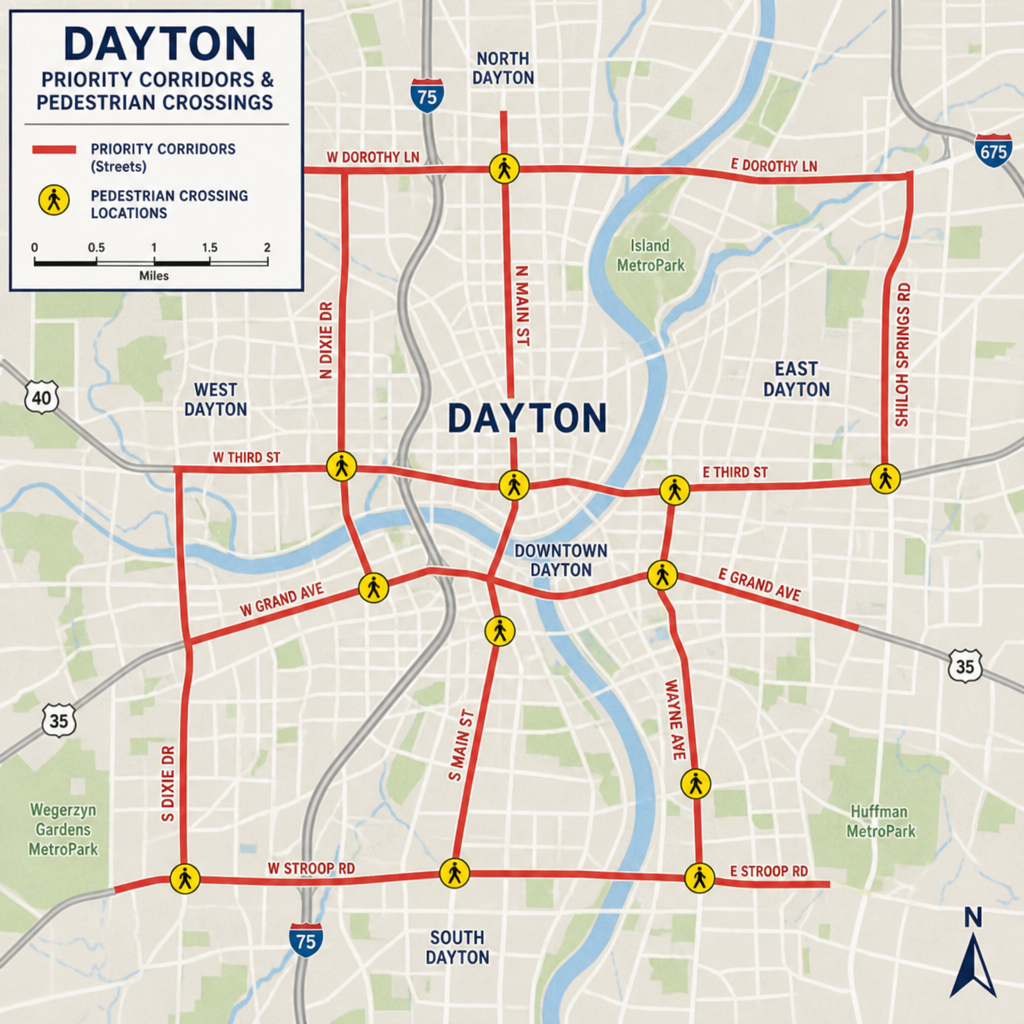
The City of Dayton, Ohio, has adopted a comprehensive Safe Streets and Roads for All (SS4A) Safety Action Plan to address traffic fatalities, serious injuries, and hazardous roadway conditions throughout the community. Using historical crash data, roadway risk assessments, and public feedback, the plan identifies traffic safety concerns and recommends improvements intended to protect motorists, pedestrians, bicyclists, and public transit passengers. For Dayton residents, understanding these findings provides valuable insight into local accident trends, potentially hazardous intersections, and the city’s priorities for improving roadway safety.
For individuals injured in a Dayton car accident, understanding local crash patterns is only one part of protecting their interests. Knowing how to obtain an official traffic crash report, preserve important evidence, access local medical resources, and understand applicable Ohio personal injury laws can be equally important. This guide examines Dayton’s roadway safety initiatives, identifies documented collision risks, explains proposed infrastructure improvements, and provides practical resources for injured motorists and their families throughout Dayton and Montgomery County.
Call (937) 884-4474 or request a free consultation today to speak with an experienced Dayton auto accident attorney at Buckeye Law Group.
What does Dayton’s safety action plan mean in 2026?
Dayton’s safety action plan is an adopted framework, not simply an upcoming proposal. The city’s March 18, 2026 document records adoption on November 12, 2025, and sets a goal of reducing roadway fatalities and serious injuries by 50% by 2040, ultimately eliminating them.
There is also a separate regional effort. The Miami Valley Regional Planning Commission, or MVRPC, adopted its regional plan in March 2026, covering Greene, Miami, and Montgomery counties and portions of northern Warren County. Dayton maintains its own city plan within that broader planning landscape.
That distinction matters when reading headlines or comparing statistics. Before accepting a number as evidence about your neighborhood, check three things: the geographic boundary, the years studied, and whether it counts crashes or people injured. A countywide total should not be presented as a city total, and a plan published in 2026 does not necessarily analyze 2026 crashes.
What does local crash data reveal about dangerous driving conditions?
Local analysis reveals two different problems: frequent collisions and crashes with devastating consequences. MVRPC’s regional roadway network analysis for 2021–2023 identifies rear-end collisions as the most common crash type, while Dayton’s city analysis highlights fixed-object, angle, and pedestrian collisions among fatal and serious-injury crashes. Priorities should reflect severity as well as frequency.
Frequent collisions point to everyday conflicts
Across the regional network, rear-end crashes represented 28% of reported collisions, followed by angle crashes at 17% and sideswipe/passing crashes at 16%. Following too closely was the most frequently reported contributing cause; failure to yield, driving off the road, improper lane changes, and red-light running also featured prominently. These findings support practical habits: leave room to stop, check adjacent lanes before moving, and approach intersections prepared for changing conditions. They also give residents useful questions to ask during project reviews:
- Repeated Rear-End Crashes: Are queues, turning vehicles, or signal visibility creating unexpected stops?
- Angle And Turning Collisions: Would clearer signals, better sightlines, or separated turning movements address the conflict?
- Sideswipe Patterns: Are lane markings and intersection approaches clear enough for unfamiliar drivers?
Treat these as questions for investigation, not diagnoses. A crash category alone cannot establish which street treatment belongs at a particular location.
Severe crashes change the investment priorities
In Dayton’s 2019–2023 analysis, fixed-object crashes accounted for 25% of fatal and serious-injury crashes, angle crashes for 22%, and pedestrian crashes for 16%. Intersections accounted for 57% of fatal and serious-injury crashes.
Those findings argue against judging a project only by how many minor collisions it might prevent. When reviewing a proposal, ask whether it addresses the specific severe-crash pattern. A treatment that improves turning safety and one that protects people crossing the street may serve different purposes, even at the same intersection.
Regional findings also identify young drivers, ages 16–25, as the most frequently involved age group. Pedestrian and bicycle crashes made up a small share of regional collisions but a disproportionate share of serious outcomes. Driver education and protection for people outside vehicles both deserve attention.
Priority corridors need more than a dangerous-road label
Dayton’s prioritized corridors include North Main Street between Hillcrest and Hershey, Salem Avenue between Tennyson and Kenwood, Wayne Avenue between Bainbridge and Wilmington, and Gettysburg Avenue between North James H. McGee and Maywood. Use those boundaries when reviewing projects. Ask which intersections, crossing points, and travel movements a proposal addresses rather than assuming every block has identical needs. Likewise, do not treat a corridor’s inclusion as proof that every proposed improvement is already funded or completed.
Regional planning distinguishes a High Injury Network, highlighting concentrated severe crashes, from a High Risk Network, identifying conditions associated with future danger. The purpose is to guide investigation and investment, including places where waiting for another severe crash would be the wrong approach.

Infrastructure and behavior must work together
MVRPC’s regional strategies combine street engineering, education, enforcement, emergency response, and evaluation. Examples include calmer traffic, safer crossings, protected left-turn signals, and multidisciplinary road safety audits. These are options to match to local conditions, not a promise that every treatment will appear on every Dayton street. For readers evaluating a road safety plan, the important connection is between the problem and the proposed response:
| Safety Concern | Potential Response | Detail Worth Checking |
|---|---|---|
| Speeding near crossings | Traffic calming or crossing improvements | Transit, emergency access, and accessibility needs |
| Left-turn conflicts | Protected left-turn signal phasing | Opposing traffic and pedestrian timing |
| Long pedestrian crossings | Refuge islands or curb extensions | Sightlines, usable ramps, and turning paths |
| Missing walking or cycling connections | Continuous sidewalks and bicycle facilities | Whether protection continues through intersections |
Signal timing can also provide protection without relying entirely on a driver noticing someone at the last moment. A leading pedestrian interval gives people a head start into the crossing before vehicles receive a green indication. FHWA includes this approach among its pedestrian safety countermeasures.
Behavior remains part of traffic accident prevention. Regional recommendations pair infrastructure changes with education addressing distracted, impaired, and aggressive driving. The useful question is not whether streets or drivers matter more; it is whether the proposed program addresses both the physical conflict and the behavior that makes it dangerous.
How can community feedback improve the evidence?
Community feedback adds information about uncomfortable crossings, recurring conflicts, and near misses that residents experience firsthand. Dayton’s planning process included an interactive map where residents could identify safety concerns and near-miss locations. These observations complement crash records rather than replacing them. For future meetings or project comments, make your report specific enough to investigate:
- Identify The Location: Give the intersection, nearest cross street, and side of the road.
- Describe The Movement: Explain whether a vehicle was turning, someone was crossing, or traffic was changing lanes.
- Add The Conditions: Note darkness, rain, parked vehicles, school activity, or a blocked view.
- Explain Recurrence: Distinguish one incident from a pattern you observe regularly.
- Describe The Access Problem: Explain how the condition affects reaching a bus stop, school, workplace, or essential service.
For example, “turning drivers repeatedly enter the crosswalk while I am crossing toward the bus stop” provides more useful detail than “this intersection is terrible.” Avoid collecting photographs or notes while driving.
Ask officials to consider who may be missing from the feedback. Dayton’s stated approach emphasizes equity and accessibility; meeting that commitment should include scrutiny of whether investment reaches people and neighborhoods facing transportation barriers, not merely locations generating the most comments.
Funding and accountability turn planning into prevention
Dayton received a federal Safe Streets and Roads for All planning grant in 2022 to support its plan. The city says the completed plan enables it to pursue implementation funding and monitor progress toward eliminating fatal and serious injuries. Planning support and construction funding are separate steps.
USDOT’s implementation grants support projects and strategies consistent with an eligible action plan. Eligibility is an opportunity to compete for funding, not a guarantee that every recommendation will be built. Residents should ask for progress updates showing project status, funding commitments, severe-crash trends, and follow-up evaluation. If agencies propose AI, video analytics, or vehicle-derived data, ask what information is collected, who can access it, and how long it is retained. Request clear limits rather than assuming a safety purpose resolves every privacy concern.
Dayton, Ohio Car Accident Resources: Where to Get Help After a Collision
For Dayton residents injured in a motor vehicle accident, knowing where to obtain medical treatment, request an official crash report, and locate court records can make the recovery and insurance claims process more manageable. Whether a collision occurs along North Main Street, Salem Avenue, Wayne Avenue, Gettysburg Avenue, or a nearby interstate, several local agencies provide resources that may help injured drivers and passengers document an accident and understand their options.
1. Dayton Police Department: Accident Reports and Assistance
The Dayton Police Department provides information about reporting traffic accidents and accessing collision records.
Contact Information:
- Address: 335 W Third Street, Dayton, OH 45402
- Non-Emergency: (937) 333-2677
- Emergency: 911
- Official Dayton Police Traffic Crash Guidance
An important distinction concerns when a formal Ohio Traffic Crash Report (OH-1) is prepared. According to the Dayton Police Department’s published policy, officers generally prepare formal reports when a collision involves an injury requiring hospital transport or a death, a hit-and-run or impaired driver, or damage requiring at least one vehicle to be towed. For other collisions, officers may assist with exchanging information without preparing a formal crash report. Dayton, OH-1 Injured motorists should also know that the city’s general online police-report filing system does not accept motor vehicle accident reports. For additional information, including available witness statements, visit the Dayton Police crash witness statement resource. Requests by email require the crash report number.
2. Ohio Department of Public Safety: Finding Your Crash Report
The Ohio Department of Public Safety Crash Report Search provides a statewide database for locating traffic collision records. Residents can search using a crash number or other available information, such as the collision date, county, and investigating agency.
The state cautions that reports may take up to six weeks to appear. Additionally, copies available through this database are not official reports for court purposes. Individuals needing an official report or supplemental documentation should contact the agency that investigated the collision. This distinction is especially important for collisions occurring outside the Dayton Police Department’s jurisdiction. Verify whether the investigating agency was Dayton Police, the Montgomery County Sheriff’s Office, or the Ohio State Highway Patrol before requesting records.
3. Miami Valley Hospital: Emergency and Trauma Care
Contact Information:
- Address: 1 Wyoming St, Dayton, OH 45409
- Emergency Department: (937) 208-8775
- Official Hospital Information
Miami Valley Hospital operates a Level I Trauma Center providing emergency treatment for serious injuries. Following a motor vehicle accident, timely medical evaluation can help identify injuries, establish appropriate treatment, and create records of symptoms and clinical findings. Individuals should accurately describe when symptoms began and report any changes during follow-up appointments. For life-threatening conditions, call 911 rather than delaying care to contact a hospital directly.
4. Dayton Children’s Hospital: Pediatric Accident Injury Care
Contact Information:
- Address: 1010 Valley St, Dayton, OH 45404
- Emergency Department: (937) 641-3500
- Pediatric Emergency And Trauma Services
Dayton Children’s Hospital operates a Level I Pediatric Trauma Center that treats children with serious injuries, including traumatic brain injuries, fractures, and other injuries that may result from car accidents. Parents and guardians should follow discharge instructions, attend recommended follow-up appointments, and communicate concerns about changes in their child’s condition to qualified medical professionals.
5. Montgomery County Clerk of Courts: Civil Case Information
Contact Information:
- Address: 41 N. Perry Street, Room 106, Dayton, OH 45422
- Civil Department: (937) 496-7623
- Montgomery County Public Records Online
For individuals researching civil litigation, the Montgomery County Clerk of Courts maintains public records relating to cases filed within its jurisdiction. The online records system permits users to research available case dockets and court filings. However, a traffic collision does not automatically result in a civil lawsuit, and filing jurisdiction depends on the circumstances of a particular claim.
Ohio Revised Code § 2305.10 generally provides a two-year statute of limitations for personal injury claims, although exceptions and different deadlines may apply. Additionally, Ohio’s comparative negligence statute, § 2315.33, can reduce recoverable damages based on a claimant’s percentage of fault and generally bars recovery when that fault exceeds 50%. Residents can review the statutes directly through the Ohio Revised Code § 2305.10 and Ohio Revised Code § 2315.33.
6. Preserving Important Evidence After a Dayton Car Accident
In addition to contacting the appropriate agencies, injured motorists should preserve available evidence that may help explain how an accident occurred and document its consequences. Important records can include photographs of vehicle damage and roadway conditions, witness contact information, medical bills, treatment instructions, insurance correspondence, towing invoices, and employment records documenting missed work.
Where relevant, identify whether nearby businesses, traffic cameras, or other sources may have recorded the collision. Video retention periods vary, and footage may not be available later. Requests for preservation should be made promptly through appropriate channels, without assuming that every camera records or retains footage.
A local Ohio personal injury attorney can help assess what additional evidence may be relevant, identify potentially responsible parties, and explain how applicable insurance coverage and filing deadlines may affect a claim. Why these resources matter: Dayton’s road safety initiatives focus on preventing serious crashes. For residents already affected by a collision, accessible police records, medical services, court information, and evidence-preservation guidance provide practical ways to navigate the aftermath.
Evaluating Dayton’s Road Safety Action Plan: Progress, Accountability, and Safer Streets
The effectiveness of Dayton’s Road Safety Action Plan should be measured by its ability to reduce traffic fatalities, prevent serious injuries, and address documented roadway hazards. Residents can help improve roadway safety by reviewing local crash data, reporting dangerous conditions, and monitoring proposed infrastructure improvements throughout Dayton and Montgomery County.
For individuals injured in Dayton car accidents, understanding local traffic risks is valuable, but determining legal responsibility requires examining police reports, roadway conditions, witness statements, and other relevant evidence. Under Ohio law, potential compensation depends on the circumstances of the collision and applicable legal standards. Ultimately, creating safer roads requires evidence-based improvements, measurable results, public accountability, and access to reliable resources for residents affected by motor vehicle accidents.
Call (937) 884-4474 or request a free consultation today to speak with an experienced Dayton auto accident attorney at Buckeye Law Group.
Legal Disclaimer: This article is provided by Buckeye Law Group for general educational and informational purposes and does not constitute individualized legal or medical advice. The content discusses Dayton, Ohio, roadway safety initiatives, local traffic conditions, motor vehicle accidents, and legal considerations involving personal injury claims. References to Ohio traffic laws, accident reporting procedures, insurance coverage, negligence, potential compensation, and filing deadlines are intended to help Dayton and Montgomery County residents better understand their rights and available resources following a car accident. Every personal injury case involves unique circumstances, and determining liability or eligibility for compensation requires an evaluation of the available evidence, applicable Ohio laws, and individual facts. Reading this article or contacting Buckeye Law Group’s Dayton auto accident attorneys does not, by itself, establish an attorney-client relationship. Individuals seeking guidance about their specific circumstances should consult a qualified Ohio personal injury attorney. Past case results do not guarantee or predict future outcomes.
Dayton’s 2026 Road Safety Action Plan: What Local Crash Data Reveals About Dangerous Driving Conditions
The City of Dayton, Ohio, has adopted a comprehensive Safe Streets and Roads for All (SS4A) Safety Action Plan to address traffic fatalities, serious injuries, and hazardous roadway conditions throughout
Cleveland’s 2026 Daylight Saving Time Change: Earlier Darkness, Pedestrian Safety, and Ohio Traffic Laws
Cleveland’s daylight saving time ends on Sunday, November 1, 2026, at 2:00 a.m., when clocks move backward one hour and Northeast Ohio returns to Eastern Standard Time (EST). While the
Halloween Weekend 2026 in Dayton: Impaired Driving Risks, Free Rideshare Resources, and Ohio Accident Laws
Halloween weekend brings celebrations throughout Dayton, Ohio, but increased nighttime traffic, pedestrians, and alcohol-related activities also create important safety concerns. Whether you are attending an event in downtown Dayton, visiting
Halloween Pedestrian Safety Near Ohio State University: Columbus Crosswalk Laws, Accident Risks, and What to Do If You’re Injured
Halloween weekend brings students, residents, and visitors throughout Columbus, particularly around The Ohio State University and the surrounding University District. As people travel between campus, restaurants, residential neighborhoods, and entertainment
Can You Pursue Compensation for a Traumatic Brain Injury After an Ohio Car Accident?
A traumatic brain injury sustained in an Ohio car accident can have significant and lasting consequences for an individual’s health, financial stability, and quality of life. When another party’s negligence
How Long After a Car Accident Can Concussion Symptoms Appear?
A concussion can cause symptoms immediately after a crash or several hours or days later. Sometimes a person first recognizes changes in sleep, mood, concentration, or memory a week or
Not at Fault in a Columbus Car Accident? What Ohio Drivers Should Do Next
Following a car accident in Columbus, Ohio, that may have been caused by another driver’s negligence, taking appropriate steps can help protect your health, preserve important evidence, and safeguard your
Is Personal Injury Mediation Legally Binding in Ohio?
Personal injury mediation in Ohio does not automatically create a binding outcome, but a settlement reached through mediation can be legally enforceable. The distinction is between negotiating a resolution and
How to Obtain an Ohio Crash Report After an Accident in Dayton
After an accident in Dayton, start with Ohio’s Crash Retrieval system to locate a report, then contact the investigating agency if you need an official copy. The Ohio Department of
T-Bone Accidents in Columbus Ohio: Who Is at Fault and What Evidence Matters?
T-bone collisions are often among the most disputed Columbus car accidents because both drivers may tell very different stories about the same intersection. Fault usually depends on who had the

Buckeye Law Group represents people injured in auto accidents, slip and falls, workplace accidents and more in Ohio. Contact us today to learn more.
© 2026 All Rights Reserved | The Buckeye Law Group Inc. Privacy Policy Sitemap
Office Locations
- Akron Office 388 S Main St #400 Akron, OH 44311 (330) 426-0288
- Cincinnati Office 201 E 5th St Ste 1910 Cincinnati, OH 45202 (513) 547-2445
- Cleveland Office 127 Public Square Ste 1540 Cleveland, OH 44114 (216) 677-5490
- Columbus Office 20 E Broad St Suite 300 Columbus, OH 43215 (614) 482-3793
- Dayton Office 70 Birch Alley Ste 240 Dayton, OH 45440 (937) 884-4474
- Euclid Office 25701 N Lakeland Blvd Suite 113-C, Cleveland, OH 44132 (216) 405-2626
- Mansfield Office 305 E Main St Ste 6A, Mansfield, OH 44904 (567) 210-2606
- Findlay Office 7430 Timberstone Dr unit 101a, Findlay, OH 45840 419-873-5119
- Mentor Office 7537 Mentor Ave Ste 101, Mentor, OH 44060 (440) 306-3536
- Middletown Office 300 N Main St #400, Middletown, OH 45042 (326) 800-9150
- Parma Office 1257 Rockside Rd #A, Parma, OH 44131 (216) 279-1664
- Springfield Office 2100 E High St Ste TL3, Springfield, OH 45505 (937) 806-5791
- Toledo Office 3950 Sunforest Ct Ste 200, Toledo, OH 43623 (567) 483-3883
- Westlake Office 26404 Center Ridge Rd Ste B2, Westlake, OH 44145 216-247-0565
- Whitehall Office 5340 E Main St Ste 203, Whitehall, OH 43213 (380) 257-5206
- Youngstown Office 306 Churchill Hubbard Rd, Youngstown, OH 44505 (234) 225-0683
Contact Us
© 2026 All Rights Reserved | The Buckeye Law Group Inc. Privacy Policy Sitemap