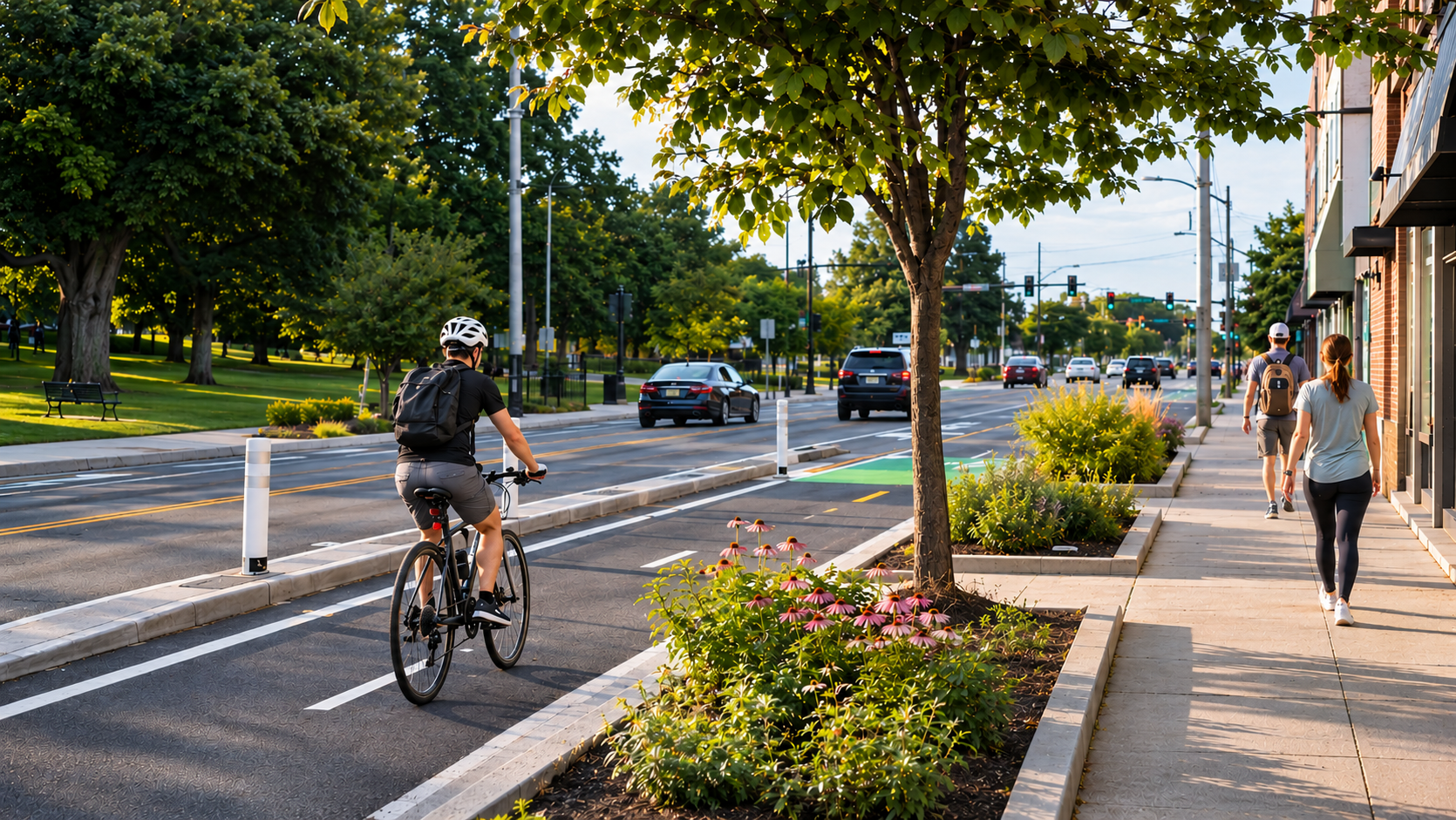
Toledo’s Summit Street Cycle Track project is a two-phase reconstruction intended to make a section of North Summit Street safer and more connected for people walking and bicycling. In 2026, the city is addressing the corridor from Galena Street to New York Avenue. A second phase, scheduled for 2027, would continue the bicycle connection to Manhattan Boulevard. The work also changes traffic lanes and parking and adds waterline improvements. The key safety questions concern crossings, turning vehicles, and transitions between paths and streets.
Call (567) 483-3883 or request a free consultation today to speak with an experienced Dayton pedestrian accident attorney at Buckeye Law Group.
Where Is the Summit Street Cycle Track, and When Will It Be Built?
The City of Toledo’s official project page identifies two segments:
- Phase I (2026): Galena Street to New York Avenue. Reconstruction includes a three-lane roadway, bump-out parking, and a path through Jamie Farr Park that transitions into a cycle track approaching New York Avenue.
- Phase II (planned for 2027): New York Avenue to Manhattan Boulevard. The city plans to extend the bicycle facility to connect with the existing path on Manhattan and install a new waterline.
The city’s construction list places both phases in District 4. On January 20, 2026, Toledo City Council approved funding-related legislation for the 2027 segment; that approval does not mean construction has started or the design is final. The city lists $11.5 million in total project support: $9.2 million federal, $1.2 million state, and $1.1 million city funds.
What Will Change on North Summit Street?
In Phase I, Toledo plans to reduce the roadway to one travel lane in each direction and a center left-turn lane. The redesign reallocates space for parking and bicycling. A side path through Jamie Farr Park will connect to the street-side cycle track. The two facilities may serve different users: a shared-use path can accommodate walking and cycling, while a cycle track generally designates space for bicycles. Signs will clarify use.
Phase II would connect to the Manhattan Boulevard path and include waterline replacement, which may affect construction access. The city has not confirmed every final detail, including track width, barriers, intersection markings, or opening dates. Do not assume the route is already usable.
How Could the Redesign Improve Bicycle and Pedestrian Safety?
A dedicated bicycle route can reduce exposure to through traffic, but design details determine how well it works. Separation between intersections is only part of the safety picture. The Federal Highway Administration’s Bikeway Selection Guide emphasizes driveways, turning movements, intersections, and transitions. Blocked or abruptly ending facilities create additional risks. Three questions deserve attention as the Summit Street design takes shape:
- How do drivers cross the bicycle route? Motorists entering or leaving driveways and turning at intersections must look for riders approaching the conflict point.
- Where do pedestrians cross? Clear crossings, adequate visibility, accessible curb ramps, and understandable signals matter, particularly near park access and bus stops.
- How do users move between facilities? The transition from the Jamie Farr Park path to the street-side cycle track should be evident to cyclists and pedestrians.
One detail matters for pedestrians: the city describes bump-out parking, but its current summary does not confirm specific curb extensions at crosswalks. Those features should not be treated as interchangeable. Before opening, residents can ask how the design handles crossings, bicycle direction, driveways, accessible curb ramps, snow clearance, and sight lines around parked vehicles. Our goal is to promote safer roadways and help reduce the risk of preventable accidents and injuries for everyone who uses them.
Do Not Confuse This Project With the Vistula Summit Street Redesign
A July 29, 2026, Toledo’s city announcement described a separate interim project between Cherry and Olive streets in Vistula, with temporary median islands and new markings. Its five-lane-to-two-travel-lane design is not the Galena-to-Manhattan cycle track plan. Verify project boundaries before comparing updates.
Traveling Through Construction: What Residents Should Check
The city last updated its Summit Cycle Track traffic notice on October 23, 2026. At that time, North Summit Street was open in both directions, but only right turns were permitted at Galena and North Summit. Those restrictions may change. Check the city’s construction updates, including your direction and intended turn, before departure. Cyclists should avoid unfinished paths and watch for driveways and work vehicles. Pedestrians should follow designated accessible routes. Drivers should anticipate temporary signs, turning restrictions, and park users. Report blocked sidewalks, damaged surfaces, or missing signs from a safe location.
What Does Ohio Law Require of Cyclists, Pedestrians, and Drivers?
Ohio Revised Code § 4511.52 applies relevant traffic rules to bicycles on roadways and bicycle-only paths. Section 4511.55 addresses roadway positioning and allows cyclists to move away from the right edge when necessary for safety.
Section 4511.39 requires drivers to assess whether turns can be made with reasonable safety, including where they cross a bicycle route.
Section § 4511.46 sets driver yielding duties at certain crosswalks; § 4511.48 addresses pedestrian responsibilities elsewhere while preserving drivers’ duty of care.
The applicable rule depends on signs, signals, the location, and the people involved. A new cycle track does not automatically determine who has the right of way in every situation.
If a Bicycle or Pedestrian Crash Occurs, Preserve the Details
Call 911 for emergencies and seek appropriate medical evaluation. When safe, record the nearest intersection, driveway, or path entrance and whether work was underway. Photograph signals, barriers, markings, lighting, and obstructions. Preserve witness contacts, medical records, damaged equipment, and insurance communications. Make note of any traffic controls that have changed.
In a typical Ohio personal injury action, § 2305.10 provides a two-year filing period, subject to exceptions and rules governing accrual. Under § 2315.33, a plaintiff’s comparative fault may reduce or prevent recovery depending on the percentage assigned. Claims involving public entities can raise additional governmental-immunity questions under Chapter 2744. Construction alone does not establish fault.
Toledo and Lucas County Resources
- Construction: Summit Cycle Track updates — phases and posted restrictions.
- City Issues: Engage Toledo, Phone: (419) 936-2020 — street and access concerns.
- Crash Reports: Ohio DPS search, allow up to six weeks; request official copies from investigators.
- Police Records: Toledo Police, Phone: (419) 245-3246, Address: 525 N. Erie St. Toledo, Oh 43604
- Civil Court: Lucas County Clerk, Address: 700 Adams St 1st Floor, Toledo, OH 43604
Frequently Asked Questions About the Summit Street Cycle Track
- Is the Summit Street Cycle Track finished in 2026? Galena-to-New York is the 2026 phase; New York-to-Manhattan is scheduled for 2027. Neither a listed year nor a funding approval confirms a path is open. Check current signs.
- Will Summit Street still carry traffic in both directions? The Phase I design retains traffic in both directions with a center turn lane. However, temporary restrictions can change; the October 23 update allowed only right turns at Galena and North Summit.
- Can pedestrians use the new cycle track? The Jamie Farr Park side path and Summit cycle track may have different permitted uses. A bike-only facility is not automatically a sidewalk; check signs when the route opens.
- Does the project guarantee fewer bicycle accidents? No. Although the proposed improvements are intended to enhance roadway safety, their effectiveness will ultimately depend on the final intersection designs, ongoing maintenance, prevailing traffic conditions, and the extent to which motorists and pedestrians exercise reasonable care and comply with applicable traffic laws.
- What if I am partly responsible for a crash? Under Ohio’s modified comparative negligence law, an injured individual may still be eligible to recover compensation if their percentage of fault does not exceed 50%. However, any compensation awarded is reduced in proportion to their share of responsibility. Determining liability requires a careful evaluation of the available evidence, the circumstances surrounding the accident, and the actions of each party involved.
What Toledo Residents Should Watch as the Project Advances
Summit Street’s proposed redesign represents an opportunity to improve bicycle and pedestrian connectivity between Jamie Farr Park, New York Avenue, and Manhattan Boulevard in Toledo. However, the project’s effectiveness should be evaluated not only by the expansion of bicycle infrastructure but also by the safety of roadway crossings, visibility at intersections, accessibility for individuals with disabilities, and the development of practical connections for all road users. As the project progresses, Toledo residents, motorists, bicyclists, and pedestrians should consult official City of Toledo updates for construction schedules, traffic changes, and potential safety concerns.
For individuals injured in a bicycle or pedestrian accident, understanding the circumstances surrounding the collision is an important first step in evaluating potential legal claims. Buckeye Law Group’s Toledo personal injury attorneys offer free consultations to review available evidence, assess potential liability, address insurance coverage questions, and explain available legal options. Every case depends on its individual facts, and past results do not guarantee future outcomes.
Call (567) 483-3883 or request a free consultation today to speak with an experienced Dayton pedestrian accident attorney at Buckeye Law Group.
Legal Disclaimer: This article is provided by Buckeye Law Group for general educational and informational purposes and addresses Toledo’s Summit Street redesign project, bicycle and pedestrian safety, and relevant Ohio traffic and personal injury laws as of November 6, 2026. The information should not be construed as individualized legal or medical advice. Construction schedules, roadway conditions, applicable regulations, and legal filing deadlines may change or vary based on individual circumstances. Determining liability and potential eligibility for compensation requires a thorough evaluation of the facts, available evidence, and applicable law. Reading this article or contacting Buckeye Law Group’s Toledo personal injury attorneys does not, by itself, establish an attorney-client relationship. Individuals seeking guidance regarding a specific accident or injury should consult a qualified Ohio personal injury attorney.
What Happens If an Insurance Company Won’t Offer a Fair Settlement After a Car Accident?
After an Ohio car accident, an insurance settlement offer may arrive while medical treatment continues and fault remains disputed. If the insurance company won’t offer a fair settlement, you do
Toledo’s Summit Street Cycle Track: What the 2026–2027 Redesign Means for Cyclist and Pedestrian Safety
Toledo’s Summit Street Cycle Track project is a two-phase reconstruction intended to make a section of North Summit Street safer and more connected for people walking and bicycling. In 2026,
Greater Dayton’s 2026 E-Bike and E-Moto Safety Proposal: What Ohio Riders and Parents Should Know
Electric bicycles and other small electric-powered vehicles are becoming increasingly common on roads, neighborhood streets, and recreational trails throughout Greater Dayton. Their growing use also raises important questions about rider
Dayton’s Keowee Street Safety Project: How Lane Reductions and New Walking Paths Could Improve Roadway Safety
Dayton’s Keowee Street safety project would reduce the roadway from seven lanes to five between East Fifth Street and East Monument Avenue, adding multi-use paths, landscaping, and signal upgrades. The
Dayton I-75 Construction in November 2026: Lane Closures, Traffic Shifts, and Work-Zone Safety
Motorists traveling along I-75 through Dayton, Ohio, in November 2026 should be aware of multiple construction projects that may affect travel times, lane configurations, and access to nearby interchanges. According
Columbus I-70/I-71 Construction in November 2026: Ramp Closures, Detours, and Driver Safety
Motorists traveling through downtown Columbus, Ohio, in November 2026 should prepare for temporary traffic disruptions as construction continues along the I-70/I-71 corridor. Overnight interstate restrictions, ramp closures, and designated detours
Mansfield’s Main Street Transformation: What Drivers and Pedestrians Should Know About Downtown Traffic Changes in 2026
As Mansfield completes its 2026 Main Street Transformation, residents and visitors should understand how the redesigned streets affect access to downtown businesses, public buildings, pedestrian crossings, and nearby parking areas.
Toledo’s Douglas Road and Monroe Street Intersection Improvements: What Drivers and Pedestrians Should Know in 2026
The City of Toledo identifies the Douglas Road and Monroe Street intersection as a 2026 improvement project intended to support pedestrian safety, driver safety, and better pavement conditions. For people
Springfield’s South Limestone Street Safety Improvements: What Drivers Should Know
South Limestone Street in Springfield, Ohio, is the focus of safety improvements intended to reduce conflicts between vehicles entering, leaving, and traveling along the corridor. The Ohio Department of Transportation’s
Middletown’s 2026 Safe Streets and Roads for All Initiative: What Residents Should Know
Middletown, Ohio’s Safe Streets and Roads for All (SS4A) effort is best understood as a road-safety planning-and-delivery process funded through the U.S. Department of Transportation. For residents following this community

Buckeye Law Group represents people injured in auto accidents, slip and falls, workplace accidents and more in Ohio. Contact us today to learn more.
© 2026 Todos los derechos reservados | The Buckeye Law Group Inc. Políticade privacidad Mapa del sitio
Ubicaciones de las oficinas
- Akron Office 388 S Main St #400 Akron, OH 44311 (330) 426-0288
- Cincinnati Office 201 E 5th St Ste 1910 Cincinnati, OH 45202 (513) 547-2445
- Cleveland Office 127 Public Square Ste 1540 Cleveland, OH 44114 (216) 677-5490
- Columbus Office 20 E Broad St Suite 300 Columbus, OH 43215 (614) 482-3793
- Dayton Office 70 Birch Alley Ste 240 Dayton, OH 45440 (937) 884-4474
- Euclid Office 25701 N Lakeland Blvd Suite 113-C, Cleveland, OH 44132 (216) 405-2626
- Mansfield Office 305 E Main St Ste 6A, Mansfield, OH 44904 (567) 210-2606
- Findlay Office 7430 Timberstone Dr unit 101a, Findlay, OH 45840 419-873-5119
- Mentor Office 7537 Mentor Ave Ste 101, Mentor, OH 44060 (440) 306-3536
- Middletown Office 300 N Main St #400, Middletown, OH 45042 (326) 800-9150
- Parma Office 1257 Rockside Rd #A, Parma, OH 44131 (216) 279-1664
- Springfield Office 2100 E High St Ste TL3, Springfield, OH 45505 (937) 806-5791
- Toledo Office 3950 Sunforest Ct Ste 200, Toledo, OH 43623 (567) 483-3883
- Westlake Office 26404 Center Ridge Rd Ste B2, Westlake, OH 44145 216-247-0565
- Whitehall Office 5340 E Main St Ste 203, Whitehall, OH 43213 (380) 257-5206
- Youngstown Office 306 Churchill Hubbard Rd, Youngstown, OH 44505 (234) 225-0683
Contáctenos
© 2026 Todos los derechos reservados | The Buckeye Law Group Inc. Políticade privacidad Mapa del sitio