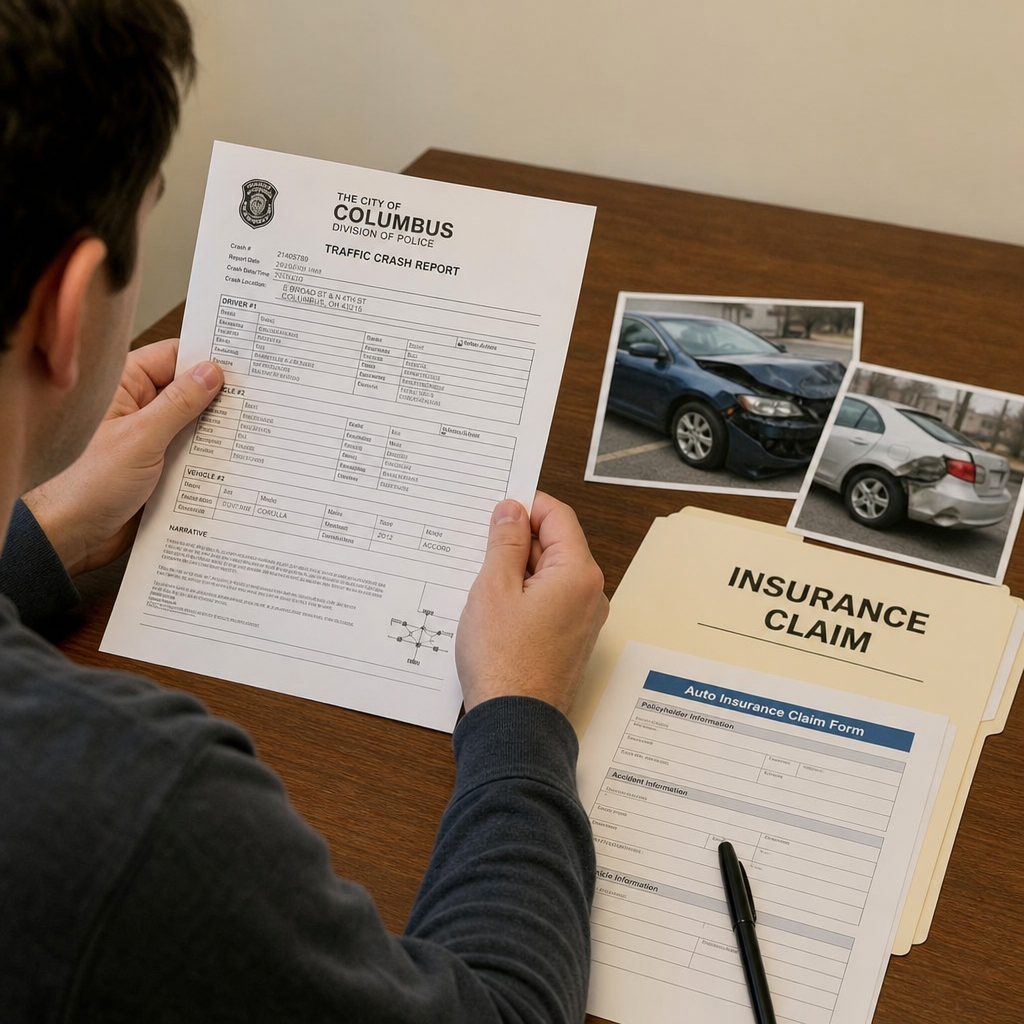
Finding an error in your police report can add uncertainty to an already difficult situation. You may worry that an incorrect diagram, missing witness, or inaccurate statement will affect your ability to recover compensation. If the police report is wrong after a Columbus car accident, obtain the complete report and identify the specific disputed information. Preserve supporting evidence, contact the investigating agency about its review process, and notify the insurance adjuster handling your claim. An inaccurate report deserves attention, but it does not automatically determine the outcome of your case. You can present other evidence supporting what happened, even when the agency leaves its report unchanged.
Call (614) 412-1230 today to schedule a complimentary consultation with a local Ohio personal injury attorney from Buckeye Law Group.
Obtain the Complete Columbus Car Accident Report
Before requesting a correction, review the complete report, including its narrative, diagram, and any available supplements. A summary from an insurance company may not contain everything the investigating agency recorded. The City of Columbus directs users to the Ohio Department of Public Safety for Columbus Division of Police crash reports. Reports become available after submission and acceptance. Copies obtained through the state website are free. Use these official resources:
- Columbus Find an Accident Report: City instructions for accessing crash reports.
- Ohio Crash Report Search: Search for a report using available crash information.
- Columbus Find a Police Report: Links to report requests and public records resources.
Check which agency prepared the report. A Columbus address alone does not identify the investigating department. Direct questions about disputed information to the agency listed on your report. If Ohio State University Police investigated the collision, the university provides a separate records request resource.
Identify What Is Incorrect, Missing, or Disputed
Compare the report with your records and recollection. Review the crash date, location, vehicle information, statements, narrative, and diagram. Pay particular attention to whether the report correctly identifies which driver and vehicle belong to each numbered unit. A mistaken unit assignment can make other sections appear inconsistent.
Incorrect Identifying Information
Errors may include a misspelled name, incorrect license plate, wrong vehicle description, or inaccurate insurance information. These issues may be supported by straightforward documentation, such as registration paperwork or an insurance identification card. Provide only the personal information needed for the request, using the agency’s accepted submission method.
Disputed Statements or Crash Diagrams
A disagreement about lane position, traffic signals, or the point of impact requires a different explanation than a typographical correction. Identify the exact statement or diagram detail you dispute. Then explain which evidence supports your account. Photographs, original video files, and independent witness information may help the agency evaluate your request. Also distinguish between an officer’s conclusion and a statement attributed to another driver. A report may accurately record what someone said even when you disagree with that person’s account.
Missing or Later-Developing Injury Information
A report indicating no apparent injury at the scene does not necessarily establish that nobody was injured. Distinguish between symptoms you reported at the scene and symptoms that developed afterward. If the report omits symptoms you described, identify that omission. If symptoms appeared later, document the timeline accurately rather than suggesting the officer knew about them. Seek appropriate medical evaluation and explain when symptoms began. Medical records can help document your condition, treatment, and reported history.
How to Request Review of a Columbus Car Accident Report
A correction request should make the disputed information easy to locate and evaluate. You do not need to write a lengthy argument.
- Keep an Unchanged Copy: Save the original report as you received it. Make notes on a separate copy or create a list of concerns. For each issue, record the page, section, disputed information, and supporting evidence. This helps distinguish your comments from the agency’s official record.
- Preserve Relevant Evidence: Useful supporting materials may include:
- Original photographs showing vehicle positions, damage, debris, signs, and roadway conditions.
- Dashcam footage showing events before, during, and after the collision.
- Witness names, contact details, and independent accounts.
- Registration or insurance documents confirming identifying information.
- Medical records documenting symptoms and treatment.
- Repair documentation identifying damaged areas.
- Preserve original files and keep backup copies. If you annotate an image, retain the unmarked version. For a crash near an intersection or interchange, record the road names, travel direction, and specific lane or ramp. These details help explain a disputed diagram more precisely than a street name alone.
- Contact the Investigating Agency: Ask how to submit information for review of an existing report. Have the report number, crash date, location, and investigating officer’s name available. Useful questions include:
- Who reviews a request concerning an existing crash report?
- How should supporting documents or video be submitted?
- Can additional information be included in a supplemental report?
- How can I obtain the report after any update?
The agency determines whether to change or supplement its record. A request does not guarantee a revision. A records request and a correction request serve different purposes. Obtaining another copy does not, by itself, ask the officer to reconsider the contents.
- Submit a Clear Written Explanation: Identify the disputed information and connect each concern to its supporting evidence. For example:
- I am requesting review of report [number] concerning the collision on [date] at [location]. The diagram on page [number] shows my vehicle traveling east. I believe this is inaccurate because my vehicle was traveling west. The attached dashcam footage shows the direction of travel. Please advise how this information can be reviewed and whether a correction or supplement is appropriate.
Use this format only when it accurately reflects your circumstances. If you do not remember a detail, say so.
- Document the Response: Keep copies of your request, attachments, and any agency response. Record the dates of calls and the names of people you contact. If the agency issues an update, request a copy and review it. Keep both versions so you can explain what changed.
Protect Your Insurance Claim During the Review
An insurer may consider the police report when evaluating a Columbus car accident claim. However, the report does not replace an assessment of the other available evidence. Tell the adjuster which information you dispute and why. Ask that your explanation and supporting materials be included in the claim file. Continue meeting applicable insurance reporting and cooperation requirements. If you are uncertain about a recorded statement or requested authorization, seek advice about your obligations before responding.
Meanwhile, keep records of medical treatment, expenses, missed work, and vehicle damage. A trusted family member can help organize these materials while you recover. Do not wait for a report correction before addressing legal deadlines. Ohio Revised Code §2305.10 generally provides two years for bodily injury and property damage lawsuits, subject to exceptions. Insurance requirements and other deadlines may also apply.
Frequently Asked Questions About Incorrect Columbus Crash Reports
- Does the Police Report Decide Who Was at Fault? A police report can influence an insurance investigation, but it is not a court judgment deciding civil responsibility. Photographs, witness testimony, video, and other evidence may support or contradict its conclusions. Fault matters under Ohio law. Generally, an injured person’s share of fault can reduce recoverable damages. Recovery is barred when that person’s fault exceeds the combined fault of the other responsible persons. An attorney can explain how these rules may apply to the evidence in your case.
- What if the Officer Will Not Change the Report? Ask whether the agency will accept additional evidence or a supplemental statement, and preserve its response. You may also ask whether further review is available through that agency. An unchanged report does not automatically eliminate a potential injury claim. An attorney can evaluate the disputed findings alongside independent evidence. The focus remains on establishing what happened, who may be responsible, and which losses the collision caused.
- Can I Pursue an Injury Claim if the Report Says “No Injury”? That entry does not automatically prevent a claim. Its significance depends on the circumstances and the supporting medical evidence. Explain accurately whether symptoms were present at the scene, developed later, or worsened over time. Tell your healthcare provider about relevant prior conditions and avoid guessing about medical causation. Medical documentation helps evaluate your injuries, but treatment alone does not establish another driver’s liability.
- Should I Wait for the Corrected Report Before Contacting Insurance? Do not assume a pending correction excuses you from your policy’s reporting requirements. Notify your insurer as required and explain that you dispute specific report information. Provide facts you know, identify uncertainties, and retain your claim number and correspondence. When a correction or supplement becomes available, send it to the adjuster and request confirmation of receipt.
- Can an Attorney Help Before the Report Is Corrected? Yes. An attorney can review the existing report, identify missing evidence, and assess how disputed information affects your claim. Depending on the circumstances, that work may include seeking witness accounts, available recordings, or additional investigation records. An attorney can also address an insurer’s reliance on disputed findings. No attorney can guarantee that an agency will revise a report or that a claim will succeed.
Get Clear Guidance After a Columbus Car Accident
You deserve an opportunity to explain what happened and receive answers you can understand. An error in a police report should not leave you feeling that your concerns cannot be heard. Buckeye Law Group’s local Ohio personal injury attorneys can review the report, discuss supporting evidence, and explain potential next steps. Our review considers the collision, your injuries, insurance issues, and applicable deadlines.
Contact Buckeye Law Group today by calling our office at (614) 482-3793 to request a free consultation about your Columbus car accident. Bring the report and information you have; you do not need a complete file before asking for professional support.
*This article provides general educational information and does not constitute legal advice. Reading it or contacting Buckeye Law Group does not, by itself, create an attorney-client relationship. Applicable deadlines and legal options depend on individual circumstances. Every case is different, and prior results do not guarantee a similar outcome.*
What to Do if the Police Report Is Wrong After a Columbus Car Accident
Finding an error in your police report can add uncertainty to an already difficult situation. You may worry that an incorrect diagram, missing witness, or inaccurate statement will affect your
The Insurer Blames You for a Columbus Motorcycle Crash What Evidence Matters
When an insurer says the rider caused a Columbus motorcycle crash, that is not the end of the claim. Fault can be challenged with the right records, careful crash scene
Akron Truck Accident Attorney: Protecting Your Rights After a Serious Collision
A serious truck crash can leave you managing medical treatment, missed work, vehicle damage, and calls from insurance companies. An Akron truck accident attorney can investigate the collision, identify potentially
Where Serious Crashes Occur in Columbus: A Data-Driven Guide to Local Roadway Risks
Understanding where serious crashes occur in Columbus can help you recognize roadway risks before your next trip. This guide draws on publicly available local crash data and safety reports to
Pedestrian Accident Near The University of Akron: What to Do and How to Protect Your Rights
A pedestrian accident near The University of Akron can interrupt your education, work, and daily life without warning. You may face medical bills, missed classes, and questions about who will
Is Ohio a No-Fault State for Car Accidents?
Ohio is not a no-fault state for car accidents. Ohio uses an at-fault, or tort, system, which means the person who caused the crash is generally responsible for the resulting
Who Pays Medical Bills After a Truck Accident in Columbus Ohio?
After a serious truck crash in Columbus, the hospital does not wait for the insurance companies to finish arguing about fault. Medical bills usually start with the coverage available right
What Is My Car Accident Case Worth in Columbus Ohio Factors That Affect Compensation
The value of an Ohio car accident case in Columbus depends on the losses you can prove, the seriousness of your injuries, available insurance, and how fault is divided. There
Injured at a Columbus Apartment Complex? What Tenants and Visitors Should Document
A fall at a Columbus apartment complex can raise more than immediate medical concerns when a dangerous property condition may have contributed to the injury. For tenants and lawful visitors,
What Happens After a Personal Injury Lawsuit Is Filed in Franklin County?
Filing a personal injury lawsuit in Franklin County, OH, places your claim within a formal court process governed by procedural rules and deadlines. After filing, the defendant must be served
Buckeye Law Group represents people injured in auto accidents, slip and falls, workplace accidents and more in Ohio. Contact us today to learn more.
© 2026 Todos los derechos reservados | The Buckeye Law Group Inc. Políticade privacidad Mapa del sitio
Ubicaciones de las oficinas
- Akron Office 388 S Main St #400 Akron, OH 44311 (330) 426-0288
- Cincinnati Office 201 E 5th St Ste 1910 Cincinnati, OH 45202 (513) 547-2445
- Cleveland Office 127 Public Square Ste 1540 Cleveland, OH 44114 (216) 677-5490
- Columbus Office 20 E Broad St Suite 300 Columbus, OH 43215 (614) 482-3793
- Dayton Office 70 Birch Alley Ste 240 Dayton, OH 45440 (937) 884-4474
- Euclid Office 25701 N Lakeland Blvd Suite 113-C, Cleveland, OH 44132 (216) 405-2626
- Mansfield Office 305 E Main St Ste 6A, Mansfield, OH 44904 (567) 210-2606
- Findlay Office 7430 Timberstone Dr unit 101a, Findlay, OH 45840 419-873-5119
- Mentor Office 7537 Mentor Ave Ste 101, Mentor, OH 44060 (440) 306-3536
- Middletown Office 300 N Main St #400, Middletown, OH 45042 (326) 800-9150
- Parma Office 1257 Rockside Rd #A, Parma, OH 44131 (216) 279-1664
- Springfield Office 2100 E High St Ste TL3, Springfield, OH 45505 (937) 806-5791
- Toledo Office 3950 Sunforest Ct Ste 200, Toledo, OH 43623 (567) 483-3883
- Westlake Office 26404 Center Ridge Rd Ste B2, Westlake, OH 44145 216-247-0565
- Whitehall Office 5340 E Main St Ste 203, Whitehall, OH 43213 (380) 257-5206
- Youngstown Office 306 Churchill Hubbard Rd, Youngstown, OH 44505 (234) 225-0683
Contáctenos
© 2026 Todos los derechos reservados | The Buckeye Law Group Inc. Políticade privacidad Mapa del sitio