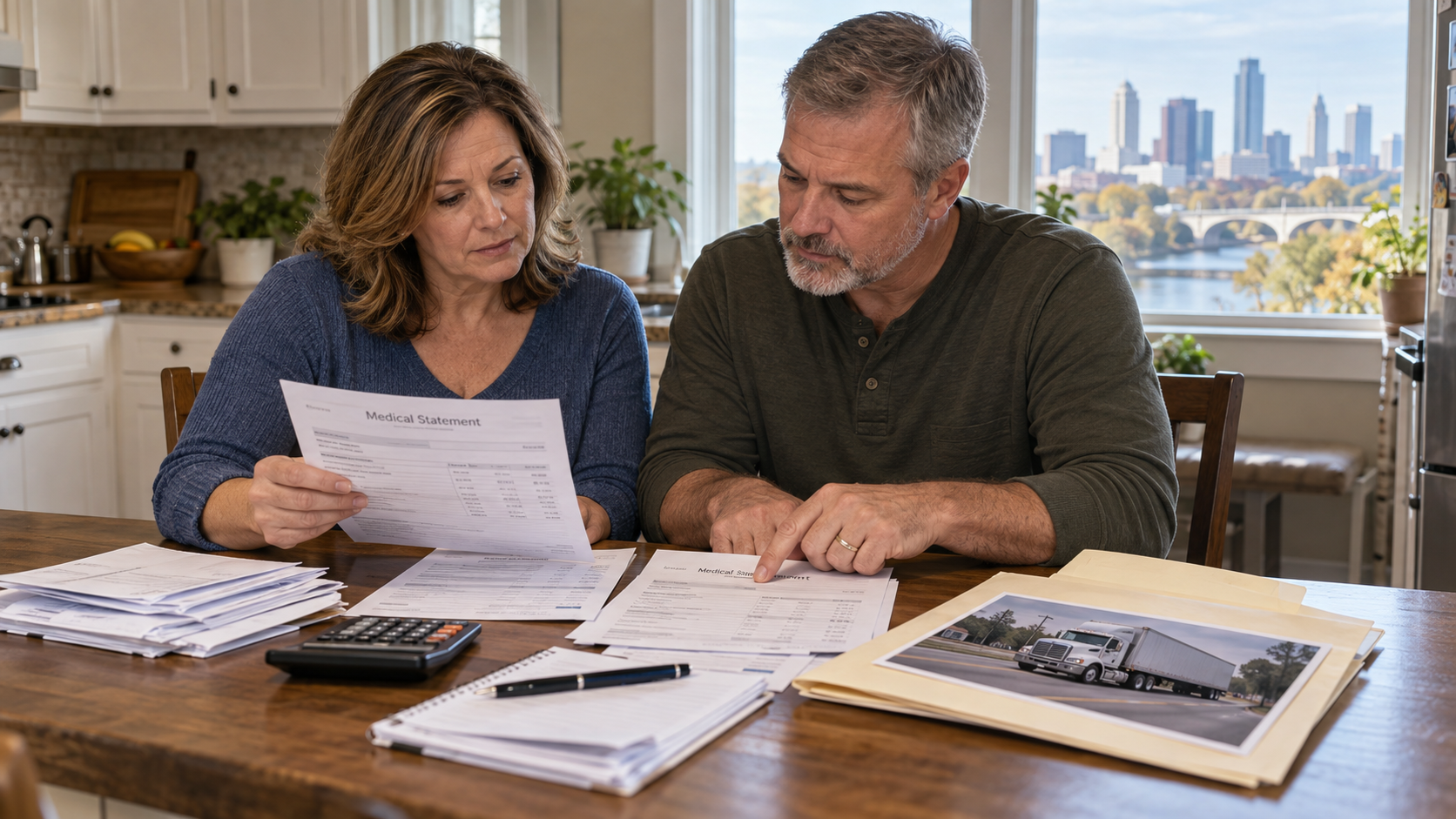
After a serious truck crash in Columbus, the hospital does not wait for the insurance companies to finish arguing about fault. Medical bills usually start with the coverage available right now, then get sorted out later through liability claims, reimbursements, and settlement negotiations. For anyone dealing with a Columbus truck accident, the key is knowing which policies may apply, what order they often move in, and how to keep treatment from turning into unmanageable debt.
Call (614) 482-3793 today to schedule a complimentary consultation with a local Ohio personal injury attorney from Buckeye Law Group.
Who pays first after a truck accident in Columbus?
In practical terms, the first payer is often your own health insurance, MedPay, Medicare, Medicaid, or another available medical coverage source, not the truck company’s liability insurer. Ohio injury claims can take time because fault, damages, policy limits, and responsible parties have to be investigated before the at-fault side pays. If a lawsuit becomes necessary, Ohio generally gives injured people two years from when the injury occurs to bring a bodily injury action, with exceptions that should be reviewed with a lawyer.
That delay surprises many people. The trucking company’s insurer may eventually pay for medical bills Ohio law allows you to claim as damages, but it typically does not pay each emergency room, surgery, rehab, or specialist bill as it arrives. This is why early bill coordination matters almost as much as proving fault.
The usual payment path for truck accident medical bills
Every case is different, but medical payments after a truck crash often move through several layers. Understanding those layers helps you avoid duplicate payments, missed claims, and quick settlements that do not account for future care.
- Health insurance: Your health plan may cover emergency care, follow-up treatment, prescriptions, imaging, surgery, or therapy according to your policy. Later, the plan may seek reimbursement from any settlement or judgment through subrogation.
- MedPay coverage: Medical Payments coverage, if included in an auto policy, can help pay crash-related medical expenses without waiting for a fault decision. It can be especially useful for deductibles, co-pays, ambulance bills, and early out-of-pocket costs.
- The at-fault party’s liability insurance: If the truck driver, trucking company, or another party caused the crash, their liability coverage may ultimately be responsible for medical expenses and other losses.
- UM/UIM coverage: If the responsible party has no insurance or too little coverage, uninsured or underinsured motorist coverage may become important. Ohio law says auto policies may include UM/UIM coverage, but it is not required.
- Government benefits: Medicare or Medicaid may pay certain bills, but repayment rules can apply if you later recover money from a settlement, judgment, or award. Medicare describes these as conditional payments that must be repaid when another payment source becomes available.
This order is not always clean. A hospital may bill health insurance while an auto insurer reviews MedPay. A lien may appear while liability is still disputed. A settlement may need to resolve health insurance, Medicare, Medicaid, and provider balances before the injured person receives the net funds.
Truck accident costs are different from ordinary crash bills
Truck accident costs can grow quickly because these crashes often involve heavier vehicles, higher-force impacts, and more complex injuries. A victim may need trauma care, orthopedic surgery, neurological treatment, long-term rehabilitation, home health support, or time away from work. Even when the medical care is clearly necessary, proving the full value of the claim takes documentation. Truck cases can also involve more than one responsible party. The driver may have made an unsafe lane change, but the employer may have pressured unrealistic delivery schedules, a maintenance vendor may have missed a brake problem, or a loading company may have created an unstable cargo shift. In some cases, a manufacturer, broker, shipper, or other business may need to be investigated.
Commercial trucking policies can carry higher limits than ordinary auto policies. For example, the Federal Motor Carrier Safety Administration lists a $750,000 minimum financial responsibility level for certain for-hire property carriers transporting non-hazardous freight with GVWR of at least 10,001 pounds. But higher limits do not automatically mean the money is easy to access, and catastrophic injuries can still exceed available coverage.
What if the at-fault driver has too little insurance?
If the available liability insurance is not enough, the claim should not stop with the first policy limit offered. The next step is to identify all possible insurance policies and liable parties, then evaluate whether UM/UIM coverage, excess coverage, employer liability, negligent maintenance, defective equipment, or other theories may apply. Ohio requires drivers to carry proof of financial responsibility, and the Ohio BMV lists minimum insurance requirements of $25,000 for injury or death of one person, $50,000 for injury or death of two or more people, and $25,000 for property damage. Those minimums can be far below the real cost of a serious truck crash. That gap is why uninsured and underinsured motorist coverage can be so important in a Columbus medical bills dispute. Before accepting a policy-limits settlement, make sure the offer accounts for known bills, expected future treatment, lost income, pain, disability, and repayment claims. Once a release is signed, it may end the claim against that party even if new symptoms, surgeries, or long-term care needs appear later.
How can you manage bills while the claim is pending?
The safest approach is to stay organized, communicate early, and avoid assuming that silence from an insurer means the bill is being handled. Hospitals, specialists, ambulance providers, imaging centers, and physical therapy offices may all bill separately. Use this checklist to protect yourself:
- Get medical care promptly. Treatment records connect your injuries to the crash and help doctors identify problems before they worsen.
- Give providers all coverage information. Include health insurance, auto insurance, MedPay, Medicare, Medicaid, and any claim numbers you have.
- Ask for itemized bills. Itemized statements help catch duplicate charges, coding issues, and unrelated treatment.
- Track every expense. Keep receipts for prescriptions, medical devices, mileage, parking, home care, and co-pays.
- Do not ignore collection notices. Ask providers whether bills can be paused, rebilled, placed on a payment plan, or handled through a lien.
- Watch reimbursement claims. Ohio Revised Code 2323.44 law limits certain subrogation recoveries when an injured person receives less than the full value of a tort claim.
- Get advice before settling. A settlement should account for liens, repayment obligations, attorney fees, and future medical needs.
Legal help can protect treatment, timing, and settlement value
A lawyer’s role is not only to argue fault. In a truck accident case, legal help can involve preserving evidence, finding every insurance policy, coordinating benefits, challenging improper denials, negotiating medical balances, and making sure repayment claims are handled before settlement funds are distributed. This is especially important when Medicare, Medicaid, self-funded health plans, or hospital liens are involved. These issues can affect how much money actually reaches the injured person after the case resolves. They can also slow payment if they are left until the end.
Who Pays Medical Bills After a Columbus Truck Accident?
After a Columbus truck accident, the at-fault party may ultimately be responsible, but your bills usually need a short-term payment strategy long before the final claim resolves. Health insurance, MedPay, liability insurance, UM/UIM coverage, and government benefits can all play a role. The earlier you organize bills, document treatment, and identify every available coverage source, the better chance you have of controlling truck accident costs and pursuing a recovery that reflects the full impact of the crash.
Call (614) 482-3793 today to schedule a complimentary consultation with a local Ohio personal injury attorney from Buckeye Law Group.
*This page provides general educational information and is not a substitute for legal advice tailored to your circumstances. Reading this page or contacting Buckeye Law Group does not, by itself, establish an attorney-client relationship. Your legal rights, filing deadlines, and potential remedies depend on the facts of your case and applicable law. Consult a qualified personal injury attorney to evaluate your circumstances, explain your options, and help protect your rights. Every case is different, and past results do not guarantee a similar outcome.*
Is Ohio a No-Fault State for Car Accidents?
Ohio is not a no-fault state for car accidents. Ohio uses an at-fault, or tort, system, which means the person who caused the crash is generally responsible for the resulting
Who Pays Medical Bills After a Truck Accident in Columbus Ohio?
After a serious truck crash in Columbus, the hospital does not wait for the insurance companies to finish arguing about fault. Medical bills usually start with the coverage available right
What Is My Car Accident Case Worth in Columbus Ohio Factors That Affect Compensation
The value of an Ohio car accident case in Columbus depends on the losses you can prove, the seriousness of your injuries, available insurance, and how fault is divided. There
Injured at a Columbus Apartment Complex? What Tenants and Visitors Should Document
A fall at a Columbus apartment complex can raise more than immediate medical concerns when a dangerous property condition may have contributed to the injury. For tenants and lawful visitors,
What Happens After a Personal Injury Lawsuit Is Filed in Franklin County?
Filing a personal injury lawsuit in Franklin County, OH, places your claim within a formal court process governed by procedural rules and deadlines. After filing, the defendant must be served
What to Do After a Hit-and-Run Accident in Columbus, Ohio
A hit-and-run accident in Columbus, OH, or the neighboring communities can leave you hurt, shaken, and unsure how to prove what happened. The right response is simple but urgent: get
Injured as a Passenger in a Columbus Car Accident? Understanding Your Options
If you were injured as a passenger in a Columbus car accident, you may have more options than you realize. Passengers are usually not the person blamed for the crash,
Who Pays Medical Bills While an Ohio Car Accident Claim Is Pending?
After a crash, medical care cannot wait for an insurance settlement. In Ohio, the person who caused the collision may ultimately be responsible for injury-related losses, but the at-fault driver’s
Cleveland Premises Liability Lawyers: Understanding Property Injury Claims in Ohio
How Cleveland Premises Liability Lawyers Evaluate Property Injury Claims Under Ohio Law A serious injury on someone else’s property can raise immediate questions about medical bills, responsibility, and your next
How Long Does an Auto Accident Settlement Take in Ohio? A Guide to the Claims Process
Ohio Auto Accident Settlement Timeline: What to Expect From Claim to Payout An Ohio auto accident settlement can move quickly when injuries are minor, liability is clear, and records are
Buckeye Law Group represents people injured in auto accidents, slip and falls, workplace accidents and more in Ohio. Contact us today to learn more.
© 2026 Todos los derechos reservados | The Buckeye Law Group Inc. Políticade privacidad Mapa del sitio
Ubicaciones de las oficinas
- Akron Office 388 S Main St #400 Akron, OH 44311 (330) 426-0288
- Cincinnati Office 201 E 5th St Ste 1910 Cincinnati, OH 45202 (513) 547-2445
- Cleveland Office 127 Public Square Ste 1540 Cleveland, OH 44114 (216) 677-5490
- Columbus Office 20 E Broad St Suite 300 Columbus, OH 43215 (614) 482-3793
- Dayton Office 70 Birch Alley Ste 240 Dayton, OH 45440 (937) 884-4474
- Euclid Office 25701 N Lakeland Blvd Suite 113-C, Cleveland, OH 44132 (216) 405-2626
- Mansfield Office 305 E Main St Ste 6A, Mansfield, OH 44904 (567) 210-2606
- Findlay Office 7430 Timberstone Dr unit 101a, Findlay, OH 45840 419-873-5119
- Mentor Office 7537 Mentor Ave Ste 101, Mentor, OH 44060 (440) 306-3536
- Middletown Office 300 N Main St #400, Middletown, OH 45042 (326) 800-9150
- Parma Office 1257 Rockside Rd #A, Parma, OH 44131 (216) 279-1664
- Springfield Office 2100 E High St Ste TL3, Springfield, OH 45505 (937) 806-5791
- Toledo Office 3950 Sunforest Ct Ste 200, Toledo, OH 43623 (567) 483-3883
- Westlake Office 26404 Center Ridge Rd Ste B2, Westlake, OH 44145 216-247-0565
- Whitehall Office 5340 E Main St Ste 203, Whitehall, OH 43213 (380) 257-5206
- Youngstown Office 306 Churchill Hubbard Rd, Youngstown, OH 44505 (234) 225-0683
Contáctenos
© 2026 Todos los derechos reservados | The Buckeye Law Group Inc. Políticade privacidad Mapa del sitio