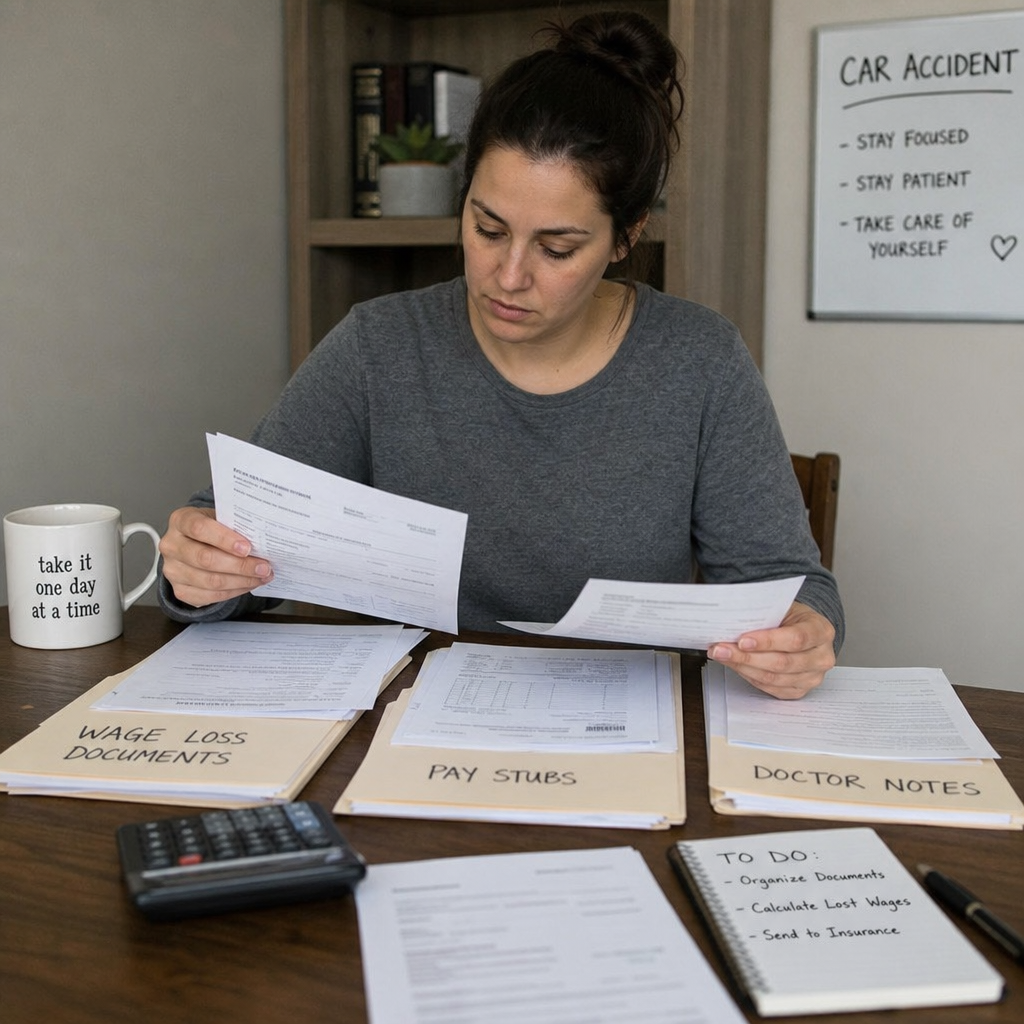
After a Columbus car accident, lost wage documentation is the paper trail that shows how your injuries reduced your income. The stronger that trail is, the easier it is to connect the crash, your medical restrictions, your missed work, and the amount of car accident compensation you are claiming. This guide walks through the records to gather, how to organize them, and where Ohio-specific issues can affect your recovery.
Call (614) 482-3793 or request a free consultation with a Columbus car accident attorney at Buckeye Law Group today.
What counts as lost wages after a Columbus car accident?
Lost wages are the income and work-related benefits you lost because accident injuries kept you from doing your job. That can include hourly pay, salary, overtime, commissions, bonuses, shift differentials, tips, paid time off used during recovery, and future earning losses if your injury limits the work you can do going forward.
For example, an hourly warehouse employee may need payroll records showing missed shifts and overtime history. A salesperson may need commission reports from before and after the crash. A contractor, rideshare driver, or small business owner may need a broader picture because income can vary month to month.
The key is not just proving that you lost money. You also need to prove why. Insurance companies often challenge claims when the medical records do not clearly connect the injury to specific work restrictions, or when income records are incomplete.
Build proof before the insurer asks for it
The best time to document wage loss is while the details are still fresh. If you wait until settlement negotiations, you may struggle to recreate missed hours, lost assignments, canceled jobs, or doctor-imposed limits. Start a folder, digital or physical, with records grouped by category:
- Accident records: police report, crash photos, insurance correspondence, claim numbers, and names of adjusters.
- Employment records: pay stubs, W-2s, employment contracts, offer letters, union agreements, schedules, time sheets, and attendance records.
- Employer verification: a letter confirming job title, pay rate, normal schedule, missed dates, missed overtime, and whether PTO or sick leave was used.
- Medical records: ER records, treatment notes, prescriptions, therapy records, work restriction notes, and return-to-work releases.
- Income history: tax returns, 1099s, profit-and-loss statements, invoices, bank deposits, and commission reports if your pay varies.
- Personal tracking: a daily log of pain levels, appointments, missed shifts, failed work attempts, and tasks you could not perform.

Keep copies of everything you send to the insurance company. If you speak with an adjuster by phone, write down the date, time, name, and what was discussed. This habit can prevent confusion later if the insurer says it never received a document or misunderstood your claim.
How does Ohio comparative fault affect lost wage recovery?
Ohio’s comparative fault rule can reduce or eliminate your recovery depending on your share of responsibility for the crash. If you are partly at fault, your compensatory damages are reduced by your percentage of fault; if your fault is greater than the combined fault of the other responsible parties, recovery can be barred. In practical terms, fault percentages matter to your lost wage claim. If your total wage loss is $20,000 and you are found 30% at fault, the recoverable amount may be reduced to reflect that percentage. That is why documentation should cover both liability and damages: evidence of how the Columbus car accident happened can be just as important as evidence of what income you lost. Do not assume partial fault means you have no claim. Also do not accept a fault percentage just because an insurer assigns one. Photos, witness statements, traffic camera footage, vehicle damage, police findings, and expert analysis may all affect how fault is evaluated.
Ask your employer for a useful wage verification letter
A short note saying “employee missed work” is usually not enough. A useful employer letter should make the lost wage calculation easy to understand and hard to dismiss. Ask your employer or HR department to include:
- Your job title and employment status.
- Your hourly rate, salary, commission structure, or average earnings.
- Your normal weekly schedule before the accident.
- The exact dates and hours missed because of the injury.
- Any overtime, shift premium, bonus, or commission opportunities lost.
- Any PTO, vacation, or sick time used during recovery.
- Whether light duty was available and whether you attempted it.
- The employer representative’s name, title, contact information, and signature.
You can make the request simple:
“I am documenting income I lost because of injuries from a car accident. Could you please provide a wage verification letter confirming my position, pay rate, usual schedule, missed work dates, lost overtime or commissions if applicable, and any PTO or sick leave used during my recovery? If your employer is slow to respond, follow up in writing and keep the email chain. A Columbus accident attorney may also be able to request records formally if cooperation becomes a problem.“
Special records for self-employed, tipped, commission, and gig workers
Variable income requires more context. An insurer may look at one slow week and argue that your loss is smaller than it really is. Your goal is to show a reasonable earning pattern before the crash and how the injury interrupted it. Self-employed people and gig workers should gather multiple years of tax returns if available, recent invoices, canceled contracts, business bank statements, mileage or delivery logs, app earnings statements, calendars, client emails, and proof of jobs declined or canceled. Tipped employees may need point-of-sale reports, tip logs, payroll summaries, and schedules from comparable weeks.
Commission-based workers should preserve sales reports, pipeline records, bonus plans, quota documents, and prior commission averages. If the crash caused you to miss a peak sales period, trade job, booked event, or seasonal work, save documents showing why that time period normally mattered. Future earning capacity is more complicated. If an injury permanently limits lifting, driving, standing, typing, or other job duties, the claim may require medical opinions and possibly vocational or economic analysis. Do not guess at future losses; build them from medical restrictions, work history, and realistic employment evidence.
Medical proof connects the injury to missed work
Lost wage claims are weakest when the income records are strong but the medical support is vague. A doctor’s note that says “off work” is helpful, but a note that states the dates, diagnosis, physical restrictions, and job duties affected is better. Ask your medical provider to be specific when appropriate. For example, a restriction against lifting more than a certain amount may matter if you work in construction, nursing, warehousing, childcare, or delivery. Limits on driving, sitting, screen time, or standing can matter just as much for office workers, drivers, technicians, and service employees. A daily work-ability journal can also help explain the gap between medical appointments. Keep entries brief but consistent:
- Pain or symptoms that affected work;
- Medication side effects;
- Appointments that caused missed hours;
- Tasks you tried but could not complete;
- Light-duty attempts and why they failed;
- Transportation problems caused by the injury or vehicle loss;
- Supervisor conversations about restrictions.
This journal should be honest, not dramatic. Its value is in showing a steady, real-time record of how your injuries affected your ability to earn income.
Timelines and legal steps can shape the claim
Ohio Revised Code § 2305.10 generally gives two years to bring a bodily injury action, including many claims arising from a car crash. That deadline is one reason to begin organizing lost wage evidence early, even if you hope the insurance claim settles without a lawsuit.
If a lawsuit becomes necessary in Franklin County, the forum and filing process may depend on the amount in dispute and the claims involved. The Franklin County Court of Common Pleas states that its General Division has authority over civil cases where the amount in dispute exceeds $15,000, and the Franklin County Clerk notes that electronic filing has been mandated for civil filings since 2011.
Once litigation begins, wage loss evidence may be exchanged through disclosures and discovery. Ohio Civil Rule 26 addresses initial disclosures and discovery procedures, including expert-related information in appropriate cases. That means your calculation should be organized enough for another party to review: totals, dates, supporting records, and clear explanations.
When a Columbus injury lawyer can help
You may be able to document a straightforward short absence on your own, especially if your employer is cooperative and your doctor’s restrictions are clear. Legal help becomes more important when the insurer disputes fault, questions whether your injuries caused the missed work, undervalues variable income, or ignores future earning limitations.
A Columbus injury lawyer can help identify missing records, communicate with the insurer, calculate wage loss, work with medical providers, and decide whether expert support is needed. A Columbus accident attorney can also help protect deadlines and handle formal discovery if negotiations do not produce fair car accident compensation.
How to Document Lost Wages After a Serious Car Accident
A well-supported lost wage claim depends on clear, consistent documentation. Medical restrictions, employment records, pay information, and missed work dates should establish how the accident affected your ability to earn income. Preserving this evidence early can strengthen the connection between your injuries and financial losses while reducing opportunities for an insurer to dispute or undervalue your claim. Careful documentation helps ensure the full financial impact of time away from work is properly considered when evaluating compensation.
Call (614) 482-3793 or request a free consultation with a Columbus car accident attorney at Buckeye Law Group.
*This article provides general information about Columbus car accident claims for educational purposes only and does not constitute legal advice for your specific circumstances. Reading this article or contacting Buckeye Law Group does not, by itself, create an attorney-client relationship. Evaluating a potential claim requires a careful review of the collision, available evidence, applicable law, insurance coverage, and relevant filing deadlines. Consult a qualified Ohio personal injury attorney for guidance regarding your rights, potential claims, and the legal options available after a Columbus car accident. Every case is different, and prior results do not guarantee a similar outcome.*
How to Document Lost Wages After a Columbus Car Accident
After a Columbus car accident, lost wage documentation is the paper trail that shows how your injuries reduced your income. The stronger that trail is, the easier it is to
How Can a Personal Injury Attorney Help After a Bicycle Accident in Middletown, Ohio?
A bicycle crash can turn an ordinary ride into a medical, financial, and legal problem in seconds. If you were hurt in a Middletown bicycle accident, a personal injury attorney
Columbus Bicycle Accidents and What to Do After A Crash
A bicycle crash can turn an ordinary ride through Columbus into a medical, financial, and legal problem in seconds. Whether the collision happens near Downtown, in the University District, along
Injured in a Columbus Rental Car Accident? Which Insurance Documents Matter
A rental car crash can turn into an insurance maze quickly, especially when someone is injured. After a Columbus rental car accident, the documents that matter most are the ones
Dog Bite at a Columbus Home or Apartment What Information Should You Preserve
A dog bite in a home, rental unit, hallway, courtyard, or apartment complex can become both a medical emergency and a legal problem within minutes. The information you preserve immediately
Pain That Appears After a Columbus Car Accident Documenting Symptoms and Treatment
Pain after a crash does not always show up at the scene. Many people walk away from a Columbus auto accident feeling shaken but “mostly fine,” only to wake up
Do I Need a Lawyer After a Car Accident in Columbus Ohio?
A car accident in Columbus can turn into a legal and financial problem long before you feel ready to deal with paperwork, phone calls, and medical bills. You may not
What to Do if the Police Report Is Wrong After a Columbus Car Accident
Finding an error in your police report can add uncertainty to an already difficult situation. You may worry that an incorrect diagram, missing witness, or inaccurate statement will affect your
The Insurer Blames You for a Columbus Motorcycle Crash What Evidence Matters
When an insurer says the rider caused a Columbus motorcycle crash, that is not the end of the claim. Fault can be challenged with the right records, careful crash scene
Akron Truck Accident Attorney: Protecting Your Rights After a Serious Collision
A serious truck crash can leave you managing medical treatment, missed work, vehicle damage, and calls from insurance companies. An Akron truck accident attorney can investigate the collision, identify potentially

Buckeye Law Group represents people injured in auto accidents, slip and falls, workplace accidents and more in Ohio. Contact us today to learn more.
© 2026 Todos los derechos reservados | The Buckeye Law Group Inc. Políticade privacidad Mapa del sitio
Ubicaciones de las oficinas
- Akron Office 388 S Main St #400 Akron, OH 44311 (330) 426-0288
- Cincinnati Office 201 E 5th St Ste 1910 Cincinnati, OH 45202 (513) 547-2445
- Cleveland Office 127 Public Square Ste 1540 Cleveland, OH 44114 (216) 677-5490
- Columbus Office 20 E Broad St Suite 300 Columbus, OH 43215 (614) 482-3793
- Dayton Office 70 Birch Alley Ste 240 Dayton, OH 45440 (937) 884-4474
- Euclid Office 25701 N Lakeland Blvd Suite 113-C, Cleveland, OH 44132 (216) 405-2626
- Mansfield Office 305 E Main St Ste 6A, Mansfield, OH 44904 (567) 210-2606
- Findlay Office 7430 Timberstone Dr unit 101a, Findlay, OH 45840 419-873-5119
- Mentor Office 7537 Mentor Ave Ste 101, Mentor, OH 44060 (440) 306-3536
- Middletown Office 300 N Main St #400, Middletown, OH 45042 (326) 800-9150
- Parma Office 1257 Rockside Rd #A, Parma, OH 44131 (216) 279-1664
- Springfield Office 2100 E High St Ste TL3, Springfield, OH 45505 (937) 806-5791
- Toledo Office 3950 Sunforest Ct Ste 200, Toledo, OH 43623 (567) 483-3883
- Westlake Office 26404 Center Ridge Rd Ste B2, Westlake, OH 44145 216-247-0565
- Whitehall Office 5340 E Main St Ste 203, Whitehall, OH 43213 (380) 257-5206
- Youngstown Office 306 Churchill Hubbard Rd, Youngstown, OH 44505 (234) 225-0683
Contáctenos
© 2026 Todos los derechos reservados | The Buckeye Law Group Inc. Políticade privacidad Mapa del sitio