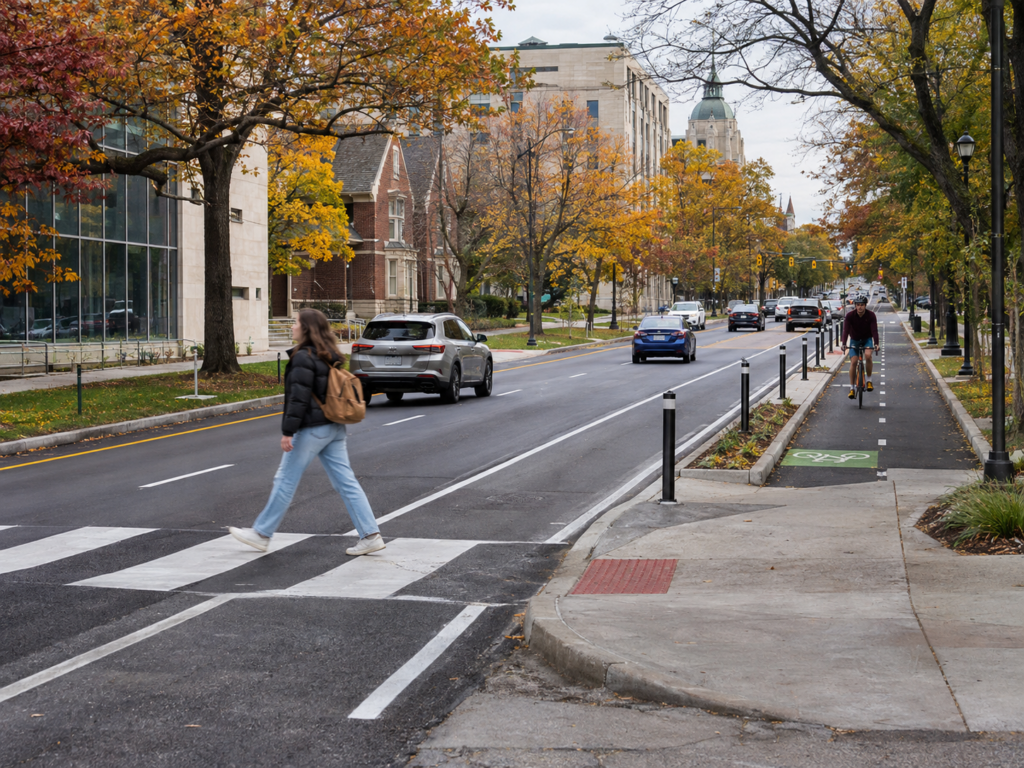
Stokes Boulevard is an important connection between Cleveland’s University Circle area and surrounding neighborhoods. With nearby schools, healthcare facilities, residential properties, and connections to established bicycle routes, the corridor serves motorists, pedestrians, cyclists, and public transportation users.
In 2026, the City of Cleveland is advancing plans to improve approximately 1.1 miles of Stokes Boulevard between Chester Avenue and Martin Luther King Jr. Drive. The proposed project includes roadway resurfacing, changes to vehicle lanes, pedestrian accessibility improvements, and a separated bicycle facility. Although construction is currently scheduled to begin in 2027, understanding the planned improvements can help Cleveland residents prepare for future traffic changes.
Call (216) 677-5490 or request a free consultation today to speak with an experienced local Cleveland personal injury attorney at Buckeye Law Group.
Why Is Cleveland Improving Stokes Boulevard?
According to the City of Cleveland’s Stokes Boulevard project overview, the improvements are intended to address speeding, roadway conditions, pedestrian safety, and gaps in the city’s bicycle network.
The city reports that approximately 38% of vehicles traveling along Stokes Boulevard exceed the posted speed limit. Its records also identify 156 crashes along the project corridor between 2021 and 2025, including one fatal crash and two crashes involving serious injuries. These findings help explain the city’s emphasis on roadway design as a safety measure. The improvements also support Cleveland’s Vision Zero initiative, which seeks to eliminate fatal and serious injury traffic crashes.
What Improvements Are Planned for Stokes Boulevard?
The project combines infrastructure maintenance with changes intended to make the corridor easier to navigate.
Roadway Resurfacing and Accessibility
The city’s planned work includes:
- Resurfacing deteriorated pavement.
- Upgrading curb ramps to accessibility standards.
- Replacing curbs, sidewalks, and driveway aprons where necessary.
- Repairing or replacing drainage structures as needed.
- Evaluating improvements to pedestrian crossings and traffic signals.
These improvements address conditions that can affect vehicle control, pedestrian access, and bicycle travel.
Proposed Vehicle Lane Changes
One significant proposal involves reducing the number of travel lanes on portions of Stokes Boulevard. According to the city’s current design:
- Chester Avenue To Euclid Avenue: The proposed configuration provides one vehicle lane in each direction and a two-way separated bicycle lane on the east side.
- Euclid Avenue To Ambler Park: The design includes two southbound vehicle lanes and the separated bicycle facility.
- Beyond Ambler Park: The existing three-lane vehicle configuration would remain.
These configurations are proposed rather than completed. Final roadway markings and traffic controls should be reviewed when construction approaches.
Bicycle Connections and Intersection Improvements
The proposed bicycle facility would extend from Chester Avenue to Ambler Park, connecting with the existing off-road Lake-to-Lakes Trail. The city also proposes bicycle traffic signals at Chester, Euclid, Carnegie, and Cedar avenues. Additional proposed improvements include intersection redesigns near Wilbur Avenue/East 107th Street and Petrarca Road, as well as a pedestrian crossing beacon near Ambler Park.
What Cleveland Drivers Should Know
The proposed lane reductions are intended to reduce vehicle speeds and improve roadway predictability. Drivers traveling near University Circle, the Cleveland Clinic area, Cedar Avenue, and neighboring residential streets should be prepared for possible changes in lane positioning and turning movements once the project is implemented.
Until the proposed improvements are implemented, motorists traveling along Stokes Boulevard should continue to observe existing traffic signals, posted signs, and roadway markings. Drivers can reduce the risk of collisions by maintaining a safe following distance, checking mirrors and blind spots before turning or changing lanes, and remaining alert for pedestrians and cyclists, particularly near intersections and designated crossings.
Seasonal weather conditions also require additional caution. Stokes Boulevard has a noticeable downhill grade, which can make vehicle control and stopping more challenging when snow, ice, or other slippery conditions are present. Motorists should adjust their speed, increase following distances, and allow additional time to stop. Although Cleveland’s project plans acknowledge the roadway’s steep grade, the proposed improvements do not include changes to the hill’s existing slope.
What Pedestrians Should Know About the Improvements
Pedestrian accessibility is an important component of the Stokes Boulevard project. The proposed changes include upgraded curb ramps, potentially shorter crossing distances, and redesigned intersection approaches that could improve visibility. These features are particularly relevant to people walking near schools, residential buildings, medical facilities, and transit connections.
Pedestrians should continue using designated crossings when available and follow applicable traffic signals. Anyone encountering damaged sidewalks, obstructed curb ramps, or unsafe crossing conditions can report those concerns through Cleveland’s 311 service.
What Cyclists Should Know About the Proposed Bikeway
Stokes Boulevard currently lacks a dedicated bicycle facility along the project corridor. The city’s proposal would introduce two-way separated bicycle lanes on the eastern side of the roadway, connecting existing bicycle infrastructure near Euclid Avenue and the Lake-to-Lakes Trail.
Physical separation is intended to reduce potential conflicts between cyclists and motor vehicles. However, separated bike lanes do not eliminate all intersection risks. Cyclists should continue observing traffic signals, watching for turning vehicles, and approaching intersections carefully. Until the new bikeway is installed and opened, cyclists must follow the roadway rules and traffic controls applicable to the existing street.
When Will Stokes Boulevard Construction Begin?
As of November 18, 2026, Cleveland’s published schedule identifies the following milestones:
| Project Milestone | Expected Timing |
|---|---|
| Design completion | Winter 2026 |
| Construction bidding | Spring 2027 |
| Construction begins | Spring/Summer 2027 |
| Construction completion | Summer 2028 |
The city anticipates performing construction in two phases, generally working on one side of the boulevard while maintaining a southbound travel lane on the opposite side. Detours are also anticipated. The exact timing of lane restrictions remains subject to future announcements. Residents should monitor the official Stokes Boulevard project page rather than assuming that proposed restrictions are already in effect.
Ohio Traffic Laws That Apply on Stokes Boulevard
Roadway improvements do not replace existing traffic safety obligations. Several Ohio statutes are particularly relevant to this corridor.
- Pedestrian Right-Of-Way: Ohio Revised Code § 4511.46 establishes when drivers must yield to pedestrians in crosswalks where traffic signals do not otherwise assign the right-of-way.
- Bicycle Operation: Ohio Revised Code § 4511.55 establishes roadway positioning requirements for cyclists while recognizing exceptions when traveling near the roadway edge would be unreasonable or unsafe.
- Distracted Driving: Ohio Revised Code § 4511.204 restricts drivers’ use of electronic wireless communication devices, subject to statutory exceptions.
- Comparative Negligence: Under Ohio Revised Code § 2315.33, an injured person’s percentage of fault may reduce recoverable damages. Recovery is generally barred when that person’s fault exceeds 50%.
Liability following a collision depends on the evidence and applicable law. The presence of a roadway defect or planned improvement does not automatically establish negligence.
What to Do After a Collision on Stokes Boulevard?
Anyone injured in a vehicle collision, pedestrian incident, or bicycle crash should prioritize safety and appropriate medical attention. When circumstances permit:
- Call 911 for an emergency and request assistance.
- Photograph the incident location, vehicle positions, visible damage, and relevant traffic controls.
- Obtain witness contact information.
- Preserve dashcam recordings, photographs, and insurance correspondence.
- Keep medical records, treatment instructions, and documentation of missed work.
The exact location may help identify relevant evidence, including nearby surveillance cameras or available traffic records.
Most Ohio bodily-injury lawsuits are subject to a two-year filing period under Ohio Revised Code § 2305.10, although exceptions and different rules may apply. Claims involving public entities require particular attention to governmental liability and procedural requirements.
Cleveland Agencies and Local Resources
The following agencies can help residents obtain project information, report roadway concerns, or locate accident records:
City of Cleveland — Mayor’s Office of Capital Projects
Project Contact: Veronica Newsome, Design Section Chief
Email: VNewsome@clevelandohio.gov
Website: Stokes Boulevard Project Information
Contact this office for questions about the proposed design, public engagement, and future construction updates.
Cleveland 311 — Street and Sidewalk Concerns
Phone: 311 or (216) 664-2000
Website: Cleveland 311
Residents can report potholes, street maintenance concerns, and other non-emergency infrastructure problems. Retain the service request number for future reference.
Cleveland Division of Police — Accident Records
Accident Records Unit: (216) 623-5269
Public Records Unit: (216) 623-5352
Police Non-Emergency: (216) 621-1234
Website: Cleveland Police Records Requests
The department provides information about obtaining available crash reports and other public records.
Northeast Ohio Areawide Coordinating Agency (NOACA)
Address: 1299 Superior Avenue, Cleveland, OH 44114
Phone: (216) 241-2414
Website: NOACA
NOACA is a regional transportation planning organization and a funding partner for the Stokes Boulevard project.
Greater Cleveland Regional Transit Authority
Phone: (216) 621-9500
Website: RTA Customer Service
Transit users can obtain route information and inquire about service adjustments if construction affects their travel.
Frequently Asked Questions
- Is Stokes Boulevard under construction in November 2026? The city’s published project timeline places construction in spring or summer 2027. The project remains in its design and preparation stage during 2026.
- Will Stokes Boulevard lose vehicle lanes? The proposed design reduces vehicle lanes along certain sections, while retaining different configurations elsewhere. Drivers should consult the city’s project drawings for segment-specific details.
- Will new bicycle lanes be separated from traffic? The city proposes a two-way separated bikeway on the east side of Stokes Boulevard from Chester Avenue toward Ambler Park, with connections to existing bicycle facilities.
- Can an injured pedestrian or cyclist pursue compensation after a collision? Potential compensation depends on the circumstances, available evidence, liability, and insurance coverage. A roadway redesign proposal alone does not establish fault.
Staying Informed About Cleveland’s Roadway Improvements
Stokes Boulevard’s proposed redesign reflects Cleveland’s effort to improve roadway conditions while accommodating motorists, pedestrians, cyclists, and transit users. During 2026, residents can review the plans, follow official project announcements, and report existing safety concerns.
If a collision results in injury, Buckeye Law Group’s Cleveland office provides free consultations to discuss the circumstances and potential legal options. Additional educational resources are available concerning car accidents, pedestrian accidents, and bicycle accidents.
Call (216) 677-5490 or request a free consultation today to speak with an experienced local Cleveland personal injury attorney at Buckeye Law Group.
Legal Disclaimer: This article provides general educational information as of November 18, 2026, and does not constitute legal advice. Project details and applicable legal requirements may change. Reading this article or contacting Buckeye Law Group does not establish an attorney-client relationship. Our firm offers free consultations and contingency-fee representation, subject to the terms of a written agreement. Every legal matter depends on its individual facts, and no particular outcome is guaranteed.