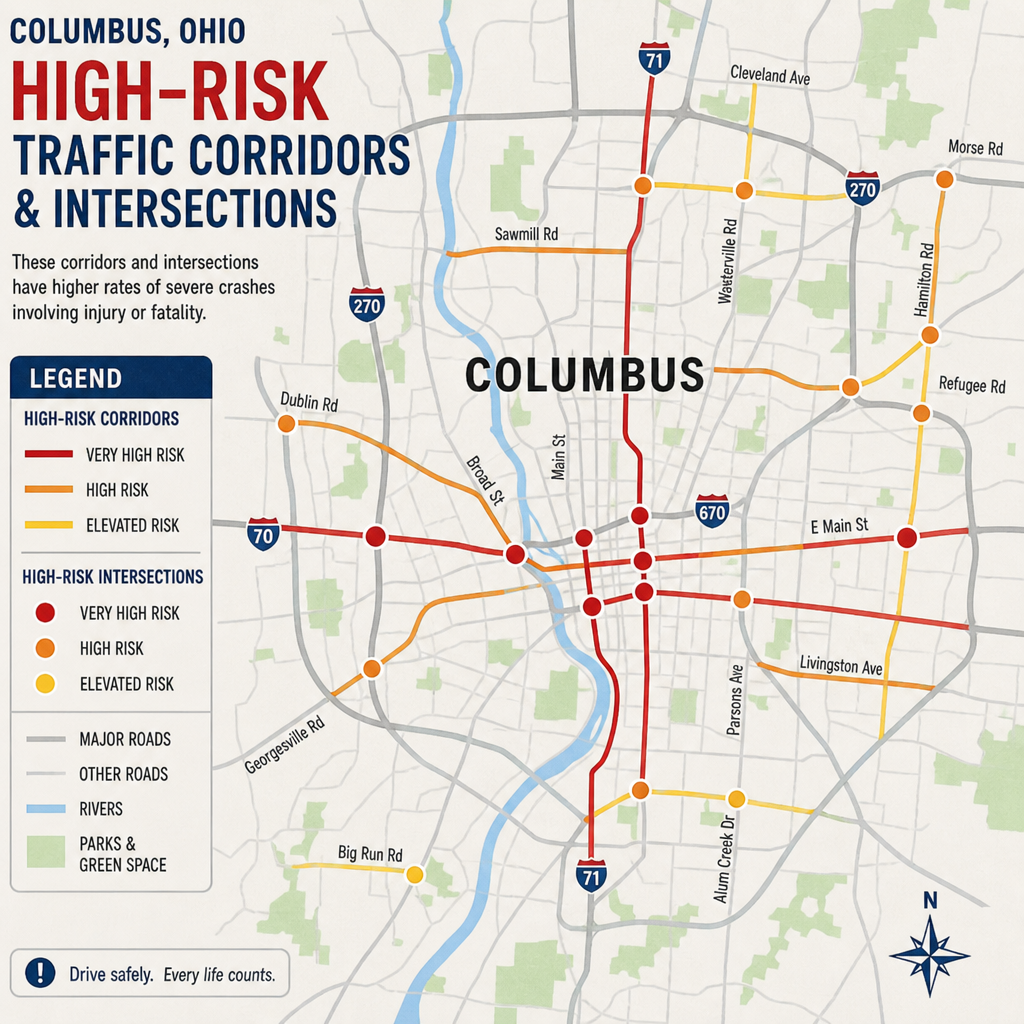
Understanding where serious crashes occur in Columbus can help you recognize roadway risks before your next trip. This guide draws on publicly available local crash data and safety reports to examine high-risk corridors, intersections, and driving conditions. It also translates those findings into practical road safety tips for drivers, pedestrians, and cyclists throughout Columbus, OH, and the neighboring communities. Historical crash patterns cannot predict every collision, but they can help you make more informed decisions about speed, spacing, and visibility.
Call (614) 482-3793 today to schedule a complimentary consultation with a local Ohio personal injury attorney from Buckeye Law Group.
Where do serious crashes happen most often in Columbus?
Serious crashes are concentrated on a relatively small share of streets, especially major arterial corridors that carry fast traffic, frequent turns, bus stops, driveways, and people walking or biking. Columbus’ Vision Zero action plan says 65% of fatal, serious-injury, and vulnerable-road-user crashes occur on 10% of Columbus streets, which is why the city uses a High Injury Network to focus safety work where the stakes are highest.
That does not mean every trip on those roads is dangerous. It means drivers should treat corridors such as East Broad Street, Livingston Avenue, Hamilton Avenue, Cassady Avenue, Roberts Road, Morse Road, and North High Street as places where small mistakes can have bigger consequences. City materials have specifically identified Livingston, Cassady, Hamilton, and Roberts as High Injury Network corridors for targeted Vision Zero safety messaging, while East Broad Street has also been described as part of the city’s High Injury Network.
Local crash patterns that deserve extra attention
The most common risks in Columbus are not mysterious. They often come from speed differences, turning conflicts, distraction, low visibility, and complicated lane changes. Good Columbus traffic safety habits come from recognizing these conditions before they turn into an emergency.
Outerbelt merges and freeway weave zones
I-270, I-70, I-71, SR-315, and SR-161 all create moments where drivers enter, exit, and cross lanes in a short distance. These “weave” conditions are especially stressful when traffic is moving at uneven speeds. The safest approach is to decide early, match traffic speed smoothly, avoid last-second lane dives, and assume a vehicle may be sitting in your blind spot. Use this quick freeway checklist to ensure your safety:
- Before the ramp: Know whether your exit is coming within the next mile so you do not cross multiple lanes late.
- At the merge: Look over your shoulder, not just in the mirror, and avoid merging beside trucks or buses.
- In congestion: Leave enough room for sudden braking; rear-end crashes often begin with one impatient tailgate.
- Near split decisions: If you miss an exit, continue safely and reroute instead of cutting across a gore area.
Downtown intersections and arterial crossings
Intersections around Broad and High, along East Broad, and on busy north-south corridors combine pedestrians, cyclists, turning cars, buses, delivery vehicles, and impatient commuters. The highest-risk behaviors are racing yellow lights, rolling right turns, unprotected left turns, and blocking the crosswalk. Traffic accident prevention in these locations depends less on speed and more on patience: enter only when you can clear the intersection, scan both crosswalks, and wait for a full gap before turning left.
East Livingston Avenue shows how targeted intersection fixes can respond to crash severity. At Courtright Road and East Livingston Avenue, a 2022 ODOT safety study found that 46% of crashes resulted in injury, and Columbus selected the location for a quick-build project intended to reduce left-turn and rear-end crashes.
Why are pedestrians and cyclists at higher risk on major corridors?
Pedestrians and cyclists are more exposed because they have little physical protection when a driver makes a mistake. Columbus’ Vision Zero materials define vulnerable road users as pedestrians, bicyclists, and motorcyclists and include their crashes in the High Injury Network analysis, so these users are central to local traffic safety initiatives.
For people walking, the biggest danger often comes before the crosswalk: poor lighting, long crossing distances, turning drivers looking only for vehicle gaps, and sidewalks that feel disconnected from destinations. For cyclists, the problem is often speed mismatch. A person riding predictably can still be placed at risk by a driver passing too closely, opening a car door, or turning across a bike lane. Practical safety tips for pedestrians and cyclists in Columbus include:
- Cross at marked locations when available, but still make eye contact with turning drivers.
- Avoid stepping into the street from behind parked vehicles, signs, or buses.
- Use lights or reflective gear at dusk, night, and in rain.
- On a bike, ride predictably, signal early, and avoid lingering beside large vehicles at intersections.
- If a crossing feels unsafe, choose the route with better lighting and fewer lanes even if it is slightly longer.
Construction zones create moving hazards
Work zones around Columbus can change from week to week. Lanes shift, barrels move, pavement markings disappear, and construction vehicles may enter the road at unexpected points. The Ohio State Highway Patrol reported that from 2020 through 2024, 35% of Ohio work-zone crashes had workers present at the time, which is a reminder that work-zone driving affects both road crews and motorists.
Strong driving safety tips for work zones are simple but non-negotiable: slow down before the taper, increase following distance, ignore phone notifications, and watch the vehicle two or three cars ahead. If a crash happens in a construction zone, document the lane layout, signs, barrels, lighting, and nearby equipment as soon as it is safe to do so. Those details may change quickly.
What should you do after a crash in Columbus?
After a crash, prioritize safety, medical care, and documentation. Ohio law requires a driver involved in a collision on a public road or highway to stop immediately, remain at the scene, and provide required identifying information to injured people, affected vehicle occupants or owners, and police at the scene. After a crash, consider these steps to protect your safety and document what happened:
- Move out of active traffic if you can do so safely.
- Call 911 for injuries, disabled vehicles, suspected impairment, hit-skip situations, or roadway hazards.
- Exchange names, addresses, vehicle registration information, insurance details, and contact information.
- Photograph vehicle positions, damage, debris, skid marks, signals, signs, weather, lighting, and visible injuries.
- Get witness names and phone numbers before they leave.
- Seek medical evaluation, even if symptoms seem minor at first.
- Notify your insurer, but avoid guessing about fault before the facts are clear.
Fault matters because Ohio uses comparative fault rules. Under Ohio law, contributory fault does not bar recovery if the injured person’s fault was not greater than the combined fault of others, and damages can be reduced in proportion to the injured person’s share of fault. Ohio law also generally requires actions for bodily injury or injury to personal property to be brought within two years after the cause of action accrues, though specific situations can vary.
Safer streets start with predictable choices
Crash data can identify patterns across Columbus, but preventing collisions requires consistent attention and responsible decisions behind the wheel. Use particular caution along High Injury Network corridors, where speed and visibility deserve close attention. Allow extra space around pedestrians and cyclists, plan freeway merges early, and follow posted work zone signs. Effective traffic accident prevention starts with predictable driving: scan ahead, signal before changing lanes, maintain a safe following distance, and eliminate distractions. When visibility is limited, slow down and proceed only when you can do so safely. Although no precaution eliminates every risk, these habits can help protect you and others sharing Columbus roads.
Call (614) 482-3793 today to schedule a complimentary consultation with a local Ohio personal injury attorney from Buckeye Law Group.
*This article provides general educational information and is not a substitute for legal advice tailored to your circumstances. Reading this article or contacting Buckeye Law Group does not, by itself, establish an attorney-client relationship. The merits of a premises liability claim depend on the facts, available evidence, applicable law, and filing deadlines. Consult a qualified Ohio attorney to evaluate your situation and discuss your legal options.*
Where Serious Crashes Occur in Columbus: A Data-Driven Guide to Local Roadway Risks
Understanding where serious crashes occur in Columbus can help you recognize roadway risks before your next trip. This guide draws on publicly available local crash data and safety reports to
Pedestrian Accident Near The University of Akron: What to Do and How to Protect Your Rights
A pedestrian accident near The University of Akron can interrupt your education, work, and daily life without warning. You may face medical bills, missed classes, and questions about who will
Is Ohio a No-Fault State for Car Accidents?
Ohio is not a no-fault state for car accidents. Ohio uses an at-fault, or tort, system, which means the person who caused the crash is generally responsible for the resulting
Who Pays Medical Bills After a Truck Accident in Columbus Ohio?
After a serious truck crash in Columbus, the hospital does not wait for the insurance companies to finish arguing about fault. Medical bills usually start with the coverage available right
What Is My Car Accident Case Worth in Columbus Ohio Factors That Affect Compensation
The value of an Ohio car accident case in Columbus depends on the losses you can prove, the seriousness of your injuries, available insurance, and how fault is divided. There
Injured at a Columbus Apartment Complex? What Tenants and Visitors Should Document
A fall at a Columbus apartment complex can raise more than immediate medical concerns when a dangerous property condition may have contributed to the injury. For tenants and lawful visitors,
What Happens After a Personal Injury Lawsuit Is Filed in Franklin County?
Filing a personal injury lawsuit in Franklin County, OH, places your claim within a formal court process governed by procedural rules and deadlines. After filing, the defendant must be served
What to Do After a Hit-and-Run Accident in Columbus, Ohio
A hit-and-run accident in Columbus, OH, or the neighboring communities can leave you hurt, shaken, and unsure how to prove what happened. The right response is simple but urgent: get
Injured as a Passenger in a Columbus Car Accident? Understanding Your Options
If you were injured as a passenger in a Columbus car accident, you may have more options than you realize. Passengers are usually not the person blamed for the crash,
Who Pays Medical Bills While an Ohio Car Accident Claim Is Pending?
After a crash, medical care cannot wait for an insurance settlement. In Ohio, the person who caused the collision may ultimately be responsible for injury-related losses, but the at-fault driver’s

Buckeye Law Group represents people injured in auto accidents, slip and falls, workplace accidents and more in Ohio. Contact us today to learn more.
© 2026 All Rights Reserved | The Buckeye Law Group Inc. Privacy Policy Sitemap
Office Locations
- Akron Office 388 S Main St #400 Akron, OH 44311 (330) 426-0288
- Cincinnati Office 201 E 5th St Ste 1910 Cincinnati, OH 45202 (513) 547-2445
- Cleveland Office 127 Public Square Ste 1540 Cleveland, OH 44114 (216) 677-5490
- Columbus Office 20 E Broad St Suite 300 Columbus, OH 43215 (614) 482-3793
- Dayton Office 70 Birch Alley Ste 240 Dayton, OH 45440 (937) 884-4474
- Euclid Office 25701 N Lakeland Blvd Suite 113-C, Cleveland, OH 44132 (216) 405-2626
- Mansfield Office 305 E Main St Ste 6A, Mansfield, OH 44904 (567) 210-2606
- Findlay Office 7430 Timberstone Dr unit 101a, Findlay, OH 45840 419-873-5119
- Mentor Office 7537 Mentor Ave Ste 101, Mentor, OH 44060 (440) 306-3536
- Middletown Office 300 N Main St #400, Middletown, OH 45042 (326) 800-9150
- Parma Office 1257 Rockside Rd #A, Parma, OH 44131 (216) 279-1664
- Springfield Office 2100 E High St Ste TL3, Springfield, OH 45505 (937) 806-5791
- Toledo Office 3950 Sunforest Ct Ste 200, Toledo, OH 43623 (567) 483-3883
- Westlake Office 26404 Center Ridge Rd Ste B2, Westlake, OH 44145 216-247-0565
- Whitehall Office 5340 E Main St Ste 203, Whitehall, OH 43213 (380) 257-5206
- Youngstown Office 306 Churchill Hubbard Rd, Youngstown, OH 44505 (234) 225-0683
Contact Us
© 2026 All Rights Reserved | The Buckeye Law Group Inc. Privacy Policy Sitemap