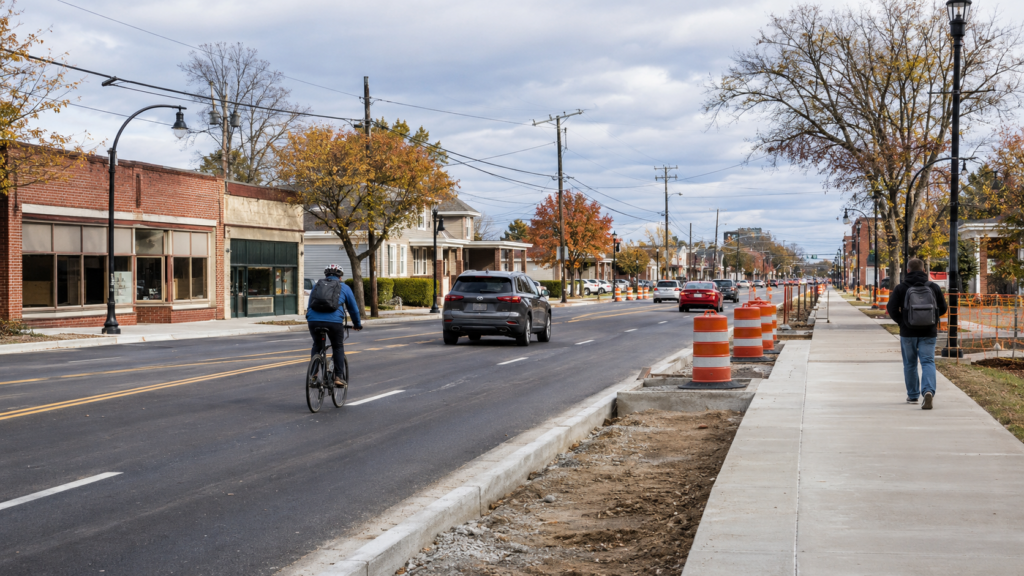
Salem Avenue is undergoing a multiyear reconstruction project intended to improve roadway conditions, pedestrian accessibility, and transportation infrastructure along one of Dayton’s important corridors. The improvements include new pavement, sidewalks, curbs, street lighting, and redesigned crosswalks. For motorists, pedestrians, cyclists, and nearby residents, construction creates important questions about traffic patterns, accessible routes, intersection safety, and precautions when traveling through an active work zone.
According to the City of Dayton’s Salem Avenue Reconstruction project overview, the overall project covers seven phases, extending from Riverview Avenue to Litchfield Avenue. Earlier sections have been completed, while additional improvements are scheduled through 2029. Understanding what is changing along Salem Avenue can help Dayton residents make informed travel decisions and recognize potential safety concerns throughout reconstruction.
Call (937) 884-4474 or request a free consultation today to speak with an experienced Dayton personal injury attorney at Buckeye Law Group.
What Is Included in Dayton’s Salem Avenue Reconstruction Project?
Dayton’s reconstruction initiative addresses aging roadway infrastructure while improving conditions for people traveling by vehicle, bicycle, or on foot. Planned improvements vary by construction phase but generally include:
- Replacement of deteriorated roadway pavement and curbs.
- Reconstruction of sidewalks and installation of accessible curb ramps.
- Upgraded street lighting and stormwater drainage infrastructure.
- Decorative or stamped-concrete crosswalks at selected intersections.
- Changes to lane configurations and bicycle facilities in designated sections.
The project is not a uniform redesign of the entire corridor. Certain sections retain existing travel lanes, while other locations incorporate changes intended to improve traffic operations and accommodate additional transportation needs.
The City of Dayton’s 2026 Safety Action Plan also identifies portions of Salem Avenue as priority corridors for roadway and pedestrian improvements. These recommendations reflect the city’s broader approach to roadway conditions and transportation safety.
Salem Avenue Construction Timeline: Completed and Upcoming Phases
Construction has progressed along Salem Avenue since 2021. As of November 13, 2026, published plans identify the following phases and improvements:
| Project Phase | Location | Published Status Or Schedule |
| Phase 1 | North Avenue to Manhattan Avenue | Substantially completed in 2021 |
| Phase 2 | West Riverview Avenue to North Avenue | Substantially completed in 2023; includes a cycle track |
| Phase 3 | Manhattan Avenue to Cornell Drive | Substantially completed in 2023 |
| Phase 4 | Cornell Drive to Emerson Avenue | Construction underway in 2026 |
| Phase 5 | Emerson Avenue to Elsmere Avenue | Planned to begin spring 2027 |
| Phase 6 | Elsmere Avenue toward Litchfield Avenue | Planned to begin spring 2028 |
The separate Salem Avenue–Philadelphia Drive intersection project also forms part of the corridor improvements. Schedules are subject to change. ODOT lists Phase 4 as an active construction project, with pavement, sidewalks, ADA curb ramps, catch basins, and lighting among its improvements.
Published schedules are not entirely consistent: Dayton’s project page anticipates Phase 4 completion by the end of 2027, while ODOT’s individual Phase 4 listing identifies fall 2026. Neither should be treated as a confirmed completion deadline without a current project update.
How Salem Avenue Construction May Affect Drivers
Road reconstruction can temporarily change familiar driving conditions. Motorists may encounter shifting lanes, temporary pavement markings, construction vehicles, and changes in access to intersections or driveways.
Watch for changing traffic patterns
Drivers should reduce speed as conditions require, observe posted warnings, and allow additional following distance. Temporary lane shifts can create confusion when older roadway markings remain visible or traffic is directed around unfinished pavement. Under Ohio Revised Code § 4511.12, drivers and pedestrians generally must obey properly placed official traffic control devices.
Use additional caution at intersections
Construction activity can make turning movements more complicated, especially where equipment, barriers, or temporary traffic configurations affect sightlines. Drivers approaching intersections such as Salem Avenue at Wabash Avenue, Emerson Avenue, or Catalpa Drive should watch for vehicles turning across traffic and pedestrians entering crosswalks.
Plan ahead for possible delays
Lane restrictions, equipment movements, and temporary access changes may affect travel times. Specific closures should not be assumed unless confirmed through an official traffic notice. Before traveling, motorists can consult ODOT’s OHGO traffic information service and current City of Dayton construction announcements.
Pedestrian Safety During Salem Avenue Reconstruction
Sidewalk reconstruction is an important part of the improvements. While new pedestrian facilities may improve accessibility when completed, unfinished sidewalks and temporary closures can create challenges during construction. Pedestrians should pay attention to temporary signs, designated crossing locations, and changes to established walking routes.
Navigating temporary sidewalk closures
When a sidewalk is closed, pedestrians should look for an accessible temporary route or designated detour. Entering an active construction area or walking around a barrier into moving traffic can create additional hazards.
People using wheelchairs, walkers, or other mobility devices may face particular difficulties where temporary routes contain uneven surfaces, steep transitions, or inaccessible curb connections. Ohio’s pedestrian laws recognize circumstances in which construction makes sidewalk use impracticable; the appropriate alternative depends on roadway conditions and applicable requirements.
Understanding crosswalk rights in Ohio
Under Ohio Revised Code § 4511.46, drivers generally must yield to pedestrians within crosswalks when traffic signals are absent, inoperative, or not clearly assigning the right-of-way, subject to the statute’s conditions.
Pedestrians also have responsibilities. Ohio Revised Code § 4511.48 establishes rules for crossing outside marked or unmarked crosswalks and requires pedestrians to yield in certain circumstances. These requirements remain important when construction changes how people reach intersections.
Bicycle Safety and Salem Avenue’s Changing Infrastructure
Cyclists should be aware that bicycle accommodations differ between project sections. Phase 2 included a 10-foot-wide cycle track between West Riverview Avenue and North Avenue. This improvement provides a designated bicycle facility along that section, but does not mean dedicated bicycle infrastructure extends continuously through every phase.
Navigating Salem Avenue during construction
Cyclists should evaluate roadway conditions before entering an active work area. Uneven pavement, loose gravel, temporary steel plates, and narrowed travel lanes can present concerns for two-wheeled vehicles.
Under Ohio Revised Code § 4511.55, bicyclists generally travel as near to the right side of the roadway as practicable, with exceptions when hazards, narrow lanes, or other circumstances make that position unsafe. Cyclists are not required to ride along an unsafe pavement edge merely to accommodate passing vehicles. Motorists must provide appropriate clearance. Ohio law generally requires at least three feet of passing distance when overtaking a bicycle, in addition to other safe-passing requirements.
What Should You Do After an Accident in a Salem Avenue Construction Zone?
Even with precautions, collisions and injuries can occur in construction areas. People involved in an accident should prioritize safety and seek appropriate assistance:
- Contact Emergency Services When Necessary: Call 911 for serious injuries, immediate hazards, or circumstances requiring emergency assistance.
- Seek Medical Evaluation: Some injuries may not be immediately apparent after a collision. Medical documentation can help establish when symptoms developed and treatment was required.
- Document Conditions When Safe: Photographs of vehicles, roadway markings, construction signs, traffic signals, barriers, and pavement conditions may help clarify circumstances.
- Preserve Relevant Information: Retain crash reports, witness contact information, medical records, repair estimates, and insurance correspondence.
Construction-related collisions may involve questions about driver conduct, temporary traffic controls, roadway maintenance, and whether relevant parties exercised reasonable care. The presence of construction equipment or a roadway hazard does not automatically establish legal responsibility.
Who May Be Responsible for a Construction-Zone Accident?
Determining responsibility requires examining the incident rather than assuming that a driver, contractor, or public agency caused the collision. Relevant considerations can include inattentive driving, failure to yield, compliance with traffic controls, road hazards, and applicable roadway safety obligations.
Ohio follows a modified comparative negligence system. Under Ohio Revised Code § 2315.33, an injured person’s contributory fault may reduce recoverable damages, and recovery may be barred if that person’s fault exceeds 50%, subject to the statute’s requirements.
Claims involving public roadways or government entities may present separate immunity, procedural, and deadline considerations. For many Ohio personal injury claims, Ohio Revised Code § 2305.10 establishes a two-year limitations period, although exceptions and different requirements may apply.
Frequently Asked Questions About Salem Avenue Reconstruction
- Is Salem Avenue currently under construction in Dayton? ODOT identifies Phase 4, between Cornell Drive and Emerson Avenue, as an active 2026 construction project. Verify current traffic restrictions through official updates.
- Will Salem Avenue have new sidewalks and crosswalks? Yes. The city’s plans include improvements to sidewalks, curbs, street lighting, and decorative crosswalks at selected intersections. Improvements vary by phase.
- Is there a dedicated bicycle path on Salem Avenue? A 10-foot cycle track was installed as part of Phase 2 between West Riverview Avenue and North Avenue. Dedicated facilities should not be assumed throughout the corridor.
- When will the Salem Avenue reconstruction be completed? The published multiyear plan anticipates additional construction through 2029. Individual phase dates may change.
Local Dayton Resources for Salem Avenue Construction Updates and Roadway Safety
Dayton residents, commuters, pedestrians, and cyclists can access several local government and transportation resources to stay informed about Salem Avenue’s reconstruction. These organizations provide project schedules, traffic information, bicycle route planning tools, and resources for reporting roadway safety concerns.
City of Dayton – Salem Avenue Reconstruction Project
The City of Dayton maintains an official project page documenting Salem Avenue’s reconstruction phases, planned infrastructure improvements, and anticipated construction schedules. Residents can review improvements affecting intersections such as Salem Avenue and North Avenue, Cornell Drive, Wabash Avenue, Emerson Avenue, and Elsmere Avenue.
Resource: City of Dayton – Salem Avenue Reconstruction
Address: 101 W Third St, Dayton, OH 45402.
Phone: (937) 333-3333
Ohio Department of Transportation – District 7
The Ohio Department of Transportation (ODOT) provides information about state and federally supported roadway improvements throughout Montgomery County. ODOT’s project listings include reconstruction between Cornell Drive and Emerson Avenue, including planned pavement replacement, accessible curb ramps, sidewalks, and street lighting. Drivers can also use OHGO to check reported traffic incidents, construction restrictions, and travel conditions before entering work zones.
Resource: ODOT – Salem Avenue Reconstruction Phase 4
Resource: OHGO – Ohio Traffic Information
District 7 Public Contact: (937) 492-1141
Miami Valley Regional Planning Commission – Bicycle and Pedestrian Resources
The Miami Valley Regional Planning Commission (MVRPC) provides regional transportation planning information, including bicycle and pedestrian resources for Dayton and surrounding Montgomery County communities.
The Miami Valley Ohio Bikeways Map is a valuable resource for cyclists navigating the Dayton region. It helps riders identify established regional trails, evaluate alternative routes, and plan safer travel options when roadway construction, temporary closures, or detours disrupt their usual routes. Cyclists should also verify current trail conditions and construction restrictions before traveling.
Resource: MVRPC – Miami Valley Bikeways Map
Dayton Police Department – Traffic Safety and Crash Reports
The Dayton Police Department provides resources for reporting traffic-related concerns and obtaining available crash reports for incidents occurring within its jurisdiction. Its Traffic Services Unit addresses traffic enforcement concerns and investigates certain serious collisions. Individuals involved in a Salem Avenue accident may be able to locate their crash report through department resources.
Resource: Dayton Police Department – Traffic Services Unit
Resource: Dayton Police Department – Reporting and Traffic Accident Records
Emergency: 911 | Non-emergency: (937) 333-2677 | Traffic Services Unit: (937) 333-1149
Why These Local Resources Matter
Because Salem Avenue’s reconstruction is being completed in multiple phases, traffic configurations, sidewalk accessibility, and construction schedules may change as work progresses.
Checking official City of Dayton announcements, ODOT traffic information, and regional transportation resources can help residents identify current restrictions and plan appropriate routes. Reliable local information is especially useful for people traveling near active construction areas.
Staying Informed About Salem Avenue Construction
Salem Avenue’s reconstruction represents an ongoing investment in Dayton’s transportation infrastructure. New pavement, sidewalks, crosswalks, and lighting are intended to address deteriorating conditions and improve how residents navigate the corridor.
Until construction is completed, temporary traffic configurations and changing pedestrian routes require additional attention. Drivers, cyclists, and pedestrians can support safer travel by observing traffic controls, adapting to changing conditions, and consulting official project information before traveling.
Buckeye Law Group provides educational information about Ohio roadway safety and legal considerations following an accident. Individuals with questions about a specific injury or collision can request a consultation with a local Ohio attorney to better understand their circumstances.
Call (937) 884-4474 or request a free consultation today to speak with an experienced Dayton personal injury attorney at Buckeye Law Group.
Legal Disclaimer: This article is provided by Buckeye Law Group for general educational and informational purposes only and does not constitute legal advice. Reading this article does not establish an attorney-client relationship. Construction schedules, traffic conditions, and project details may change. Legal rights and responsibilities depend on the circumstances of each case. Prior results do not guarantee future outcomes. Buckeye Law Group offers free consultations and handles eligible personal injury matters on a contingency-fee basis, subject to a written fee agreement.