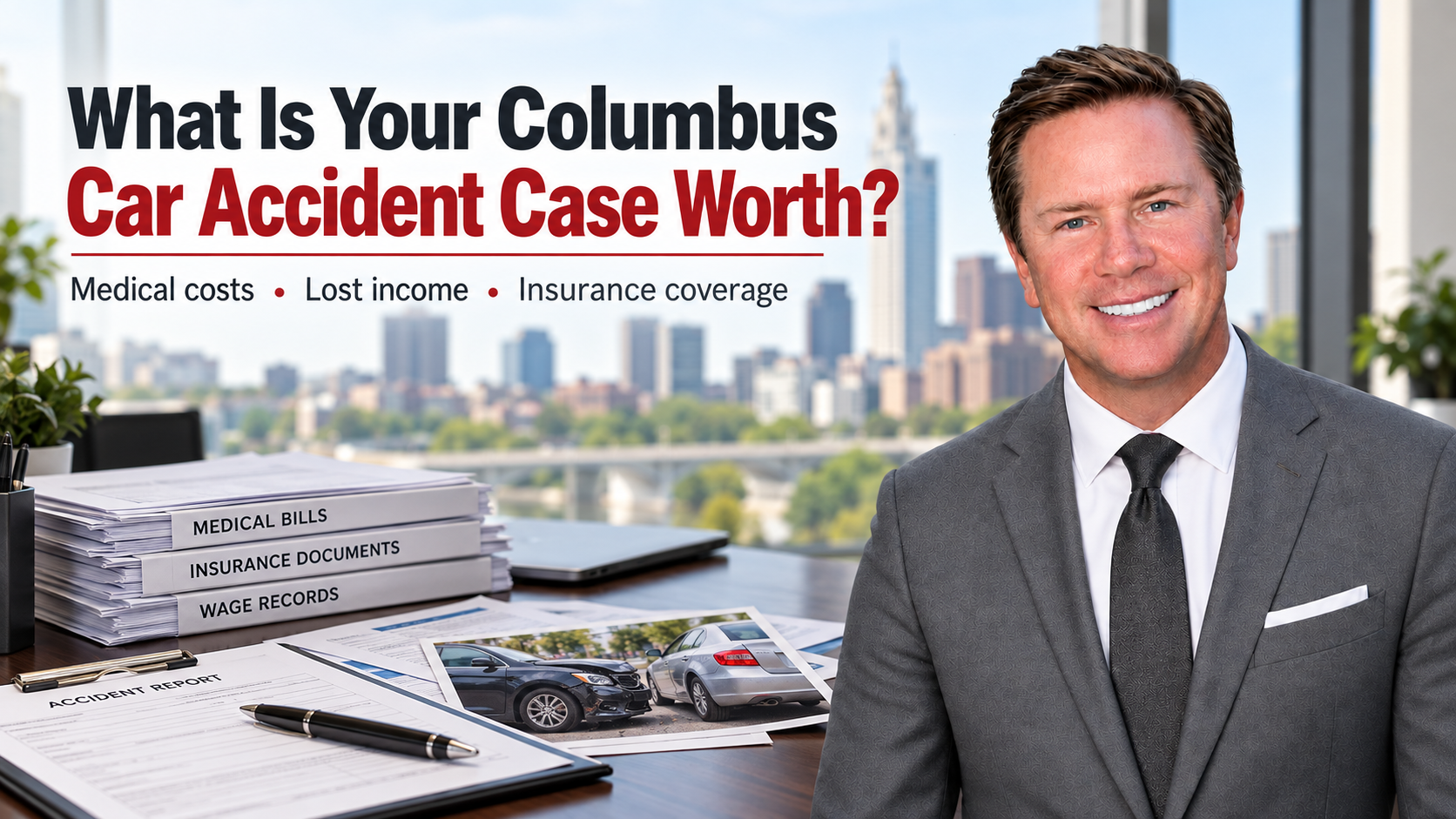
The value of an Ohio car accident case in Columbus depends on the losses you can prove, the seriousness of your injuries, available insurance, and how fault is divided. There is no reliable “average” number that fits every crash, but understanding the main valuation factors can help you protect your claim and avoid settling too early.
Call (614) 482-3793 today to schedule a complimentary consultation with a local Ohio personal injury attorney from Buckeye Law Group.
What factors determine car crash compensation in Columbus?
Car crash compensation is usually built from two broad categories: economic losses and non-economic losses. Economic losses are the bills and financial harm you can document, such as medical treatment, lost income, rehabilitation, vehicle repairs, and other out-of-pocket costs. Ohio law describes economic loss to include wages, medical care, rehabilitation, and other expenditures caused by the injury or property loss.
Non-economic losses are harder to measure because they deal with the human impact of the crash. Pain, emotional distress, loss of enjoyment, disfigurement, and similar intangible harms may be part of car accident claims when supported by medical records, consistent treatment, and credible evidence about how the injury changed daily life. Ohio law defines noneconomic loss to include pain and suffering, mental anguish, disfigurement, loss of companionship, and other intangible loss.

The evidence behind your losses matters
A claim is not valued only by what happened; it is valued by what can be proven. Insurance adjusters often look for gaps in treatment, inconsistent statements, missing wage documentation, or unclear medical opinions. Strong documentation makes it easier to connect the crash to the injury and the injury to the financial demand. Useful evidence may include:
- Medical records and bills showing diagnosis, treatment, referrals, prescriptions, therapy, and future care needs.
- Proof of income loss such as pay stubs, employer letters, tax records, or missed-work documentation.
- Crash evidence including the police report, photos, witness information, dashcam footage, and repair estimates.
- Daily impact notes describing pain levels, missed activities, sleep disruption, mobility limits, and caregiving needs.
- Insurance paperwork from all involved policies, including liability, medical payments, uninsured motorist, and underinsured motorist coverage.
This is especially important in columbus insurance claims where the insurer may accept that a crash occurred but still dispute the severity, duration, or cause of the injury.
How does Ohio fault law affect your settlement?
Ohio uses a comparative fault rule: if you are partly responsible, your compensation can be reduced by your percentage of fault, and if your fault is greater than the combined fault of others, you cannot recover damages. The Ohio Revised Code 2315.33 states that contributory fault does not bar recovery when the plaintiff’s fault is not greater than the fault of others, but damages are reduced in proportion to the plaintiff’s percentage of fault.
For example, if your damages are valued at $80,000 and you are found 20% at fault, the recoverable amount may be reduced to $64,000. If the insurer argues you were 51% or more responsible, your claim may be denied entirely under Ohio’s modified comparative fault system. That is why fault evidence, traffic signals, lane position, speed, phone use, weather, road design, and witness accounts, can be just as important as medical evidence.
Insurance limits can cap practical recovery
Even a strong claim can run into insurance limits. Ohio requires proof of financial responsibility in the amount of $25,000 for bodily injury or death to one person, $50,000 for bodily injury or death to two or more people in one accident, and $25,000 for property damage.
If the at-fault driver carries only minimum coverage, the available liability insurance may be far lower than the full value of a serious injury claim. In that situation, your own uninsured/underinsured motorist coverage, medical payments coverage, health insurance, or claims against other responsible parties may become important. Commercial vehicles, rideshare vehicles, delivery vehicles, or crashes involving employers may involve different coverage questions, so identifying every available policy early can make a major difference.
Ohio damage caps may affect pain and suffering
Ohio does not cap economic damages in ordinary tort cases, meaning proven medical expenses, lost wages, and similar financial losses are not subject to the same statutory ceiling. Ohio does, however, limit many non-economic damages to the greater of $250,000 or three times the economic loss, with a maximum of $350,000 per plaintiff and $500,000 per occurrence, unless a statutory exception applies. Important exceptions may apply for severe injuries, including permanent and substantial physical deformity, loss of use of a limb, loss of a bodily organ system, or a permanent physical functional injury that prevents independent self-care and life-sustaining activities. Those exceptions make injury classification and medical documentation especially important in catastrophic cases.
Common mistakes that reduce car accident claims
Many claim problems begin before a lawsuit is ever filed. A recorded statement, a casual social media post, or a missed doctor’s appointment can become an argument for a lower offer. The goal is not to exaggerate the claim; it is to preserve accurate evidence before it disappears. Avoid these pitfalls:
- Delaying medical care. Gaps give insurers room to argue that the injury was minor or unrelated.
- Settling before diagnosis is clear. Once you sign a release, later treatment may not be covered by the settlement.
- Guessing about fault. Say what you know, but avoid speculation in recorded statements.
- Posting about the crash or injuries online. Photos and comments can be taken out of context.
- Ignoring deadlines. Ohio generally requires actions for bodily injury or injury to personal property to be brought within two years after the cause of action accrues.
A realistic way to think about case value
Instead of asking for a single average settlement number, think of case value as a range shaped by proof, risk, and recovery. A minor soft-tissue injury with short treatment, clear liability, and limited bills will usually be valued very differently from a surgical injury, permanent impairment, or crash involving long-term wage loss. A practical valuation review usually asks:
- What medical treatment has already happened, and what future care is likely?
- Can the injury be clearly linked to the crash?
- How much income has been lost, and is earning capacity affected?
- Is fault disputed, and what evidence supports each side?
- What insurance coverage is available?
- Do Ohio’s non-economic damage limits or exceptions matter?
The strongest ohio car accident claims are built patiently, with attention to medical progress and legal deadlines. If you are dealing with a Columbus crash, gather records early, be careful with insurer communications, and avoid signing a release until you understand the full value of your losses. A fair result depends less on a quick estimate and more on proving the complete financial and personal impact of the collision.
Call (614) 482-3793 today to schedule a complimentary consultation with a local Ohio personal injury attorney from Buckeye Law Group.
*Every personal injury claim is different. Your legal rights, applicable filing deadlines, potential claims, and available remedies depend on the specific facts of your situation and the law that applies to your case. Because important deadlines and legal issues may affect your rights, you should consult with a qualified attorney who can evaluate your circumstances and provide guidance tailored to your situation. No information on this page should be used as a substitute for individualized legal advice. Every case is different, and past results do not guarantee a similar outcome.*
Is Ohio a No-Fault State for Car Accidents?
Ohio is not a no-fault state for car accidents. Ohio uses an at-fault, or tort, system, which means the person who caused the crash is generally responsible for the resulting
Who Pays Medical Bills After a Truck Accident in Columbus Ohio?
After a serious truck crash in Columbus, the hospital does not wait for the insurance companies to finish arguing about fault. Medical bills usually start with the coverage available right
What Is My Car Accident Case Worth in Columbus Ohio Factors That Affect Compensation
The value of an Ohio car accident case in Columbus depends on the losses you can prove, the seriousness of your injuries, available insurance, and how fault is divided. There
Injured at a Columbus Apartment Complex? What Tenants and Visitors Should Document
A fall at a Columbus apartment complex can raise more than immediate medical concerns when a dangerous property condition may have contributed to the injury. For tenants and lawful visitors,
What Happens After a Personal Injury Lawsuit Is Filed in Franklin County?
Filing a personal injury lawsuit in Franklin County, OH, places your claim within a formal court process governed by procedural rules and deadlines. After filing, the defendant must be served
What to Do After a Hit-and-Run Accident in Columbus, Ohio
A hit-and-run accident in Columbus, OH, or the neighboring communities can leave you hurt, shaken, and unsure how to prove what happened. The right response is simple but urgent: get
Injured as a Passenger in a Columbus Car Accident? Understanding Your Options
If you were injured as a passenger in a Columbus car accident, you may have more options than you realize. Passengers are usually not the person blamed for the crash,
Who Pays Medical Bills While an Ohio Car Accident Claim Is Pending?
After a crash, medical care cannot wait for an insurance settlement. In Ohio, the person who caused the collision may ultimately be responsible for injury-related losses, but the at-fault driver’s
Cleveland Premises Liability Lawyers: Understanding Property Injury Claims in Ohio
How Cleveland Premises Liability Lawyers Evaluate Property Injury Claims Under Ohio Law A serious injury on someone else’s property can raise immediate questions about medical bills, responsibility, and your next
How Long Does an Auto Accident Settlement Take in Ohio? A Guide to the Claims Process
Ohio Auto Accident Settlement Timeline: What to Expect From Claim to Payout An Ohio auto accident settlement can move quickly when injuries are minor, liability is clear, and records are

Buckeye Law Group represents people injured in auto accidents, slip and falls, workplace accidents and more in Ohio. Contact us today to learn more.
© 2026 All Rights Reserved | The Buckeye Law Group Inc. Privacy Policy Sitemap
Office Locations
- Akron Office 388 S Main St #400 Akron, OH 44311 (330) 426-0288
- Cincinnati Office 201 E 5th St Ste 1910 Cincinnati, OH 45202 (513) 547-2445
- Cleveland Office 127 Public Square Ste 1540 Cleveland, OH 44114 (216) 677-5490
- Columbus Office 20 E Broad St Suite 300 Columbus, OH 43215 (614) 482-3793
- Dayton Office 70 Birch Alley Ste 240 Dayton, OH 45440 (937) 884-4474
- Euclid Office 25701 N Lakeland Blvd Suite 113-C, Cleveland, OH 44132 (216) 405-2626
- Mansfield Office 305 E Main St Ste 6A, Mansfield, OH 44904 (567) 210-2606
- Findlay Office 7430 Timberstone Dr unit 101a, Findlay, OH 45840 419-873-5119
- Mentor Office 7537 Mentor Ave Ste 101, Mentor, OH 44060 (440) 306-3536
- Middletown Office 300 N Main St #400, Middletown, OH 45042 (326) 800-9150
- Parma Office 1257 Rockside Rd #A, Parma, OH 44131 (216) 279-1664
- Springfield Office 2100 E High St Ste TL3, Springfield, OH 45505 (937) 806-5791
- Toledo Office 3950 Sunforest Ct Ste 200, Toledo, OH 43623 (567) 483-3883
- Westlake Office 26404 Center Ridge Rd Ste B2, Westlake, OH 44145 216-247-0565
- Whitehall Office 5340 E Main St Ste 203, Whitehall, OH 43213 (380) 257-5206
- Youngstown Office 306 Churchill Hubbard Rd, Youngstown, OH 44505 (234) 225-0683
Contact Us
© 2026 All Rights Reserved | The Buckeye Law Group Inc. Privacy Policy Sitemap