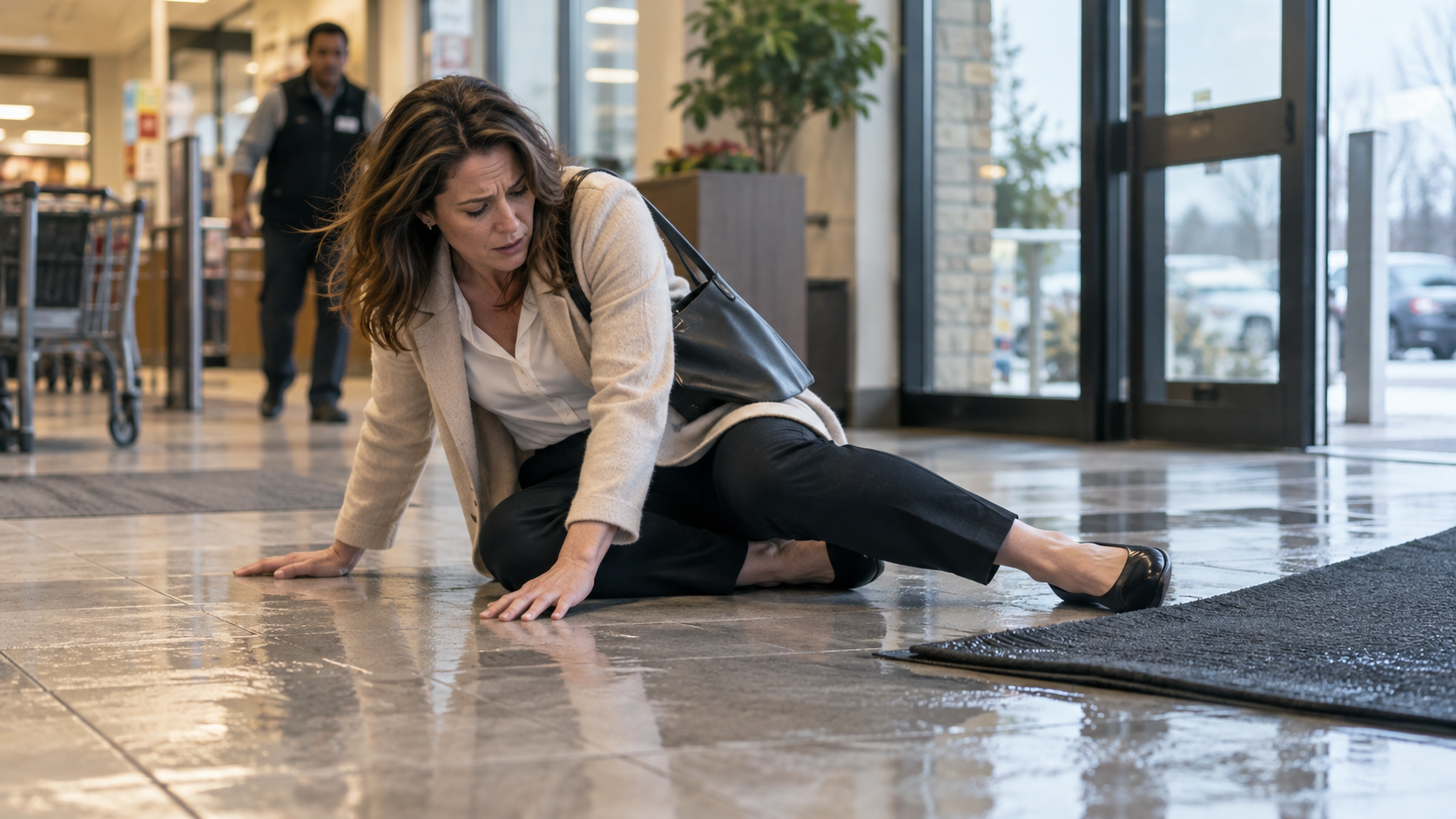
A slip-and-fall injury claim in Cincinnati, Ohio, usually turns on proof: what caused the fall, who controlled the property, what the owner or occupier knew or should have known, and how the fall caused real harm to you a loved one. Strong claims are built early, with photos, medical records, witness details, incident reports, and a clear timeline. This article explains how evidence fits together in an Ohio premises liability case and why working with a Cincinnati slip and fall lawyer can help preserve the details that insurers often challenge.
Call (513) 547-2445 or request a free consultation to speak with a local Cincinnati slip & fall injury lawyer at Buckeye Law Group today.
What do you have to prove after a slip and fall in Cincinnati?
To prove a slip-and-fall injury claim in Cincinnati, Ohio, you generally need to show that a hazardous condition existed, the property owner or occupier owed you a duty of care, they failed to act reasonably, that failure caused your fall, and you suffered severe damages. Ohio premises cases often focus on whether the injured person was lawfully on the property, whether the danger was hidden or obvious, and whether the property owner had notice of the problem.
In practical terms, a slip fall lawsuit is not won simply because someone fell on another person’s property. The evidence must connect the condition to the fall and connect the fall to the injury. That is why an accident injury lawyer will usually look for proof from several angles instead of relying on one piece of evidence. A strong claim often includes evidence of:
- The Dangerous Condition: Water, ice, grease, uneven flooring, loose mats, broken stairs, poor lighting, debris, or an unmarked hazard.
- Control Of The Property: Who owned, leased, operated, managed, cleaned, or maintained the area where the fall happened.
- Notice: Proof the owner knew or should have known about the hazard before the fall.
- Causation: Medical and factual evidence showing the fall caused or worsened the injury.
- Damages: Treatment costs, lost income, pain, mobility limits, and other losses tied to the incident.
Ohio law also matters. For bodily injury claims, Ohio Revised Code Section 2305.10 generally gives two years from the date the injury occurs to bring the action, although unusual facts can affect deadlines. That makes early documentation important, even if you hope the claim will resolve without filing a lawsuit.
The first evidence is often the most valuable
The best evidence is usually closest in time to the fall. Conditions change quickly in stores, apartment buildings, restaurants, parking lots, and public walkways. Spills get mopped, mats get moved, snow gets cleared, and surveillance footage may be overwritten.
If you are able, photograph the exact area before anything changes. Capture close-up images of the hazard and wider shots showing lighting, warning signs, traffic patterns, nearby displays, stairs, entrances, or weather conditions. If shoes or clothing became wet, dirty, torn, or damaged, keep them rather than washing or discarding them. It also helps to report the fall immediately. Ask for an incident report and write down the name and job title of the person who took the report. You may not receive a copy on the spot, but the fact that you reported the fall creates a time-stamped trail. Useful early evidence includes:
- Photos or video of the hazard and surrounding area.
- Names and contact information for witnesses.
- The incident report number, if one exists.
- Receipts, parking records, appointment reminders, or other proof you were there.
- Notes about what employees, managers, tenants, or maintenance workers said.
- Weather screenshots if snow, ice, or rain played a role.
- Medical records from urgent care, emergency treatment, or follow-up appointments.
Do not exaggerate or guess when giving a report. A simple statement such as “I slipped on a wet floor near the entrance” is stronger than a dramatic account that later needs correction.
Notice is the center of many Ohio slip-and-fall cases
In many Cincinnati personal injury claims involving falls, the hardest part is proving notice. Property owners are not automatically responsible for every hazard the moment it appears. The key question is often whether they created the hazard, actually knew about it, or should have discovered it through reasonable inspections. For example, if a grocery store employee mopped a tile aisle and left it wet without warning signs, the store may have created the condition. If a customer told staff about spilled liquid and no one responded, that may support actual notice. If a leak persisted long enough that a property owner should have discovered it through reasonable inspections, that evidence may help establish constructive notice.
Evidence of notice can come from surveillance footage, maintenance logs, cleaning schedules, prior complaints, witness statements, employee admissions, repair records, or the appearance of the hazard itself. A puddle with track marks, dirt, or shopping cart lines may suggest it was present for more than a few seconds. A broken handrail with rust, old tape, or prior patching may tell a similar story. This is one reason a Cincinnati slip and fall attorney may send preservation letters quickly. Those letters ask the property owner, insurer, or business to preserve video, reports, inspection records, and other materials before they disappear.
Why does the “open and obvious” rule matter?
The “open and obvious” rule matters because Ohio property owners may argue they had no duty to warn about a danger that a reasonable person would have seen and avoided. Ohio courts recognize that a premises owner generally does not owe a duty for dangers that are open and obvious, and that defense can be a major issue in slip & fall cases. That does not mean every visible hazard defeats a claim. The details still matter. Lighting, crowding, distractions created by the property, blocked sightlines, weather, placement of merchandise, lack of warning signs, or the injured person’s route can all affect how the hazard is evaluated.
For instance, a bright orange cone beside a freshly mopped floor may be difficult to challenge. But a clear liquid on a glossy floor near a busy checkout lane is different. Similarly, poor lighting may conceal a change in floor height, while a loose entrance mat may create a hazard for visitors who are focused on the path ahead rather than looking down at every step. Good proof addresses this defense before the insurer raises it. Photos from eye level, witness statements, and measurements can show whether the hazard was actually noticeable. A careful claim also explains what the injured person was doing and why it was reasonable under the circumstances.
Medical proof connects the fall to the injury
Medical documentation is not just about showing that you were hurt. It helps prove when the symptoms started, how severe they were, what treatment was necessary, and whether the injury affected work or daily life. Seek care promptly after a fall, especially if you hit your head, injured your back, twisted a knee, fractured a wrist, or developed pain that worsens over time. Delays in treatment give insurers room to argue the injury came from something else. Gaps in care can also weaken a slip & fall settlement because they make the injury story harder to follow.
Tell medical providers exactly how the injury happened. If you slipped on water and landed on your hip, say that. If you grabbed a railing and injured your shoulder while trying not to fall, include that detail. Medical records should match the facts of the claim as closely and honestly as possible. Keep a file with:
- Emergency room, urgent care, orthopedic, chiropractic, and physical therapy records.
- Diagnostic imaging reports, if any.
- Prescriptions and assistive device receipts.
- Work restrictions and disability notes.
- Mileage, parking, and out-of-pocket treatment expenses.
- A short recovery journal describing pain levels, missed activities, sleep problems, and mobility limits.
A recovery journal should be factual, not performative. A few specific notes each week are more useful than exaggerated daily entries.
Comparative fault can reduce or block recovery
Ohio uses a comparative fault rule in negligence cases. Under Ohio Revised Code Section 2315.33, a claimant’s recovery can be reduced by their percentage of fault, and recovery can be barred if their fault is greater than the combined fault of the parties from whom they seek damages. In a slip-and-fall case, an insurer may argue that you were looking at your phone, wearing unsafe shoes, walking too fast, ignoring signs, taking an unnecessary route, or failing to watch where you were going. These arguments are common. They are also fact-dependent.
The response is evidence. Footage may show you were walking normally. Photos may show there were no warning signs. Witnesses may confirm the hazard was hard to see. Medical records may show the injury is consistent with the way you fell. This is where a Cincinnati personal injury case can become a detailed reconstruction of ordinary moments: where you entered, what you saw, how the surface looked, how long the hazard existed, and what the business did or did not do.
Property control can be more complicated than it looks
One fall may involve several responsible parties. A retail store may lease space from a property owner. A shopping center may hire a snow removal contractor. An apartment complex may use a management company. A restaurant may rely on a cleaning vendor or maintenance contractor. Identifying the right defendant matters because the responsible party is often the one with control over the hazard. If you fell in a parking lot, the store you visited may not control snow removal or pavement repairs. If you fell inside a business, the landlord may not control daily cleaning or aisle safety.
Documents that can clarify control include leases, maintenance contracts, cleaning logs, snow removal agreements, inspection records, and internal policies. An individual claimant may not have access to these materials early, but a Cincinnati slip & fall lawyer can often request them during the claim or litigation process.
Settlement value depends on proof, not assumptions
A slip fall settlement is usually based on liability risk, injury severity, medical support, lost income, future care needs, and the credibility of the evidence. Two people can fall in similar places and receive very different outcomes because the proof is different.
Insurers tend to value claims more cautiously when liability is disputed, treatment is delayed, records are inconsistent, or the injured person had similar prior symptoms. On the other hand, a claim may be stronger when the hazard was documented immediately, witnesses support the account, medical care is consistent, and damages are well organized. Before discussing settlement, it is helpful to gather a complete picture of your losses. That includes not only bills already received but also expected follow-up care, missed work, reduced earning ability, and the practical impact of the injury. Settling too early can be risky if the medical outcome is still unclear.
Common mistakes that weaken a claim
Even valid claims can become harder to prove when small mistakes pile up. After a fall, try to avoid these problems:
- Leaving without reporting the incident.
- Failing to photograph the hazard.
- Giving a recorded statement before understanding the issues.
- Posting about the fall, injuries, activities, or settlement online.
- Missing medical appointments without explanation.
- Throwing away shoes, clothing, receipts, or other physical evidence.
- Assuming the insurer will collect evidence for you.
- Waiting until the deadline is close before seeking legal guidance.
The goal is not to make the claim look perfect. The goal is to preserve the truth while it can still be proven.
Cincinnati resources for slip-and-fall injuries and property safety
After a slip & fall accident in Cincinnati or elsewhere in Hamilton County, local medical professionals, public agencies, and legal resources may help you address an unsafe condition, obtain records, and understand your options. The appropriate resource depends on where the fall occurred and what assistance you need.
Emergency medical care in Cincinnati
If a fall causes a serious injury, seek prompt medical attention. The UC Medical Center Emergency Department, at 3188 Bellevue Ave, Cincinnati, OH 45219 provides around-the-clock emergency care. Another local option is Good Samaritan Hospital, at 375 Dixmyth Avenue. For a medical emergency, call 911. Keep copies of discharge instructions, imaging reports, medical bills, and follow-up recommendations for your records.
Report unsafe sidewalks or property conditions through 311Cincy
For hazards within Cincinnati city limits, 311Cincy accepts service requests involving damaged sidewalks, blocked pedestrian routes, uncleared sidewalk snow and ice, and certain property code concerns. When submitting a request, describe the location accurately and retain any confirmation or request number. A 311 report does not replace notifying a business or property manager about your fall, and it does not, by itself, establish legal liability.
Research property ownership through the Hamilton County Auditor
The Hamilton County Auditor’s Property Search allows the public to look up property information by address, parcel identification, or owner. This can be a useful starting point when a fall occurs at a rental property, shopping center, parking lot, or commercial building. However, the listed owner is not necessarily the party responsible for the hazard. Leases, management agreements, and maintenance contracts may identify who actually controlled the area.
Access civil court information through the Hamilton County Clerk of Courts
The Hamilton County Clerk of Courts Civil Division maintains records for civil lawsuits, including personal injury cases, and provides information about court filings and records. The office is located at 1000 Main Street, Room 315, in downtown Cincinnati. Court records can help residents understand the civil litigation process, but court staff cannot evaluate an individual injury claim or provide legal advice.
Find local legal professionals and community legal assistance
The Cincinnati Bar Association Lawyer Referral Service connects members of the public with local attorneys. The referral service can be reached at 513-381-8359. The Legal Aid Society of Greater Cincinnati, at 513-241-9400, provides qualifying residents with assistance on certain civil legal matters, including unsafe housing conditions. Legal Aid does not necessarily handle personal injury claims, so confirm whether your specific concern falls within its services.
These Cincinnati resources can help you find professional support and preserve important information. However, no single incident report, property record, or medical bill proves negligence on its own. If your injury may involve unsafe premises, a Cincinnati slip & fall attorney can review the evidence, identify potentially responsible parties, and explain how Ohio premises liability rules may apply.
A stronger claim is built one fact at a time
Proving a fall case in Cincinnati is about more than saying a property was unsafe. It requires a clear story supported by timely evidence: the condition existed, the responsible party knew or should have known about it, reasonable care was not taken, and the fall caused measurable harm. Because Ohio premises liability defenses can be technical, it is wise to take the claim seriously from the beginning. Save evidence, get medical care, document your losses, and consider speaking with a local Ohio accident injury lawyer or Cincinnati slip and fall attorney before negotiating with an insurer. The better organized the proof, the harder it is for the other side to dismiss what happened.
Call (513) 547-2445 or request a free consultation today to speak with a local Cincinnati slip & fall injury lawyer at Buckeye Law Group.
*This article provides general information about how Cincinnati slip and fall lawyers may assist individuals injured due to hazardous property conditions throughout Cincinnati and Hamilton County, Ohio. It is intended for educational purposes only and does not constitute legal advice. Reading this article or contacting Buckeye Law Group does not establish an attorney-client relationship. Slip-and-fall injury claims may involve disputed liability, unsafe property conditions, inadequate maintenance, medical expenses, lost income, and applicable Ohio legal deadlines. Evaluating these premises liability claims may require reviewing incident reports, surveillance footage, property maintenance records, witness statements, medical documentation, and evidence establishing whether a property owner or occupier knew or should have known about a dangerous condition. A Cincinnati slip & fall lawyer at Buckeye Law Group may help injured individuals investigate negligence, identify potentially responsible parties, preserve critical evidence, evaluate potential compensation, negotiate with insurance companies, and understand their legal rights under Ohio premises liability law. Every case is different, and prior results do not guarantee a similar outcome.*
Rear-End Collisions in Columbus: Who Is at Fault and What Evidence Matters?
Rear-end crashes can look simple from the outside, but fault still depends on what each driver did, what the road conditions were, and what the evidence shows. In Columbus, Ohio,
How to Prove a Slip-and-Fall Injury Claim in Cincinnati Ohio
A slip-and-fall injury claim in Cincinnati, Ohio, usually turns on proof: what caused the fall, who controlled the property, what the owner or occupier knew or should have known, and
What to Do After a Truck Accident in Cleveland, Ohio: A Step-by-Step Guide
A serious truck crash can leave you shaken, injured, and unsure what to do next. This Cleveland truck accident guide walks you through the practical steps to protect your health,
Are Personal Injury Settlements Taxable in Ohio?
A personal injury settlement in Ohio is often not taxable when the money compensates you for physical injuries or physical sickness. But some parts of a settlement can be taxable,
Is It Worth Hiring a Cincinnati Car Accident Attorney After a Minor Crash?
A minor crash can feel like something you should be able to handle with a few phone calls and a repair estimate. Sometimes that is true. But if pain appears
Does Homeowners Insurance Cover Dog Bite Injuries in Cincinnati?
Homeowners insurance often provides coverage for dog bite injuries in Cincinnati, Ohio. However, coverage is not guaranteed. Whether an insurance policy covers a particular incident depends on its liability provisions,
Who Is Responsible for a Multi-Vehicle Car Accident on I-480 Near Cleveland?
A multi-vehicle crash on I-480 can feel chaotic from the first second: traffic stops, drivers swerve, several insurers get involved, and everyone has a different version of what happened. Responsibility
How to prove liability in a Toledo slip and fall accident
How to prove liability in a Toledo slip and fall accident comes down to evidence: what caused the fall, who controlled the property, what they knew or should have known,
How Long Does a Car Accident Settlement Take in Toledo Ohio?
If you were hurt in a crash in Toledo, the settlement timeline depends on the injury, the insurance coverage, the evidence, and whether the insurer accepts responsibility. A straightforward claim
PTSD After a Columbus Car Accident: Can Psychological Injuries Support Compensation?
A Columbus car accident can cause more than physical injuries. The psychological effects of a serious collision may persist long after visible injuries have healed. Individuals may experience recurring nightmares,
Buckeye Law Group represents people injured in auto accidents, slip and falls, workplace accidents and more in Ohio. Contact us today to learn more.
© 2026 All Rights Reserved | The Buckeye Law Group Inc. Privacy Policy Sitemap
Office Locations
- Akron Office 388 S Main St #400 Akron, OH 44311 (330) 426-0288
- Cincinnati Office 201 E 5th St Ste 1910 Cincinnati, OH 45202 (513) 547-2445
- Cleveland Office 127 Public Square Ste 1540 Cleveland, OH 44114 (216) 677-5490
- Columbus Office 20 E Broad St Suite 300 Columbus, OH 43215 (614) 482-3793
- Dayton Office 70 Birch Alley Ste 240 Dayton, OH 45440 (937) 884-4474
- Euclid Office 25701 N Lakeland Blvd Suite 113-C, Cleveland, OH 44132 (216) 405-2626
- Mansfield Office 305 E Main St Ste 6A, Mansfield, OH 44904 (567) 210-2606
- Findlay Office 7430 Timberstone Dr unit 101a, Findlay, OH 45840 419-873-5119
- Mentor Office 7537 Mentor Ave Ste 101, Mentor, OH 44060 (440) 306-3536
- Middletown Office 300 N Main St #400, Middletown, OH 45042 (326) 800-9150
- Parma Office 1257 Rockside Rd #A, Parma, OH 44131 (216) 279-1664
- Springfield Office 2100 E High St Ste TL3, Springfield, OH 45505 (937) 806-5791
- Toledo Office 3950 Sunforest Ct Ste 200, Toledo, OH 43623 (567) 483-3883
- Westlake Office 26404 Center Ridge Rd Ste B2, Westlake, OH 44145 216-247-0565
- Whitehall Office 5340 E Main St Ste 203, Whitehall, OH 43213 (380) 257-5206
- Youngstown Office 306 Churchill Hubbard Rd, Youngstown, OH 44505 (234) 225-0683
Contact Us
© 2026 All Rights Reserved | The Buckeye Law Group Inc. Privacy Policy Sitemap