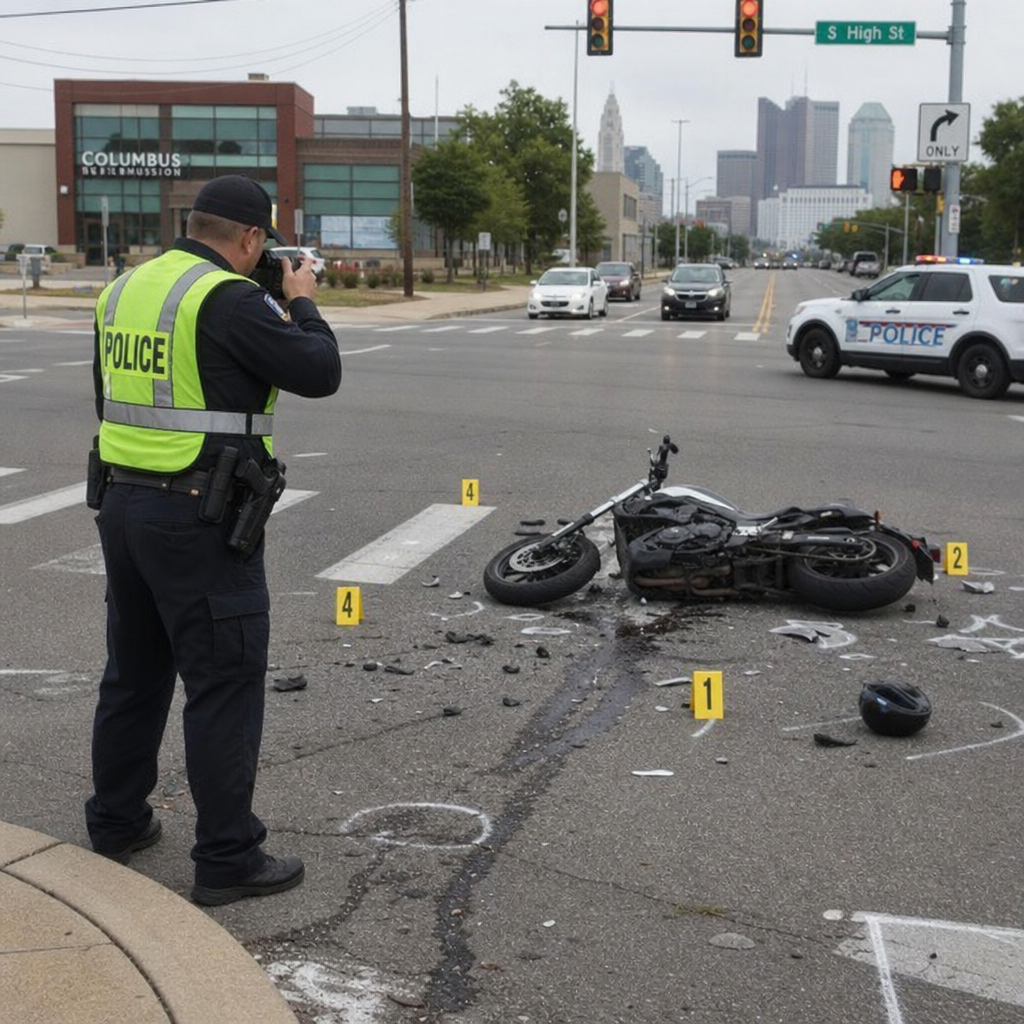
When an insurer says the rider caused a Columbus motorcycle crash, that is not the end of the claim. Fault can be challenged with the right records, careful crash scene analysis, and a clear timeline showing what each driver did before impact. This guide explains which evidence matters most, how Ohio fault rules affect recovery, and why early evidence collection methods can make a disputed claim stronger.
Call (614) 482-3793 or request a complimentary consultation with a Columbus motorcycle accident attorney at Buckeye Law Group.
What evidence can challenge blame after a Columbus motorcycle crash?
The strongest evidence is evidence that moves the discussion away from assumptions about motorcyclists and toward verifiable facts. A motorcycle crash report may identify who was cited, where the vehicles came to rest, and what witnesses said, but it is only one piece of the claim. Photos, video, vehicle damage, medical records, and expert review can all help show whether the rider was actually speeding, weaving, following too closely, or unable to avoid a driver who violated the right of way.
Insurers often focus on rider conduct because motorcycles are easy to stereotype. A driver may say the bike “came out of nowhere,” even when the issue was a left turn, unsafe lane change, distraction, or failure to yield. The goal is to build a record that answers the practical question: what happened, in what order, and what proof supports it?
The motorcycle crash report is important, but not final
A police report can be persuasive because it is created close in time to the collision. It may include diagrams, road conditions, citations, insurance information, witness names, and the officer’s initial observations. If the report supports your version of events, it can help push back against an insurer’s unsupported blame.
But reports can also be incomplete. Officers may arrive after vehicles were moved, speak first with an uninjured driver, or miss a witness who left before the scene cleared. If the motorcycle crash report contains an error, a Columbus motorcycle accident attorney may help identify supporting evidence and request that supplemental information be added where appropriate. Useful details to review include:
- Point of Impact: Damage location can show whether a car turned into the motorcycle’s path or merged into its lane.
- Final Resting Positions: Where the bike and other vehicle stopped can support or contradict a driver’s account.
- Road and Weather Notes: Rain, glare, construction, debris, potholes, and visibility can explain why a crash unfolded quickly.
- Witness Information: Neutral witnesses may be more credible than drivers trying to avoid fault.
- Citations or Warnings: A ticket does not automatically decide the civil claim, but it can shape the fault debate.
Crash scene analysis turns scattered facts into a timeline
Crash scene analysis looks at the physical evidence and asks whether the insurer’s theory makes sense. If the insurer claims the rider was speeding, for example, the analysis may consider skid marks, braking distance, impact angles, debris fields, vehicle crush damage, traffic signal timing, and available video. The point is not to guess; it is to test competing versions against evidence.
This can be especially important on busy Columbus roads where traffic volume, short merge areas, construction zones, and turning vehicles create fast-moving hazards. Intersections, freeway ramps, and multi-lane corridors can produce conflicting stories because each driver may have seen only part of the event.
In serious cases, accident reconstruction professionals may inspect the vehicles, map the scene, review photos, and use available data to estimate movement before impact. Electronic evidence may also matter, including dashcam footage, nearby business surveillance, GPS data, phone records, or vehicle event data if it is available and legally obtainable.
How does Ohio comparative negligence affect your claim?
Ohio follows a comparative fault rule: a plaintiff’s damages are reduced by the plaintiff’s percentage of fault, and recovery is allowed only if the plaintiff’s fault is not greater than the combined fault of others. In practical terms, being blamed 10%, 25%, or 50% can reduce compensation, while being found more than 50% at fault can prevent recovery. That is why fault percentages matter so much. If the insurer can shift enough blame to the rider, it can lower the claim value or argue that nothing is owed. Evidence that reduces the rider’s assigned fault may directly affect the amount recoverable.
Ohio law also requires motorcycles on a roadway to ride no more than two abreast in a single lane, except in areas set aside for such use. That rule can become relevant if an insurer argues that the rider was improperly positioned, lane splitting, or passing between vehicles. Helmet and licensing issues may also appear in insurer arguments. Ohio rules require helmets for riders under 18 and for those with certain novice or temporary permit status, while the Ohio BMV provides motorcycle endorsement information for operators. Even when those issues do not prove who caused the crash, insurers may try to use them to dispute injuries or credibility.
Evidence collection methods that protect your position
If you are medically able, evidence should be preserved as soon as possible. If you are seriously hurt, medical care comes first; a passenger, friend, family member, or attorney can often help gather information later. A practical post-crash checklist includes:
- Call 911 and Get Medical Help: Delayed treatment can give insurers room to question the injury connection.
- Photograph the Full Scene: Capture vehicle positions, damage, skid marks, debris, traffic controls, lane markings, lighting, weather, and nearby cameras.
- Get Witness Names and Contact Details: Independent witnesses can disappear quickly after a crash.
- Preserve Gear and the Motorcycle: Helmets, jackets, gloves, boots, broken parts, and impact damage may help show force and direction.
- Avoid Guessing in Statements: Saying “I’m fine” or estimating speed while shaken can be used out of context.
- Request the Motorcycle Crash Report: Review it for missing witnesses, inaccurate diagrams, or incorrect assumptions.
- Save Digital Evidence: Back up helmet-cam footage, GPS routes, messages, rideshare or delivery app records, and photos.
These evidence collection methods are not about creating a story. They are about preventing the other side from filling gaps with assumptions.
Insurer tactics riders should recognize
An insurer may call quickly, sound friendly, and ask for a recorded statement before you know the full medical picture. It may offer a fast settlement, argue that the rider was naturally hard to see, or treat normal motorcycle movement as reckless. The problem is that early statements and low offers often arrive before all evidence is gathered. Be cautious if the insurer asks leading questions about speed, lane position, protective gear, prior injuries, or whether you “could have avoided” the crash. Those questions may be designed to support a comparative negligence argument. A careful response supported by documents is usually stronger than an emotional debate over blame.
A Columbus motorcycle accident attorney can help preserve proof
A Columbus motorcycle accident attorney can help identify missing evidence, communicate with insurers, review the crash report, locate video, work with reconstruction experts, and connect the facts to Ohio’s comparative negligence framework. Legal help is especially useful when injuries are serious, the report is unfavorable, witnesses disagree, or the insurer is pushing for a recorded statement or quick settlement.
Blame is not proof. If an insurer says you caused the crash, the next step is to secure the records, analyze the scene, and build a fact-based response before evidence disappears. This article is general information, not legal advice, but acting quickly can protect your ability to challenge an unfair fault decision.
Call (614) 482-3793 or request a complimentary consultation with a Columbus motorcycle accident attorney at Buckeye Law Group.
*This article offers general educational information and is not a substitute for legal advice specific to your situation. Reading this article or contacting Buckeye Law Group does not, by itself, establish an attorney-client relationship. A thorough evaluation of a truck accident claim requires careful review of the facts, available evidence, applicable law, and filing deadlines. Consult a qualified Ohio attorney to understand your rights and the legal options available to you. Every case is different, and prior results do not guarantee a similar outcome.*
The Insurer Blames You for a Columbus Motorcycle Crash What Evidence Matters
When an insurer says the rider caused a Columbus motorcycle crash, that is not the end of the claim. Fault can be challenged with the right records, careful crash scene
Akron Truck Accident Attorney: Protecting Your Rights After a Serious Collision
A serious truck crash can leave you managing medical treatment, missed work, vehicle damage, and calls from insurance companies. An Akron truck accident attorney can investigate the collision, identify potentially
Where Serious Crashes Occur in Columbus: A Data-Driven Guide to Local Roadway Risks
Understanding where serious crashes occur in Columbus can help you recognize roadway risks before your next trip. This guide draws on publicly available local crash data and safety reports to
Pedestrian Accident Near The University of Akron: What to Do and How to Protect Your Rights
A pedestrian accident near The University of Akron can interrupt your education, work, and daily life without warning. You may face medical bills, missed classes, and questions about who will
Is Ohio a No-Fault State for Car Accidents?
Ohio is not a no-fault state for car accidents. Ohio uses an at-fault, or tort, system, which means the person who caused the crash is generally responsible for the resulting
Who Pays Medical Bills After a Truck Accident in Columbus Ohio?
After a serious truck crash in Columbus, the hospital does not wait for the insurance companies to finish arguing about fault. Medical bills usually start with the coverage available right
What Is My Car Accident Case Worth in Columbus Ohio Factors That Affect Compensation
The value of an Ohio car accident case in Columbus depends on the losses you can prove, the seriousness of your injuries, available insurance, and how fault is divided. There
Injured at a Columbus Apartment Complex? What Tenants and Visitors Should Document
A fall at a Columbus apartment complex can raise more than immediate medical concerns when a dangerous property condition may have contributed to the injury. For tenants and lawful visitors,
What Happens After a Personal Injury Lawsuit Is Filed in Franklin County?
Filing a personal injury lawsuit in Franklin County, OH, places your claim within a formal court process governed by procedural rules and deadlines. After filing, the defendant must be served
What to Do After a Hit-and-Run Accident in Columbus, Ohio
A hit-and-run accident in Columbus, OH, or the neighboring communities can leave you hurt, shaken, and unsure how to prove what happened. The right response is simple but urgent: get
Buckeye Law Group represents people injured in auto accidents, slip and falls, workplace accidents and more in Ohio. Contact us today to learn more.
© 2026 All Rights Reserved | The Buckeye Law Group Inc. Privacy Policy Sitemap
Office Locations
- Akron Office 388 S Main St #400 Akron, OH 44311 (330) 426-0288
- Cincinnati Office 201 E 5th St Ste 1910 Cincinnati, OH 45202 (513) 547-2445
- Cleveland Office 127 Public Square Ste 1540 Cleveland, OH 44114 (216) 677-5490
- Columbus Office 20 E Broad St Suite 300 Columbus, OH 43215 (614) 482-3793
- Dayton Office 70 Birch Alley Ste 240 Dayton, OH 45440 (937) 884-4474
- Euclid Office 25701 N Lakeland Blvd Suite 113-C, Cleveland, OH 44132 (216) 405-2626
- Mansfield Office 305 E Main St Ste 6A, Mansfield, OH 44904 (567) 210-2606
- Findlay Office 7430 Timberstone Dr unit 101a, Findlay, OH 45840 419-873-5119
- Mentor Office 7537 Mentor Ave Ste 101, Mentor, OH 44060 (440) 306-3536
- Middletown Office 300 N Main St #400, Middletown, OH 45042 (326) 800-9150
- Parma Office 1257 Rockside Rd #A, Parma, OH 44131 (216) 279-1664
- Springfield Office 2100 E High St Ste TL3, Springfield, OH 45505 (937) 806-5791
- Toledo Office 3950 Sunforest Ct Ste 200, Toledo, OH 43623 (567) 483-3883
- Westlake Office 26404 Center Ridge Rd Ste B2, Westlake, OH 44145 216-247-0565
- Whitehall Office 5340 E Main St Ste 203, Whitehall, OH 43213 (380) 257-5206
- Youngstown Office 306 Churchill Hubbard Rd, Youngstown, OH 44505 (234) 225-0683
Contact Us
© 2026 All Rights Reserved | The Buckeye Law Group Inc. Privacy Policy Sitemap