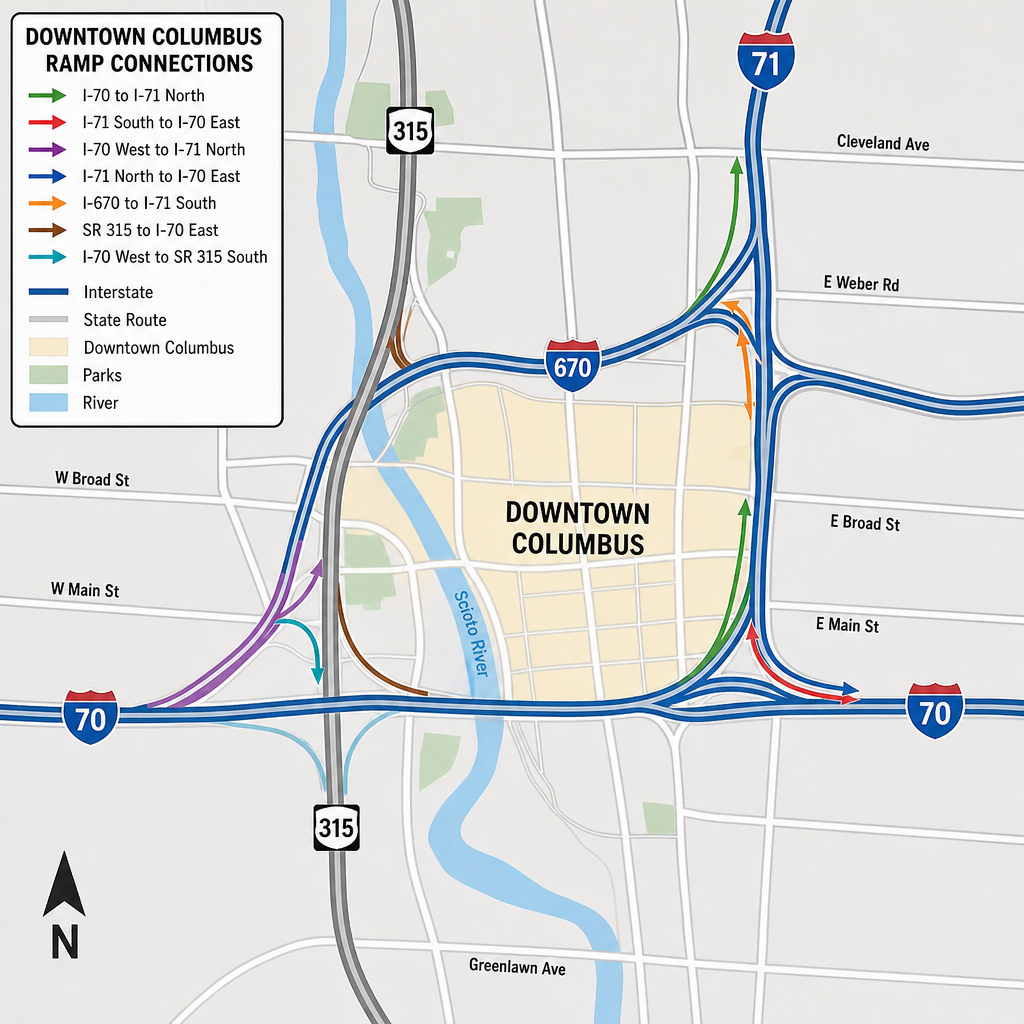
Motorists traveling through downtown Columbus, Ohio, in November 2026 should prepare for temporary traffic disruptions as construction continues along the I-70/I-71 corridor. Overnight interstate restrictions, ramp closures, and designated detours involving State Route 315 and I-670 may affect daily commutes, downtown access, and travel times throughout central Ohio. The Ohio Department of Transportation (ODOT), through its Downtown Ramp Up project, provides construction advisories identifying scheduled closures, traffic restrictions, and permanent interchange changes that motorists should understand before traveling. Even familiar routes may require additional planning as roadway improvements progress.
This guide explains which downtown Columbus highway connections may be affected, how to identify official detour routes, where to find current ODOT construction updates, and what precautions drivers can take when navigating work zones. Whether commuting into downtown Columbus, traveling through Franklin County, or accessing nearby businesses, understanding these changes can help motorists make informed travel decisions and reduce unexpected delays. (transportation.ohio.gov)
Call (614) 482-3793 or request a free consultation to speak with an experienced Columbus personal injury attorney at Buckeye Law Group today.
The dates below describe published early-November notices, not a guaranteed schedule for the entire month. All listed construction is weather permitting; verify your travel date with ODOT and OHGO.
Which I-70/I-71 closures affect Columbus drivers in early November?
ODOT lists overnight closures affecting Mound Street ramps, I-70 eastbound, and both directions of SR 315 at I-70 during the first week of November. Match the precise direction and connection, not just the highway number, to your trip.
| Affected Connection | Published Overnight Window | ODOT Detour |
|---|---|---|
| Mound Street → I-71 south | November 2–7, 7 p.m.–5 a.m. | Second Street → U.S. 62 → SR 315 south → I-71 south |
| I-70 west → Mound Street | November 2–5, 7 p.m.–5 a.m. | Central Avenue → Mound Street |
| Mound Street → I-70 east | November 2–5, 7 p.m.–5 a.m. | Central Avenue → Broad Street → I-70 east |
| SR 315 north at I-70 | November 2–5, 9 p.m.–5 a.m. | I-70 east → I-71 north → I-670 west → SR 315 north |
| I-70 east, SR 315–I-71 | November 2–5, 10 p.m.–5 a.m. | I-670 east → I-71 south → I-70 east |
| SR 315 south at I-70 | November 5–6, 9 p.m.–5 a.m. | I-670 east → I-71 south → I-70 west → I-71 south |
Treat the table as a route-screening tool. Find the connection you intended to use, note its closing time, and review the complete detour before starting. For overnight travel near the beginning or end of a published date range, confirm the individual closure in OHGO rather than guessing which morning the notice includes.
Permanent ramp changes still matter
The Third Street entrance to I-70 westbound is permanently closed; use Mound Street instead. Drivers approaching the new I-71 southbound ramp from I-70 westbound should keep right. The SR 315 southbound connection to I-70 eastbound remains under a multiyear closure. Another lasting change affects the downtown arrival route: the former I-70 eastbound exit to Livingston Avenue is permanently closed. The replacement approach uses Fulton Street, then Third Street to Livingston Avenue. Franklin County’s courthouse guidance specifically warns visitors to prepare for changed traffic patterns and follow posted signs. (drj.fccourts.org)
If you have not driven downtown recently, review both your arrival and departure. Save the actual parking entrance as your destination, rather than relying only on a building’s street address. For the return trip, check how you will reach the freeway from that entrance; do not simply assume the outbound route reverses your arrival.
Nearby closures can affect your backup route
ODOT’s Franklin County advisory lists an additional restriction for Friday, November 6: the I-71 southbound ramp to Main Street is scheduled to close overnight from 9 p.m. to 6 a.m. The detour uses Spring Street, Lester Drive, Broad Street, Parsons Avenue, and Main Street. Overnight lane restrictions are also scheduled on I-71 southbound between Town Street and Main Street during that window. (transportation.ohio.gov)
Outside downtown, U.S. 62 between Orders Road and Rensch Road is scheduled to close November 5–9 for culvert replacement. ODOT lists a detour involving SR 665, I-71, and I-270. Include this notice in your review if your trip extends into southwest Franklin County. Screen your alternative as carefully as your usual route. Before choosing a bypass, trace it all the way to your destination and check every freeway-to-freeway connection it requires.
Where should you check Columbus traffic alerts before leaving?
Use ODOT’s Downtown Ramp Up advisory for project-specific restrictions, its Franklin County advisory for surrounding construction, and OHGO for current conditions. OHGO provides construction information, incidents, cameras, travel delays, and weather-related road conditions through its website and mobile app. Together, these sources help distinguish scheduled work from a problem developing during your travel window. For useful Columbus construction updates, follow this sequence while parked:
- Read The Dated Advisory: Check the road, direction, affected ramp, and hours against your actual itinerary.
- Inspect OHGO’s Construction And Incident Layers: Look at your primary route and the full alternative, not only the downtown segment.
- Review Cameras And Travel Delays: Use available views to assess conditions around the approaches you plan to use.
- Set Route Notifications: OHGO supports personalized alerts for regular travel routes and schedules.
- Check Again Before Your Return: Build a second review into your plans, especially if you will leave after an overnight closure begins. (ohgo.com)
When searching for the I-70 construction schedule, include “Columbus,” your direction, and your travel date. Open the underlying advisory rather than relying on a search-result headline. Keep the notice available for reference before departure, but put the phone away once you begin driving.
Turn the detour into a workable trip plan
A useful route plan should answer three things: where you leave your normal route, which signed connections you follow, and how you reach the final entrance. Write down those decision points before leaving. This is especially worthwhile for an unfamiliar downtown appointment or an evening return trip. Use this short checklist when reviewing Columbus road closures:
- Identify The Exact Movement: Write “SR 315 south to I-70 east,” rather than simply “315,” so you review the correct notice.
- Check The Clock: Compare the scheduled closure with your expected time at the interchange, not just your departure time.
- Review The Last Mile: Confirm the parking entrance, pickup location, or delivery access with your destination when necessary.
- Choose A Fallback In Advance: Know which route you will review if current conditions make your first choice unsuitable.
- Allow Flexibility: Leave room for rerouting without assigning yourself an unsupported, fixed delay estimate.
For a time-sensitive trip, separate the required arrival time from the departure decision. Check conditions first, then choose when to leave. If transporting someone to an appointment, agree on the entrance and pickup arrangement beforehand so neither person must solve those details at a freeway exit.
Columbus, Ohio Work-Zone Safety: Essential Driving Precautions During I-70/I-71 Construction
Ohio’s work-zone guidance emphasizes slowing down at the first warning sign, maintaining following distance, and avoiding distractions. Changed lanes and narrowed roadway space remain hazards even when workers are not visible. Nighttime work zones require particular attention because visibility is limited. (otso.ohio.gov)
Apply these habits throughout the construction corridor:
- Watch Beyond The Vehicle Ahead: Look for brake lights, warning signs, and changing lane alignment; be ready for stopped traffic.
- Leave Space Between You And The Other Vehicle: Avoid tailgating, and give larger commercial vehicles additional room when following or maneuvering nearby.
- Limit Lane Changes: Position yourself using advance signs instead of making repeated moves through restricted space.
- Follow Merge Instructions: Ohio’s guidance recommends using available lanes to the merge point when traffic is congested, then taking turns.
- Remove Distractions: Set navigation before departure and avoid adjusting the phone or radio through the work area.
Follow directions from officers or flaggers, and stay out of areas closed with cones or barriers. The objective is not to preserve your usual driving rhythm; it is to leave enough time and space to respond to the roadway as it exists now. (publicsafety.ohio.gov)
Planning Ahead for Downtown Columbus Construction and Traffic Changes
As construction continues along Columbus’ I-70/I-71 corridor in November 2026, staying informed about changing traffic patterns, ramp restrictions, and designated detours can help motorists navigate downtown more safely and efficiently. Before traveling, identify the specific highway interchange and direction you intend to use, review the latest construction advisories from the Ohio Department of Transportation (ODOT), and confirm that your planned route provides access to your destination.
Drivers should also allow additional travel time, maintain appropriate following distances, obey posted work-zone speed limits, and remain attentive to temporary signs, lane shifts, and construction personnel. For real-time information, ODOT’s OHGO traffic platform provides updates on reported incidents, road closures, traffic delays, and available traffic cameras. Review these conditions before departure or after parking safely. As Columbus continues improving its downtown highway infrastructure, preparation, patience, and awareness remain essential. Familiar routes may change as construction progresses, making current information more reliable than yesterday’s driving experience. Taking a few minutes to plan your trip can help reduce unexpected delays and support safer travel for motorists, construction workers, and everyone sharing Ohio’s roadways.
Call (614) 482-3793 or request a free consultation to speak with an experienced Columbus personal injury attorney at Buckeye Law Group today.
Legal Disclaimer: This article is provided by Buckeye Law Group for general educational and informational purposes and does not constitute individualized legal or medical advice. The information discusses Columbus, Ohio’s November 2026 I-70/I-71 corridor construction, the Ohio Department of Transportation’s Downtown Ramp Up project, temporary highway restrictions, interstate ramp closures, designated detours, changing traffic patterns, work-zone safety, and related personal injury considerations affecting Columbus and Franklin County residents. References to Ohio traffic laws, roadway safety requirements, negligence, accident reporting procedures, insurance coverage, potential compensation, and applicable legal filing deadlines are intended to help readers better understand general legal considerations following a motor vehicle accident. Every personal injury claim involves unique circumstances, and determining liability or eligibility for compensation requires a careful evaluation of the available evidence, applicable Ohio laws, and individual facts. Reading this article or contacting Buckeye Law Group’s Columbus personal injury attorneys does not, by itself, establish an attorney-client relationship. Individuals seeking legal guidance regarding a specific accident or injury should consult a qualified Ohio personal injury attorney. Past case results do not guarantee or predict future outcomes.
Columbus I-70/I-71 Construction in November 2026: Ramp Closures, Detours, and Driver Safety
Motorists traveling through downtown Columbus, Ohio, in November 2026 should prepare for temporary traffic disruptions as construction continues along the I-70/I-71 corridor. Overnight interstate restrictions, ramp closures, and designated detours
Mansfield’s Main Street Transformation: What Drivers and Pedestrians Should Know About Downtown Traffic Changes in 2026
As Mansfield completes its 2026 Main Street Transformation, residents and visitors should understand how the redesigned streets affect access to downtown businesses, public buildings, pedestrian crossings, and nearby parking areas.
Toledo’s Douglas Road and Monroe Street Intersection Improvements: What Drivers and Pedestrians Should Know in 2026
The City of Toledo identifies the Douglas Road and Monroe Street intersection as a 2026 improvement project intended to support pedestrian safety, driver safety, and better pavement conditions. For people
Springfield’s South Limestone Street Safety Improvements: What Drivers Should Know
South Limestone Street in Springfield, Ohio, is the focus of safety improvements intended to reduce conflicts between vehicles entering, leaving, and traveling along the corridor. The Ohio Department of Transportation’s
Middletown’s 2026 Safe Streets and Roads for All Initiative: What Residents Should Know
Middletown, Ohio’s Safe Streets and Roads for All (SS4A) effort is best understood as a road-safety planning-and-delivery process funded through the U.S. Department of Transportation. For residents following this community
Euclid’s Lakeshore Boulevard Pedestrian Safety Improvements: What Drivers and Walkers Should Know
Euclid’s Lakeshore Boulevard pedestrian safety improvements aim to enhance roadway visibility, provide safer crossing opportunities, and strengthen connections between Downtown Euclid, Sims Park, and the Lake Erie waterfront. The City
Cincinnati’s Victory Parkway Safety Improvements: What Drivers and Pedestrians Should Know in 2026
Cincinnati’s Victory Parkway Improvement Project represents a significant investment in roadway safety, pedestrian accessibility, and transportation infrastructure. Overseen by the Cincinnati Department of Transportation & Engineering (DOTE), the project includes
What Greater Akron’s latest crash data reveals about roadway safety and serious injuries
Greater Akron’s latest regional crash report shows fewer crashes overall, but serious injuries remain a concern. The Akron Metropolitan Area Transportation Study’s 2022–2024 analysis separates encouraging declines in fatalities from
Why Is St. Clair Avenue One of Cleveland’s Most Dangerous Roads? Crash Data and Safety Improvements Explained
St. Clair Avenue’s danger comes into focus when you look beyond fender-benders to deaths and life-changing injuries. Cleveland reports at least 14 people killed and 79 seriously injured between East
Dayton’s 2026 Road Safety Action Plan: What Local Crash Data Reveals About Dangerous Driving Conditions
The City of Dayton, Ohio, has adopted a comprehensive Safe Streets and Roads for All (SS4A) Safety Action Plan to address traffic fatalities, serious injuries, and hazardous roadway conditions throughout

Buckeye Law Group represents people injured in auto accidents, slip and falls, workplace accidents and more in Ohio. Contact us today to learn more.
© 2026 All Rights Reserved | The Buckeye Law Group Inc. Privacy Policy Sitemap
Office Locations
- Akron Office 388 S Main St #400 Akron, OH 44311 (330) 426-0288
- Cincinnati Office 201 E 5th St Ste 1910 Cincinnati, OH 45202 (513) 547-2445
- Cleveland Office 127 Public Square Ste 1540 Cleveland, OH 44114 (216) 677-5490
- Columbus Office 20 E Broad St Suite 300 Columbus, OH 43215 (614) 482-3793
- Dayton Office 70 Birch Alley Ste 240 Dayton, OH 45440 (937) 884-4474
- Euclid Office 25701 N Lakeland Blvd Suite 113-C, Cleveland, OH 44132 (216) 405-2626
- Mansfield Office 305 E Main St Ste 6A, Mansfield, OH 44904 (567) 210-2606
- Findlay Office 7430 Timberstone Dr unit 101a, Findlay, OH 45840 419-873-5119
- Mentor Office 7537 Mentor Ave Ste 101, Mentor, OH 44060 (440) 306-3536
- Middletown Office 300 N Main St #400, Middletown, OH 45042 (326) 800-9150
- Parma Office 1257 Rockside Rd #A, Parma, OH 44131 (216) 279-1664
- Springfield Office 2100 E High St Ste TL3, Springfield, OH 45505 (937) 806-5791
- Toledo Office 3950 Sunforest Ct Ste 200, Toledo, OH 43623 (567) 483-3883
- Westlake Office 26404 Center Ridge Rd Ste B2, Westlake, OH 44145 216-247-0565
- Whitehall Office 5340 E Main St Ste 203, Whitehall, OH 43213 (380) 257-5206
- Youngstown Office 306 Churchill Hubbard Rd, Youngstown, OH 44505 (234) 225-0683
Contact Us
© 2026 All Rights Reserved | The Buckeye Law Group Inc. Privacy Policy Sitemap