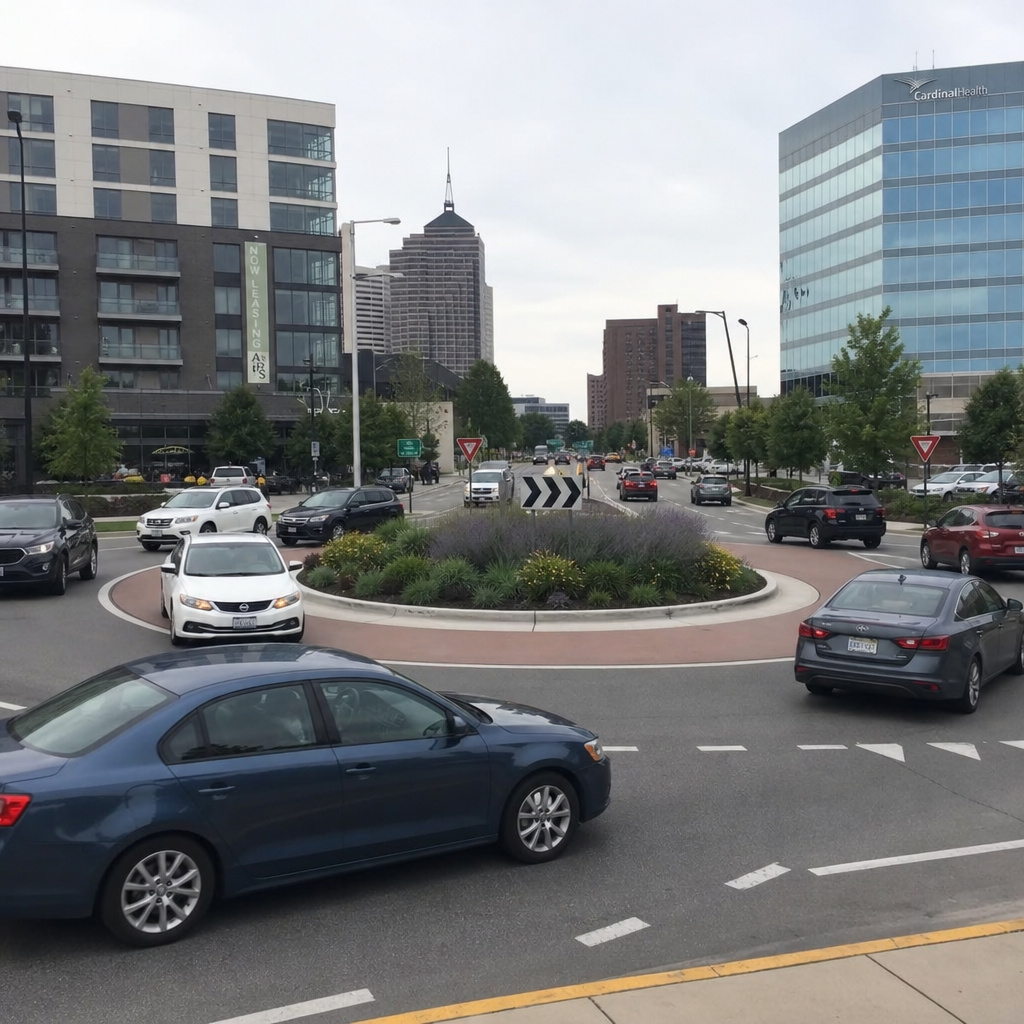
If you drive through Central Ohio, you have likely noticed a significant shift in intersection design. From Hilliard to Zanesville, roundabouts are replacing many traditional four-way stops and traffic signals. Although these intersections are designed to improve traffic flow and reduce severe crashes, unfamiliar lane patterns and yielding requirements can still confuse drivers.
After a collision, motorists often have questions about Columbus roundabout accidents, including who had the right of way and who may be liable. Understanding Ohio traffic laws, proper roundabout procedures, and the steps to take after a crash can help protect your safety and legal rights. A knowledgeable roundabout accident lawyer can review the evidence, assess liability, and explain your options for pursuing compensation.
A Columbus Roundabout Accident Lawyer Explains Traffic Circle Safety and Driver Confusion
The safety benefits of modern roundabouts in Central Ohio are well documented by traffic engineers. Because vehicles travel in the same direction at lower speeds, roundabouts can reduce the risk of severe T-bone and head-on collisions. Compared with traditional intersections, they also eliminate left turns across oncoming traffic, which can help prevent serious crashes.
However, lower-speed accidents still occur. Crash data from Dublin, OH, a city known for its extensive roundabout network, shows that minor collisions and sideswipes remain possible even when fatal and serious-injury crashes decline. Driver distraction, improper yielding, unsafe lane changes, and confusion about right-of-way rules may contribute to these incidents. If a collision leaves you injured or fault is disputed, a roundabout accident lawyer serving Central Ohio can review the evidence, explain your legal options, and help determine who may be liable.
What a Columbus Roundabout Accident Lawyer Considers in Right-of-Way Disputes
To determine who is liable in a crash, you first have to understand the rules of the road. The Ohio Revised Code establishes clear right-of-way rules for drivers navigating roundabouts.
Vehicle Yielding Rules
The golden rule of yielding rules in Ohio roundabouts is simple: traffic already inside the circle has the right of way.
- Approaching vehicles: You must slow down and yield to all vehicles currently circulating in the roundabout. You should only enter when there is a safe gap in traffic.
- Circulating vehicles: Once you are in the roundabout, you have the right of way. You should not stop to let other cars enter.
Mastering the safe entry and exit of traffic circles in Columbus, OH, requires attention and anticipation. As you approach, look left and yield to vehicles already traveling within the roundabout. Before exiting, use your right turn signal to alert nearby drivers. If a collision occurs because another motorist fails to yield or exits improperly, a Columbus roundabout accident lawyer can review the evidence and explain your legal options.
What About Pedestrians?
Pedestrian traffic is a frequent source of confusion in Columbus roundabouts. Under Ohio law, drivers must yield to pedestrians using marked crosswalks near roundabout entrances and exits. Many modern traffic circles include pedestrian refuge islands that allow people to cross one direction of traffic at a time. If a driver fails to yield and causes an injury, a roundabout accident lawyer can review the evidence, determine liability, and explain the pedestrian’s legal options.

Who is Liable When a Crash Happens?
When an accident occurs, liability often depends on which driver acted negligently. Because traffic moves continuously through Columbus roundabouts, these crashes can differ from collisions at traditional intersections. A knowledgeable roundabout accident lawyer can review traffic laws, roadway markings, witness statements, and other evidence to determine fault. Below, we examine common causes of Columbus traffic circle collisions and how liability may be assigned.
Failure to Yield
The most common roundabout crashes are rear-end or angle collisions near the entrance. Determining negligence in a failure-to-yield accident is often straightforward. If Driver A is already traveling within a Columbus roundabout and Driver B enters without yielding, causing a collision, Driver B may be found at fault. Ohio law requires the entering driver to wait for a safe gap and yield to traffic already circulating. A Columbus roundabout accident lawyer can review the police report, witness statements, traffic-camera footage, and vehicle damage to determine liability based on the specific facts.
Sideswipe Accidents
Multi-lane traffic circles add another layer of complexity. So, who is at fault in a roundabout sideswipe accident? Generally, the driver who fails to maintain the proper lane may be liable. The outside lane is typically used for right turns or traveling straight, while the inside lane may allow drivers to continue straight, turn left, or make a U-turn, depending on posted signs and pavement markings. If an inside-lane driver suddenly crosses the outside lane to exit and sideswipes another vehicle, that driver may be responsible for the collision. A Columbus roundabout accident lawyer can review lane markings, traffic-camera footage, witness statements, and the police report to determine fault under Ohio law.
Best Practices for Driving in Roundabouts
To keep your daily commute safe and stress-free, follow these actionable tips on how to navigate a multi-lane roundabout safely:
- Pick your lane early: Look at the roadside signs and pavement markings before you arrive at the yield line. Choose the correct lane for your destination before you enter.
- Yield to all lanes: If you are entering a multi-lane roundabout, you must yield to vehicles in both the inside and outside lanes.
- Never change lanes inside the circle: The easiest method for avoiding lane change accidents in traffic circles is to stay in your chosen lane from the moment you enter until the moment you exit.
- Use your signals: Activate your right turn signal as you approach your exit so entering drivers know they can safely proceed.
- Don’t stop inside the roundabout: Unless you are avoiding an accident or yielding to a pedestrian at an exit crosswalk, keep moving.

Frequently Asked Questions: What to Do After an Accident
Columbus roundabout accidents often raise important questions about right-of-way, liability, insurance claims, and what drivers should do afterward. The following FAQs explain how Ohio traffic laws may apply to failure-to-yield crashes, unsafe lane changes, sideswipes, and other common roundabout hazards throughout Central Ohio. A Columbus roundabout accident lawyer can evaluate the available evidence, identify potentially liable parties, and explain your legal options after a collision.
- Who has the right of way in a Columbus, OH, roundabout? Drivers already traveling inside a Columbus roundabout generally have the right of way. Approaching motorists must slow down and yield until a safe opening is available. Drivers must also yield to pedestrians using designated crosswalks near entrances and exits. If a collision occurs because another motorist fails to yield, a roundabout accident lawyer can review the evidence and explain how Ohio traffic laws may affect liability.
- Who is usually liable for a roundabout accident in Columbus? Liability generally depends on which driver violated a traffic law or acted negligently. A driver may be responsible for failing to yield, entering without enough space, speeding, driving distracted, or leaving a designated lane. A Columbus roundabout accident lawyer can review police reports, photographs, witness statements, and available traffic-camera footage to help determine fault under Ohio law.
- Who is at fault in a multi-lane roundabout sideswipe accident? The driver who leaves a designated lane or improperly crosses into another lane is often responsible for a sideswipe collision. However, fault depends on the lane markings, vehicle positions, turn signals, and actions of each driver. A Columbus roundabout accident lawyer can evaluate crash reports, photographs, witness statements, and other evidence to determine liability. Ohio’s comparative negligence rules may also apply when multiple drivers share responsibility.
- What should I do after a roundabout accident in Columbus? Check for injuries, call 911, and move to a safe location if possible. Photograph the vehicles, damage, lane markings, traffic signs, and surrounding intersection. Exchange insurance information, obtain witness details, request a police report, seek appropriate medical care, and promptly notify your insurer. After 911, Call 1-800-411-7246
- When should I contact a Columbus roundabout accident lawyer? Consider contacting a Columbus roundabout accident lawyer if you suffered injuries, fault is disputed, or an insurance company is minimizing your losses. An attorney can investigate the collision, preserve evidence, evaluate liability, document your damages, and explain your options under Ohio law.
Every roundabout collision presents different circumstances, and determining liability may require a careful review of the available evidence. If you were injured or fault is disputed, a Columbus roundabout accident lawyer can investigate the crash, address the insurance company, and explain your legal options. Acting promptly may also help preserve photographs, witness information, traffic footage, and other important evidence.
Understanding Right-of-Way and Liability in Columbus Roundabout Accidents
Traffic circles are here to stay. Although they can improve road safety, navigating them requires close attention and an understanding of Ohio traffic laws. When questions arise about right-of-way and liability in Columbus roundabout accidents, fault often depends on whether each driver yielded properly and maintained their lane. Slowing down, selecting the correct lane early, and respecting the right-of-way can help motorists travel through Central Ohio more safely. If a collision occurs, a Columbus roundabout accident lawyer can evaluate the evidence, explain your legal options, and determine who may be responsible.
Cleveland Premises Liability Lawyers: Understanding Property Injury Claims in Ohio
How Cleveland Premises Liability Lawyers Evaluate Property Injury Claims Under Ohio Law A serious injury on someone else’s property can raise immediate questions about medical bills, responsibility, and your next
How Long Does an Auto Accident Settlement Take in Ohio? A Guide to the Claims Process
Ohio Auto Accident Settlement Timeline: What to Expect From Claim to Payout An Ohio auto accident settlement can move quickly when injuries are minor, liability is clear, and records are
How Buckeye Law Group’s Slip and Fall Injury Lawyers Help Injured Ohioans Understand Their Legal Options
Ohio Slip and Fall Injury Lawyers Helping You Understand Your Rights After a Serious Injury A slip and fall can turn an ordinary trip to a store, apartment building, workplace,
How Can an Ohio Truck Accident Lawyer Help You Protect Your Rights After a Commercial Truck Crash?
Legal Guidance After an Ohio Truck Accident: How an Ohio Truck Accident Lawyer Can Support Your Claim A truck accident lawyer from Buckeye Law Group can help injured individuals and
Should You Accept An Insurance Settlement Offer? Why Ohio Injury Victims Should Speak With An Attorney First
After an accident, an insurance settlement offer may provide welcome financial relief while medical bills and lost wages continue to accumulate. However, accepting an offer before the full extent of
What Should You Do After a Pedestrian Accident Near Ohio State University in Columbus?
A pedestrian accident near Ohio State University can leave you hurt, disoriented, and unsure what to do next. In the OSU area, where student foot traffic, Uber & Lyft rideshare
How Do I Choose the Right Dog Bite Lawyer in Columbus, Ohio?
If you were bitten or otherwise injured by a dog in central Ohio, the right lawyer can help determine liability, preserve evidence, communicate with insurance companies, and pursue fair compensation
How to Choose the Right Columbus Wrongful Death Attorney for Your Family
Losing someone because of another person’s negligence is devastating, and choosing the right legal help can feel overwhelming when your family is already grieving. The best wrongful death attorneys combine
What Must You Prove in an Ohio Medical Malpractice Claim, and How Can a Columbus Medical Malpractice Attorney Help?
An unexpected complication can leave a patient with serious questions. Was the outcome an unavoidable medical risk, or did a preventable error cause additional harm? Not every unsuccessful treatment amounts
Columbus Auto Accident Attorneys: Legal Guidance for Injured Drivers in Central Ohio
A serious crash can disrupt every part of your life. Medical expenses, lost income, vehicle repairs, and insurance calls can quickly become overwhelming. The experienced Columbus auto accident attorneys at
Buckeye Law Group represents people injured in auto accidents, slip and falls, workplace accidents and more in Ohio. Contact us today to learn more.
© 2026 All Rights Reserved | The Buckeye Law Group Inc. Privacy Policy Sitemap
Office Locations
- Akron Office 388 S Main St #400 Akron, OH 44311 (330) 426-0288
- Cincinnati Office 201 E 5th St Ste 1910 Cincinnati, OH 45202 (513) 547-2445
- Cleveland Office 127 Public Square Ste 1540 Cleveland, OH 44114 (216) 677-5490
- Columbus Office 20 E Broad St Suite 300 Columbus, OH 43215 (614) 482-3793
- Dayton Office 70 Birch Alley Ste 240 Dayton, OH 45440 (937) 884-4474
- Euclid Office 25701 N Lakeland Blvd Suite 113-C, Cleveland, OH 44132 (216) 405-2626
- Mansfield Office 305 E Main St Ste 6A, Mansfield, OH 44904 (567) 210-2606
- Findlay Office 7430 Timberstone Dr unit 101a, Findlay, OH 45840 419-873-5119
- Mentor Office 7537 Mentor Ave Ste 101, Mentor, OH 44060 (440) 306-3536
- Middletown Office 300 N Main St #400, Middletown, OH 45042 (326) 800-9150
- Parma Office 1257 Rockside Rd #A, Parma, OH 44131 (216) 279-1664
- Springfield Office 2100 E High St Ste TL3, Springfield, OH 45505 (937) 806-5791
- Toledo Office 3950 Sunforest Ct Ste 200, Toledo, OH 43623 (567) 483-3883
- Westlake Office 26404 Center Ridge Rd Ste B2, Westlake, OH 44145 216-247-0565
- Whitehall Office 5340 E Main St Ste 203, Whitehall, OH 43213 (380) 257-5206
- Youngstown Office 306 Churchill Hubbard Rd, Youngstown, OH 44505 (234) 225-0683
Contact Us
© 2026 All Rights Reserved | The Buckeye Law Group Inc. Privacy Policy Sitemap